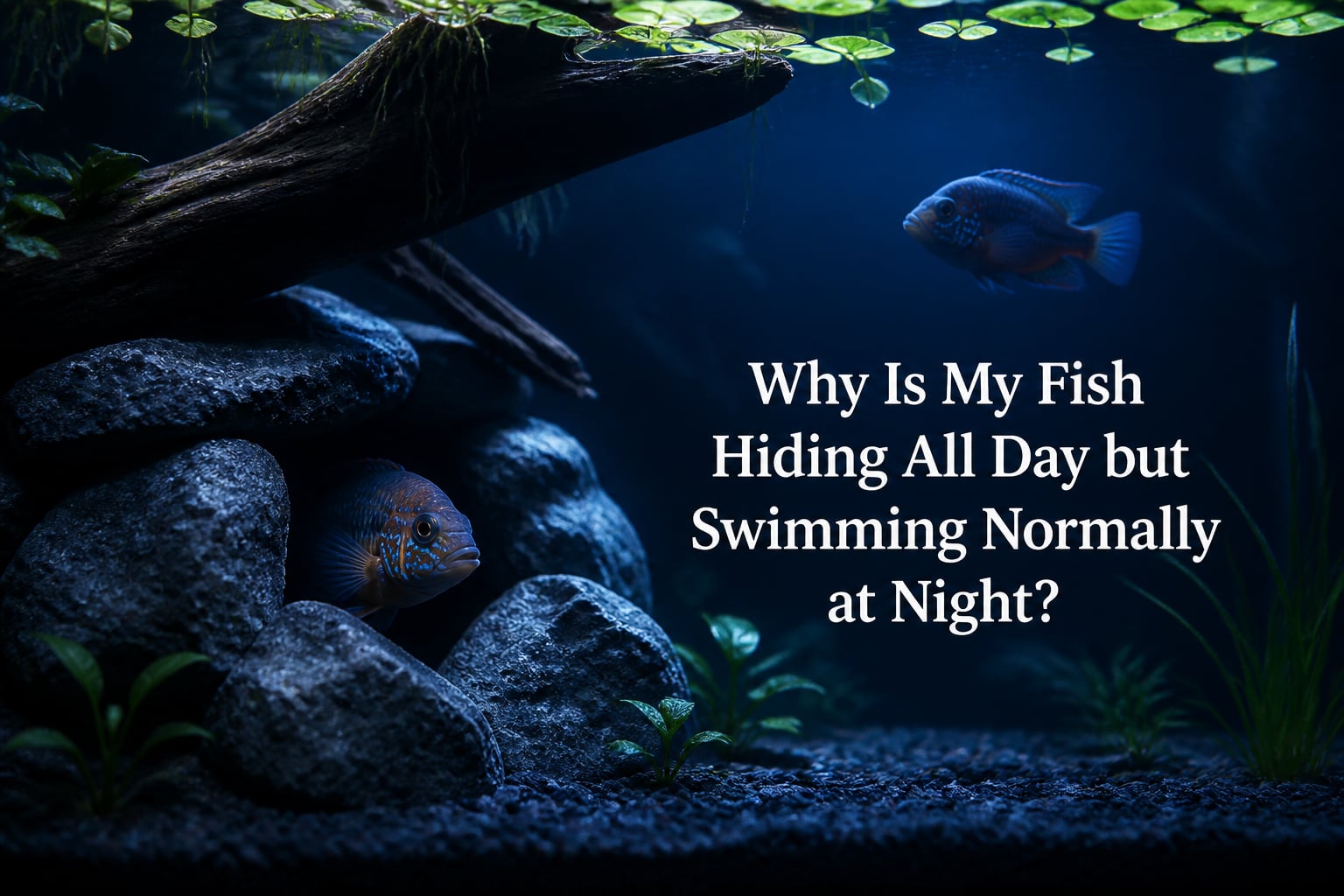
If you’ve ever walked past your aquarium during the day and wondered where your fish disappeared to, only to spot it happily cruising the tank after lights out, you’re not alone. Fish hiding all day but swimming normally at night is one of the most common questions we get from new and experienced aquarists alike. The good news is that in most cases, this pattern is completely natural and rooted in millions of years of evolution.
Still, there are times when daytime hiding signals something that needs your attention. In this guide, I’ll walk you through the most likely reasons for the behavior, how to tell normal hiding from stress, and practical steps you can take to bring your fish out of the shadows.
Contents Table of Contents →
- 1Natural Nocturnal Behavior: Why Some Fish Are Active at Night
- 2Light sensitivity and pupil response
- 3Common Reasons Your Fish Is Hiding All Day
- 4Why Your Fish Swims Normally at Night
- 5When Hiding Is Normal vs When to Worry
- 6Quick decision guide
- 7Water Quality Checklist for Hiding Fish
- 8How to Help Your Fish Feel Safe and Come Out During the Day
- 9Patience pays off
- 10FAQs
- 11Why are my fish hiding all of a sudden?
- 12How long does it take for new fish to stop hiding?
- 13How to tell if a fish is unhappy?
- 14Why is my fish hiding under the filter?
- 15How do I get my fish to stop hiding?
- 16Do fish hide when they are dying?
- 17Final Thoughts on Your Fish Hiding All Day but Swimming at Night
Natural Nocturnal Behavior: Why Some Fish Are Active at Night
Many freshwater and saltwater species are nocturnal by nature, which means they rest when the lights are on and come alive when the tank dims. Cardinalfish, plecos, kuhli loaches, and most catfish species fit this category. In the wild, these fish spent the day tucked into reef crevices or under cover to avoid daytime predators, then emerged at dusk to feed.
Some fish even use a technique called ram ventilation, swimming forward slowly while they rest so water flows across their gills. If you watch your tank after dark and see a fish gliding steadily in place, that’s often what you’re seeing.
Diurnal fish (most tetras, gouramis, and livebearers) do the opposite. They forage and interact during the day and slow down at night. Knowing which pattern your species follows is the first clue to whether your fish is acting normally.
Light sensitivity and pupil response
Fish don’t have eyelids, but their pupils still react to brightness. A tank with strong overhead lighting can feel like open water under a blazing sun to a prey species. When the room goes dark or your aquarium light cycles off, the perceived threat drops and your fish finally feels safe enough to move around.
Common Reasons Your Fish Is Hiding All Day
Even fish that aren’t strictly nocturnal may spend the day hiding for a handful of reasons. I keep this mental checklist handy whenever I troubleshoot a shy fish for our readers.
New fish acclimation: A fish that just arrived in your tank needs 2 to 7 days to settle in, and some shy individuals take 2 full weeks before they feel at home.
Bullying or aggression: A more dominant tank mate may be chasing, nipping, or simply occupying the open swimming space.
Water quality problems: Even slight spikes in ammonia or nitrite irritate gills and skin, sending fish into cover.
Too much light: Bright, unbroken lighting with no shaded areas can keep a shy fish pinned to its cave all day.
Overcrowding: Too many fish for the tank size creates constant competition for space and food.
Illness or injury: Sick fish often isolate themselves and lose color or appetite.
Breeding behavior: Mouthbrooders and cave spawners sometimes disappear for days while guarding eggs.
Notice how the list starts with the most likely cause and ends with rarer ones. If your fish only hides during the day and comes out at night, you can usually rule out serious illness right away, since sick fish tend to hide around the clock.
Why Your Fish Swims Normally at Night
The nighttime activity is the part of this behavior that confuses people the most. If your fish is sick, why does it look perfectly healthy at 11 PM?
The simplest explanation is that darkness resets the threat level in your fish’s brain. Once the room goes dark, your fish can no longer be seen from above. That triggers its ancient “safe window” for foraging, exploring, and patrolling territory. It’s the same reason reef divers see far more activity during night dives.
Daytime-active tank mates are usually asleep or resting too. Your shy fish has the entire tank to itself, with no competition for food and no risk of being chased. Many species also cue on dawn and dusk transitions specifically, since that’s when their instincts tell them to move.
Feeding patterns play a role as well. If you’re dropping food in after lights out, you’ve trained your fish to associate darkness with meals. It will come out eagerly every night as a result.
When Hiding Is Normal vs When to Worry
Healthy hiding looks like this: your fish picks a favorite cave or plant, stays near it during the day, peeks out to check on tank mates, and comes out confidently at feeding time. It eats well, colors look normal, and gills move at a steady, calm rate.
Stress hiding looks different. Watch for these warning signs:
Hiding around the clock, not just during the day
Refusing food or spitting it out
Clamped fins, faded color, or visible wounds
Rapid breathing or gasping at the surface
Lying on the bottom with labored gill movement
Erratic darts or crashing into decor
Our team has found that the “one spot, all day” pattern is the biggest red flag. A fish that just sits in one corner and never comes out, day or night, is telling you something is wrong. A fish that hides by day and swims by night is usually telling you it’s a prey species doing what prey species do.
Quick decision guide
Ask yourself these three questions: Does the fish eat? Is it active at any point in the 24-hour cycle? Are water parameters within range? If you answer yes, yes, and yes, you almost certainly have a normal, healthy, shy fish on your hands.
Water Quality Checklist for Hiding Fish
Before you change anything in the tank, test your water. I cannot stress this enough, because poor water quality is the silent culprit behind most “personality problems” people blame on their fish. Use a liquid test kit (not strips) and check these parameters against the ranges below.
Ammonia: 0 ppm (any reading above 0 is dangerous)
Nitrite: 0 ppm (any reading above 0 is dangerous)
Nitrate: Below 20 ppm for most freshwater, below 10 ppm for reef tanks
pH: Stable within your species’ preferred range; swings stress fish more than the absolute number
Temperature: Stable within 1 degree of your target; sudden drops or spikes trigger hiding
If your tank is still cycling, expect hiding to be common until the beneficial bacteria colony is established. Cycling takes 4 to 6 weeks for most freshwater setups and longer for saltwater.
How to Help Your Fish Feel Safe and Come Out During the Day
Once you’ve ruled out water quality and illness, you can work on building your fish’s confidence with a few simple changes. These steps are based on what worked for our readers over many years of community tank keeping.
Add more hiding spots. Use caves, driftwood, dense plants, and rockwork to break up sight lines. Even open-water fish feel safer with cover nearby.
Rearrange the decor. Moving every piece when you add new fish resets territorial boundaries and prevents established bullies from claiming the whole tank.
Lower the lighting or add floating plants. Dimmer light and dappled shade mimic dawn and dusk conditions, which makes fish more comfortable in the open.
Set a consistent photoperiod. 8 to 10 hours of light per day with a slow ramp-up or ramp-down (using a timer) trains your fish’s natural rhythm and reduces stress.
Adjust feeding times. Try feeding a small amount right after lights come on and again right before lights go off. This encourages activity at both transitions.
Check tank mate compatibility. Research whether your species should be in groups. Many schooling fish stay hidden when kept in groups of fewer than 6.
Limit sudden movement around the tank. Tap on the glass less, keep loud noises away, and avoid sudden shadows passing overhead.
I particularly like the floating plant trick for shy fish. A layer of stem plants or duckweed at the surface cuts light intensity by half and gives the tank a much more natural feel. Even notoriously shy species like kuhli loaches start venturing out into open water once they feel shielded from above.
Patience pays off
Whatever you change, give it at least a week before judging the results. Fish don’t reset their behavior overnight, especially after stress. With consistent conditions, hiding usually decreases within 2 to 4 weeks.
FAQs
Why are my fish hiding all of a sudden?
Sudden hiding usually points to a change in the tank: new fish, rearranged decor, a water parameter shift, a light change, or a new aggressive tank mate. Test the water first and look for signs of bullying before assuming illness.
How long does it take for new fish to stop hiding?
Most new fish settle in within 2 to 7 days, but shy species like kuhli loaches, plecos, and many catfish can take 2 full weeks before they feel confident enough to come out in the open during the day.
How to tell if a fish is unhappy?
An unhappy fish hides constantly (day and night), refuses food, loses color, clamps its fins, breathes rapidly, or shows visible wounds. Compare your fish’s behavior to its normal pattern over the past weeks to spot changes quickly.
Why is my fish hiding under the filter?
The filter outflow creates a strong current that weaker fish avoid, and the intake area often feels sheltered. If your fish only hides there during the day, it likely feels exposed in open water and prefers the filtered, shaded spot.
How do I get my fish to stop hiding?
Add more plants and caves, dim the lighting, keep a consistent photoperiod, feed at the same times daily, and make sure tank mates are compatible. Avoid tapping the glass and give the fish at least 2 weeks to adjust.
Do fish hide when they are dying?
Yes. Sick or dying fish often isolate themselves in a corner or behind decor, lose appetite, breathe heavily, and lose color. Hiding alone does not mean a fish is dying, but combined with these other signs it warrants a closer look.
Final Thoughts on Your Fish Hiding All Day but Swimming at Night
Fish hiding all day but swimming normally at night is usually a sign that you’re keeping a prey species the way it was designed to live, with cover nearby and predictable light cycles. Start by testing your water, then give your fish more hiding options, gentler lighting, and time to adjust. Within a few weeks you should see it venturing out for longer stretches, especially if you feed right at the light transitions.
If the behavior changes suddenly, or if your fish stops eating, loses color, or hides around the clock, that is your cue to dig deeper into water quality, illness, and tank mate dynamics. Stay patient, stay observant, and your fish will reward you with more daytime appearances soon enough.