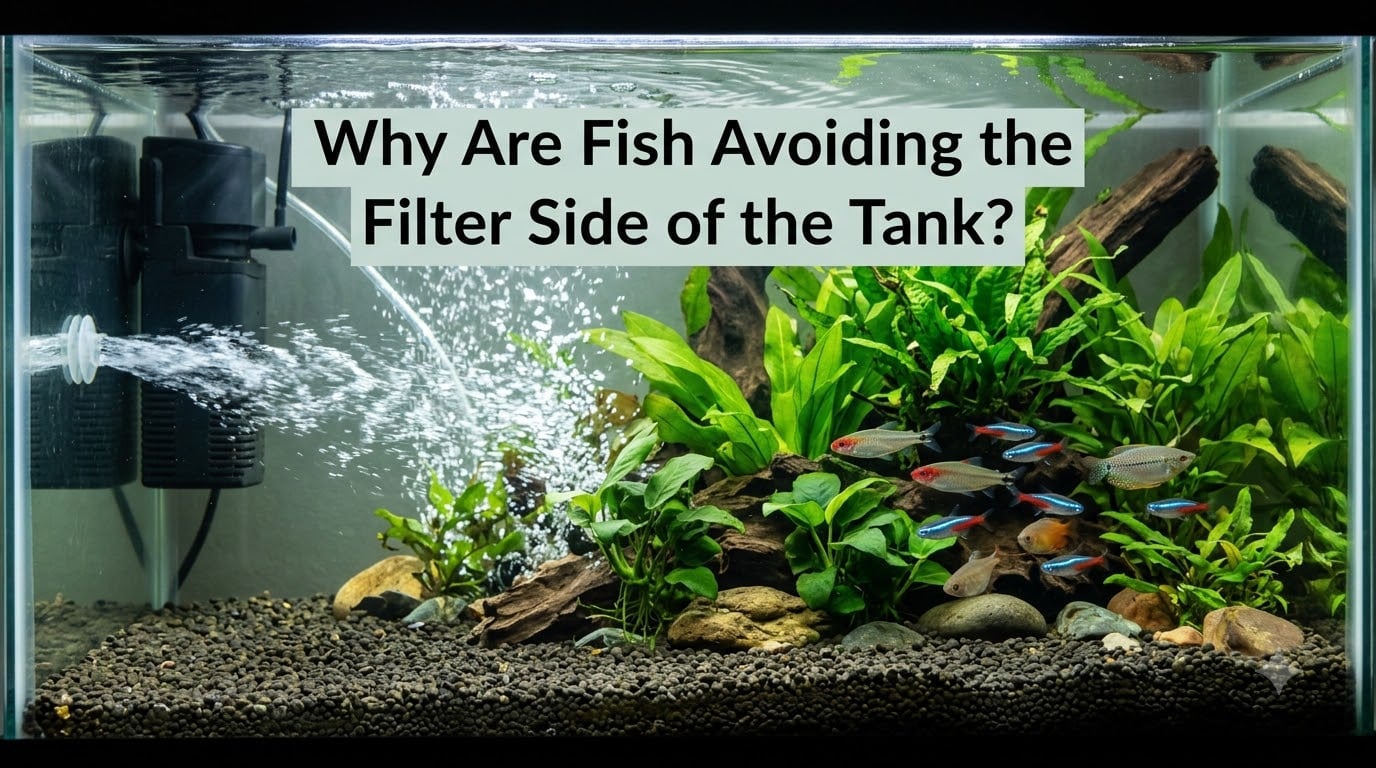
You set up your aquarium, added your fish, and now you notice something strange. They all crowd on one side while the other side sits empty. If you are wondering why fish are avoiding the filter side of the tank, you are dealing with one of the most common questions in fishkeeping. The good news is that this behavior almost always has an identifiable cause.
Fish use their lateral line system to detect subtle changes in water movement, temperature, and pressure. This sensory organ tells them which areas of the tank feel safe and which feel hostile. When something near the filter makes that area uncomfortable, fish simply vote with their fins and move away.
In this guide, our team breaks down the six most common reasons fish avoid the filter side of the tank. We cover water flow, temperature, stress, water quality, oxygen levels, and hiding preferences. For each cause, you will find practical solutions you can try today. By the end, you will know exactly what to check and how to fix it.
Contents Table of Contents →
- 1Strong Filter Flow Is the Most Common Cause
- 2Temperature Differences Across the Tank Push Fish Away
- 3Fish Hide Near the Filter When They Feel Stressed or Threatened
- 4Poor Water Quality Pushes Fish Toward or Away From the Filter
- 5Fish May Cluster Near the Filter Output Because of Higher Oxygen
- 6Dark, Covered Areas Near Equipment Feel Safer to Fish
- 7How to Tell Which Cause Is Affecting Your Fish
- 8Frequently Asked Questions About Fish Avoiding the Filter
- 9What are the signs of a stressed fish?
- 10How long will fish live without a filter?
- 11Why does my fish only stay on one side of the tank?
- 12Why do fish like to be near the filter?
- 13Final Thoughts on Fish Behavior Around Filters
Strong Filter Flow Is the Most Common Cause
If your fish are avoiding the filter side of the tank, water flow is the first thing to check. Filters create current, and when that current is too strong, fish cannot comfortably swim in that area. They spend energy fighting the flow and eventually give up, retreating to calmer water on the opposite side.
Different species tolerate different flow rates. Betta fish, gouramis, and many community fish prefer gentle water movement. Danios, barbs, and river-dwelling species actually enjoy a brisk current. The problem arises when your filter output exceeds what your specific fish can handle. I have seen a single hang-on-back filter clear out an entire 20-gallon tank because the current was simply too powerful for the species living there.
Signs that your filter flow is too strong include fish struggling to maintain position, getting pushed into decorations, or constantly swimming at an angle. You might also notice your fish darting through the current in short bursts rather than lingering in the area.
How to reduce filter flow:
- Install a spray bar to disperse the output across a wider area
- Add a flow baffle using a sponge pre-filter or DIY plastic deflector
- Point the filter output against the glass to break up the current
- Switch to an adjustable-flow filter if your current model runs at one speed
- Consider an air-driven sponge filter for species that need minimal current
One aquarist on a forum noted that their fish immediately spread out across the entire tank after they installed a simple spray bar. The fix took ten minutes and completely changed the behavior. If you suspect flow is the issue, start here before testing anything else.
Temperature Differences Across the Tank Push Fish Away
Tropical fish are cold-blooded, meaning their body temperature matches the surrounding water. They actively seek out areas that match their preferred temperature range. If one side of your tank is significantly warmer or cooler than the other, fish will congregate where the temperature feels right and avoid the area that does not.
Temperature gradients happen more often than most aquarists realize. A single heater placed at one end of a long tank can create a difference of two to three degrees from one side to the other. One forum user discovered their fish were clustered on the heater side because that zone ran 2.5 degrees warmer than the opposite end. That small difference was enough to dictate where the fish spent their entire day.
Filter placement can actually worsen temperature stratification. If your filter intake sits right next to the heater, it pushes warm water to one side of the tank while the other side stays cooler. Without adequate circulation, the temperature never equalizes.
To fix temperature gradients:
- Place your heater near the filter intake so heated water gets distributed evenly
- Use two smaller heaters at opposite ends of tanks longer than 36 inches
- Check temperature at multiple points across the tank, not just one spot
- Ensure your filter creates enough circulation to mix the water thoroughly
A simple thermometer placed at each end of the tank will tell you within minutes whether temperature is your problem. Digital thermometers with probe attachments let you monitor multiple zones without moving equipment around.
Fish Hide Near the Filter When They Feel Stressed or Threatened
Sometimes the question is not why fish are avoiding the filter side of the tank but why they are clustering in one specific area away from it. Stress drives fish to seek shelter, and they will pick whatever corner or zone feels safest. If the filter side feels exposed while the opposite side has plants, decorations, or shadows, fish will naturally gravitate toward the protected area.
Stress in fish comes from many sources. New tank mates, aggressive tank mates, bright lighting, loud noises outside the tank, and sudden changes in water parameters all trigger stress responses. A subdominant fish being bullied by others will retreat to whatever corner offers the most cover and stay there.
Common signs of a stressed fish:
- Clamped fins held tight against the body
- Loss of color or fading patterns
- Rapid gill movement or gasping at the surface
- Hiding constantly and refusing to come out for food
- Flicking or rubbing against objects (flashing)
- Sitting motionless at the bottom for extended periods
If you notice these signs, stress is likely the root cause of the behavior. Adding more hiding spots throughout the tank, not just on one side, helps distribute fish more evenly. Plants, caves, driftwood, and decorative structures all create security zones that reduce stress and encourage natural exploration.
One forum contributor shared that their fish were hiding in a single corner until they added a large piece of driftwood to the opposite side. Within hours, the fish began exploring the full tank because they finally had cover on both ends.
Poor Water Quality Pushes Fish Toward or Away From the Filter
Water quality plays a direct role in where fish choose to spend their time. Ammonia and nitrite are invisible killers that damage fish gills and reduce their ability to absorb oxygen. During the cycling process, when beneficial bacteria have not yet established, these toxins build up and cause genuine suffering.
Here is the interesting twist. During cycling, fish often cluster near the filter because that area has the highest oxygen concentration. The filter output agitates the surface water, driving oxygen into solution. When fish are struggling to breathe because ammonia is burning their gills, they instinctively move toward the most oxygen-rich zone. So if your fish are suddenly obsessed with the filter area, poor water quality during cycling may be the reason.
On the flip side, if the filter side has developed a problem, such as a dead spot collecting detritus or a bacterial bloom around the filter media, fish may avoid that area entirely. They sense something is off and move away from it.
How to check water quality:
- Test for ammonia, nitrite, and nitrate using a liquid test kit
- Ammonia should read zero in a cycled tank
- Nitrite should also read zero
- Nitrate should stay below 20 to 40 parts per million
- Perform partial water changes of 25 to 30 percent if any parameter reads high
The API Freshwater Master Test Kit is the standard recommendation from experienced fishkeepers on forums. Test strips are less accurate and can give false readings. If your tank is still cycling, expect ammonia and nitrite spikes and plan accordingly with frequent water changes.
Fish May Cluster Near the Filter Output Because of Higher Oxygen
Oxygen levels vary across a tank, and fish know exactly where to find the richest supply. The filter output creates surface agitation, which is where gas exchange happens. Oxygen enters the water and carbon dioxide exits right at that turbulent surface layer. Fish that need more oxygen will naturally gather in that zone.
Warm water holds less dissolved oxygen than cool water. If your tank runs at 80 degrees or higher, oxygen saturation drops and fish may struggle. Adding to the problem, a heavily stocked tank consumes oxygen faster than a lightly stocked one. The fish near the filter are essentially breathing the freshest air available.
If you notice fish gasping at the surface, hanging around the filter output, or breathing rapidly, low oxygen may be the culprit. This is different from ammonia poisoning but can occur alongside it.
To increase oxygen levels:
- Add an air stone or air pump to create additional surface agitation
- Lower the water level slightly so the filter output creates a waterfall effect
- Reduce stocking density if the tank is overcrowded
- Lower the temperature slightly if your fish species can tolerate it
- Add live plants, which produce oxygen during daylight hours
One forum member reported that their fish stopped clustering near the filter within a day of adding a simple air stone. The added surface agitation distributed oxygen more evenly throughout the tank, and the fish no longer needed to crowd in one spot.
Dark, Covered Areas Near Equipment Feel Safer to Fish
Fish have a natural instinct to seek shadows and cover. In the wild, open water means exposure to predators. In your aquarium, the areas around the filter, heater, and equipment often create shadows that mimic the protective cover fish would seek in nature. If your fish prefer the area away from the filter, it might be because the opposite side of the tank is darker or more heavily planted.
Conversely, if the filter side has caves, overhanging decorations, or dense plant growth, fish may actually prefer that side and cluster there. The key is understanding where the shadows and cover exist in your specific setup.
Betta fish are notorious for seeking out dark, quiet corners. Many betta keepers find their fish hovering behind the filter or wedging themselves between equipment and the glass. This is normal shelter-seeking behavior, not a sign of distress. However, if your betta is refusing to leave one spot entirely, other factors like flow or water quality should be investigated.
To create balanced hiding spots:
- Place decorations and plants on both sides of the tank, not just one
- Add floating plants to diffuse overhead lighting
- Use tall background plants along the back wall to create a continuous shelter zone
- Position caves or PVC pipes at intervals across the tank floor
When fish have secure hiding spots distributed throughout the tank, they explore more freely instead of retreating to a single safe zone. I rearranged a tank once to add plants on both sides, and the change in fish behavior was immediate. They started using the entire space within hours.
How to Tell Which Cause Is Affecting Your Fish
Diagnosing why fish are avoiding the filter side of the tank requires a process of elimination. Work through these steps in order, checking the most common causes first.
Step 1: Check the flow. Turn the filter off for five minutes and watch your fish. If they immediately spread out and start exploring the filter side, flow is too strong. This is the fastest diagnostic test you can run.
Step 2: Test the temperature. Place a thermometer at each end of the tank. If there is more than a one-degree difference, temperature stratification is driving the behavior. Reposition your heater near the filter intake to fix it.
Step 3: Test the water. Check ammonia, nitrite, and nitrate levels. Any reading above zero for ammonia or nitrite indicates a water quality problem that needs immediate attention through water changes.
Step 4: Observe stress signs. Look for clamped fins, rapid breathing, loss of color, or hiding behavior. If multiple fish show these signs, investigate aggression, water parameters, and tank setup for sources of stress.
Step 5: Evaluate oxygen and cover. Check whether the tank has adequate surface agitation and whether hiding spots exist on both sides. Add an air stone if oxygen is low, and redistribute decorations if cover is lopsided.
Most fishkeepers find the answer within the first two steps. Flow and temperature account for the majority of cases where fish avoid one side of the tank.
Frequently Asked Questions About Fish Avoiding the Filter
What are the signs of a stressed fish?
Signs of a stressed fish include clamped fins held tight against the body, faded color, rapid gill movement, gasping at the surface, constant hiding, loss of appetite, flicking against objects, and sitting motionless at the bottom for long periods. If you notice several of these signs together, test your water parameters immediately and check for aggressive tank mates.
How long will fish live without a filter?
Fish can survive without a filter for roughly 2 to 4 hours in a well-established tank, though this depends on stocking levels and tank size. Without filtration, ammonia builds quickly and oxygen drops. In a pinch, an air stone or frequent small water changes can keep fish alive temporarily, but a filter should be restored or replaced as soon as possible.
Why does my fish only stay on one side of the tank?
Fish stay on one side of the tank most commonly because of water flow, temperature gradients, stress, or water quality issues. Check if the filter current is too strong on one side, whether the heater creates a temperature difference, and test ammonia and nitrite levels. Most cases resolve by adjusting flow or heater placement.
Why do fish like to be near the filter?
Fish gather near the filter because the output creates surface agitation that increases oxygen levels in that area. During tank cycling, when ammonia and nitrite impair breathing, fish instinctively seek the most oxygen-rich water. The filter area may also provide shadows and cover that feel safe to stressed fish.
Final Thoughts on Fish Behavior Around Filters
When fish are avoiding the filter side of the tank, the cause almost always comes down to water flow, temperature, stress, water quality, oxygen levels, or hiding preferences. Start by checking flow strength and temperature consistency, as these two factors solve most cases. Then test your water parameters to rule out ammonia and nitrite issues.
The fix is usually straightforward. A spray bar, a repositioned heater, or an air stone can transform your tank dynamics in a single afternoon. Your fish will tell you when you have solved the problem by spreading out and using the full space again. That is the moment every fishkeeper works toward.