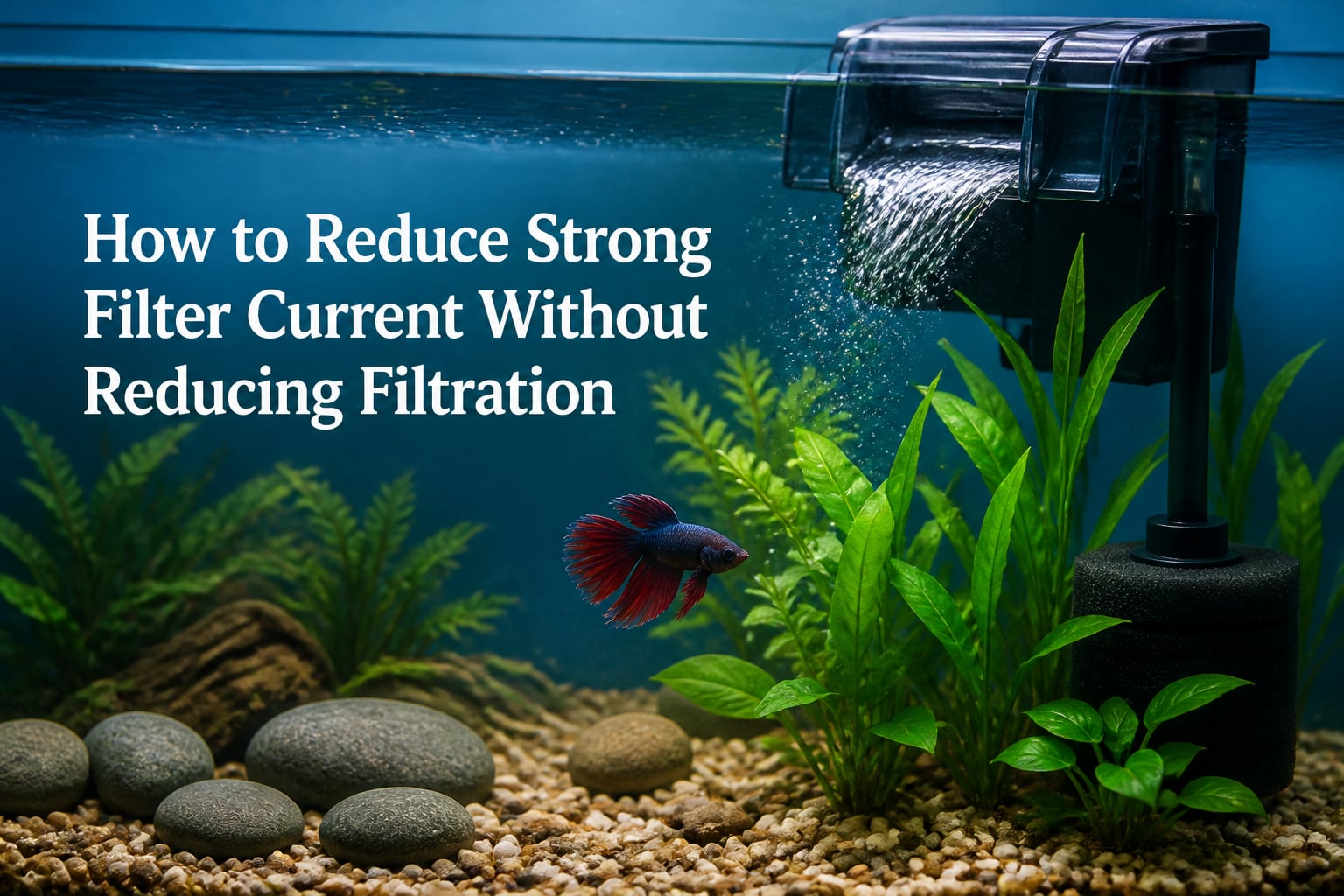
I still remember the first time I set up a planted tank for a betta. The water was crystal clear, the plants swayed beautifully, and my betta spent the entire afternoon hiding behind a rock because the hang-on-back filter was pushing him around like a leaf in a hurricane. That is exactly the problem you fix when you learn how to reduce strong filter current without reducing filtration.
Most new aquarists face this same issue. You buy a filter rated for your tank size, plug it in, and discover the current is far stronger than your fish can handle. The temptation is to throttle back the filter or swap it for a smaller unit. But that often means giving up the very water cleaning power that keeps your fish alive.
The good news is you can slow the current while keeping the full filtration capacity of your existing setup. In this guide, I cover seven proven methods I have tested across my own tanks and community recommendations from r/Aquariums and r/bettafish, plus the flow-rate math, species-specific advice, and troubleshooting fixes for common problems like sponges falling off mid-cycle.
By the end, you will have a ranked list of methods that work for hang-on-back, canister, internal, and sponge filters alike, all without sacrificing the beneficial bacteria and mechanical cleaning your tank depends on.
Contents Table of Contents →
- 1Why Strong Filter Current Is a Problem for Your Aquarium
- 2Can There Be Too Much Current in a Fish Tank?
- 3Signs Your Filter Flow Is Too Strong
- 4What Flow Rate Does Your Aquarium Actually Need?
- 5How to Reduce Strong Filter Current: 7 Proven Methods
- 6Method 1 – Switch to a Slower or Adjustable Filter
- 7Method 2 – Baffle the Filter Output
- 8Method 3 – Add a Pre-Filter Sponge on the Intake
- 9Method 4 – Aim the Output at the Glass or Surface
- 10Method 5 – Use Live Plants and Decorations to Break Up Current
- 11Method 6 – Install a Spray Bar or Diffuser
- 12Method 7 – Reduce Flow on a Canister or Internal Power Filter
- 13Best Method for Betta Fish, Shrimp, and Slow Swimmers
- 14Quick Comparison of All 7 Methods
- 15Troubleshooting Common Baffle Problems
- 16Frequently Asked Questions About Reducing Filter Current
- 17How to make filter current less strong?
- 18Is my filter current too strong?
- 19Can there be too much current in a fish tank?
- 20How do I slow down the current in my fish tank?
- 21What is the recommended flow rate for a 20-gallon long tank?
- 22Is too much flow bad for fish?
- 23Will a pre-filter sponge reduce my filtration?
- 24Final Thoughts: A Gentle Tank Is a Healthy Tank
Why Strong Filter Current Is a Problem for Your Aquarium
Strong current from your filter is not always a bad thing. Many fish and beneficial bacteria thrive with high flow because the moving water carries dissolved oxygen, distributes heat evenly, and lifts waste into the filter media. The problem starts when that flow exceeds what your fish can comfortably swim against.
For bettas, fancy goldfish, cherry shrimp, fry, and nano species, even a moderately powered hang-on-back filter can act like a treadmill they never asked for. Fish forced to constantly fight the current burn extra calories, develop torn fins, and suppress their immune systems from the ongoing stress. Shrimp get blown off their foraging grounds and may stop breeding. Fry can be pinned against the intake or pushed into decor.
Strong current also disrupts feeding. Flakes and pellets whip around the surface instead of sinking where your fish expect them, and bottom-feeders like Corydoras may miss meals entirely. Live plants with delicate leaves can uproot, and substrate gets pushed into unsightly piles.
Can There Be Too Much Current in a Fish Tank?
Yes. There absolutely can be too much current in a fish tank, and recognizing it is the first step toward fixing the problem. The right amount of flow is enough to keep debris moving toward the filter and to provide gentle surface agitation for oxygen exchange, but never so much that your fish struggle to hold their position or feed.
The ideal turnover rate for most community tanks is about 4 to 6 times the tank volume per hour. Anything significantly above that, especially for slow-swimming species, is excessive. The goal is a tank where water moves but your fish never feel like they are swimming upstream.
Signs Your Filter Flow Is Too Strong
You do not need a flow meter to tell whether your filter is overpowering the tank. Your fish will tell you with their behavior, and your tank decor will confirm it. Here are the most common warning signs to watch for.
- Constant hiding. Fish that spend most of the day wedged behind filters, heaters, or decor are usually trying to escape the current.
- Erratic or backward swimming. If your fish gets swept across the tank or has to swim at an angle just to hold position, the flow is too strong.
- Fish staying near the bottom corners. These are the lowest-flow zones in most tanks, and stressed fish will congregate there.
- Surface disturbance that resembles a rolling boil. A small ripple is good for oxygen exchange, but a churning surface means the flow is excessive.
- Plants uprooting or bending flat against the substrate. Delicate stems cannot hold position in too-strong flow.
- Food circling the tank instead of sinking. If flakes orbit the surface for a minute before going anywhere, your output is too aggressive.
- Torn or frayed fins on long-finned species. Betta fins especially show damage from getting pinned against intakes or whipped by flow.
If you see two or more of these signs, it is time to reduce the filter current. The methods below will show you how to do that without downsizing your filter or compromising water quality.
What Flow Rate Does Your Aquarium Actually Need?
Before reducing flow, it helps to know the right target. Aquarium filters are rated in GPH (gallons per hour), and the general rule is to aim for a turnover rate of about 4 to 6 times your tank volume per hour for standard community setups.
For a 20-gallon long tank, that means a filter rated around 80 to 120 GPH. For a 55-gallon community tank, you would look at roughly 220 to 330 GPH. Slow-water species like bettas and fancy goldfish are happier at the lower end of that range, around 3 to 4 times turnover, while hillstream loaches and river-dwelling species can handle 8 to 10 times turnover.
Keep in mind that the GPH printed on a filter is the maximum output with no media resistance. Once you add filter pads, ceramic bio-media, and a pre-filter sponge, actual flow drops 20 to 40 percent. That is part of why a properly stocked filter feels gentler than the spec sheet suggests.
Once you know your target, the rest is just matching the methods below to your filter type and the species you keep.
How to Reduce Strong Filter Current: 7 Proven Methods
There are many ways to reduce strong filter current without reducing filtration. The seven methods below are ranked roughly from easiest to most involved, and most of them can be combined for even gentler flow. Each one preserves your filter media and the beneficial bacteria living in it.
Method 1 – Switch to a Slower or Adjustable Filter
If your filter has a built-in flow dial, this is the easiest fix of all. Many canister filters, internal power filters, and some hang-on-back models include an adjustable flow valve. Turn it down incrementally over a day or two so your fish can acclimate, and stop when the current looks comfortable.
If your filter is not adjustable, swapping to a model with a flow control knob, or even to a gentle sponge filter, can solve the problem at the source. This is the method I recommend most for betta and shrimp tanks, because sponge filters provide both mechanical and biological filtration with almost no detectable current.
The trade-off is cost and the hassle of cycling a new filter. Always run the new filter alongside the old one for at least two weeks so the beneficial bacteria colony transfers over before you remove the original.
Method 2 – Baffle the Filter Output
A filter baffle is anything you place over or in front of the output to spread the water over a wider area, dropping its speed without restricting total volume. This is the single most popular DIY approach in the aquarium community, and there are versions for nearly every filter type.
For hang-on-back filters, the classic DIY baffle is a clean plastic water bottle with the bottom cut off. Slide the bottle over the output lip so the water cascades down the inside of the bottle and out the open bottom, hitting the surface as a gentle sheet rather than a focused jet. Tape or a rubber band holds it in place.
For canister and internal filters, wedge a piece of filter sponge, coarse filter pad, or even a new dish-scrubber (no soap residue) over the output nozzle. The sponge breaks the jet into a soft, dispersed flow while the filter still pushes the same volume of water through your media.
Reddit users in r/Aquariums consistently recommend this approach. One popular thread describes a user who wedged a half-sponge into the output tube and reported the flow became spread out and gentle with no loss of filtration capacity.
Method 3 – Add a Pre-Filter Sponge on the Intake
A pre-filter sponge is a foam sleeve that slides over your filter intake. It does two jobs at once: it catches large debris before it reaches your main media, and it slightly reduces the suction force at the intake, which means your filter works a little gentler overall.
Pre-filter sponges are especially popular for shrimp tanks because they stop baby shrimp and fry from getting sucked into the filter. They also boost your biological filtration, since the sponge itself grows beneficial bacteria over time. Just rinse the sponge in old tank water every week or two so it does not clog and choke your flow.
One warning: a pre-filter sponge reduces flow on the intake side, so if your filter is already barely keeping up, this can push it past its limit. Watch the output after installation and clean the sponge more often if you see flow dropping noticeably.
Method 4 – Aim the Output at the Glass or Surface
Sometimes you do not need to reduce flow at all. You just need to redirect it. Pointing your filter output directly at the side glass, the surface, or a dense patch of plants spreads the energy over a larger area and breaks up the jet pattern.
Aiming at the surface is doubly useful because it improves oxygen exchange while softening the perceived current down in the water column. Aiming at glass is a favorite trick for betta keepers, because the fish still get clean, oxygenated water without having to swim against a direct stream.
Adjustable output nozzles on most canister filters make this easy. For hang-on-back filters with a fixed lip, you can tape a small acrylic or plastic deflector at an angle to redirect the cascade without restricting flow.
Method 5 – Use Live Plants and Decorations to Break Up Current
Live plants and hardscape are nature’s baffles. Tall stem plants, dense moss, driftwood, and rockwork all create natural flow breaks that scatter current into gentler eddies. Position them between the filter output and the rest of the tank and you get a much calmer swimming zone on the far side.
This method does not reduce total flow through your filter, so filtration stays fully intact. It also doubles as enrichment for shy species, who appreciate the cover. Just be aware that plants alone rarely solve a truly overpowering filter. They are best used in combination with one of the methods above.
Vallisneria, Java fern, Anubias, and dense mosses like Java moss or Christmas moss all work well as flow-dampening cover. Avoid brittle stem plants in very strong flow because they will uproot or snap.
Method 6 – Install a Spray Bar or Diffuser
A spray bar is a long perforated tube that replaces the standard output nozzle on a canister filter. Instead of all the water exiting through one hole, it sprays out through dozens of small holes along the bar, distributing the same total flow across a much wider area.
Most canister filters either ship with a spray bar or have one available as an accessory. Position the spray bar just below the water surface pointing slightly down, or along the back wall pointing across, and the current becomes a gentle, even distribution rather than a single focused jet.
Spray bars are especially loved by goldfish keepers and planted-tank hobbyists because they keep debris from piling up in dead spots while still delivering comfortable flow. Some hang-on-back filters can be retrofitted with a DIY spray bar made from rigid airline tubing and a drilled plastic tube.
Method 7 – Reduce Flow on a Canister or Internal Power Filter
Canister filters and internal power filters often include an adjustable flow valve on the output. If yours does, simply throttle it down until the current feels right. If it does not, you can install an in-line valve on the output tubing to manually restrict flow.
Never restrict flow on the intake side of a canister filter. That can starve the impeller, cause cavitation, and shorten the motor’s life. Always restrict on the output side, or better yet, use a spray bar or output sponge as described in the methods above.
For internal filters without a dial, you can wrap a thin layer of filter floss around the output grate or wedge a small piece of sponge against the slits. The filter still cycles the same volume of water through the media, just at a gentler exit speed.
Best Method for Betta Fish, Shrimp, and Slow Swimmers
Betta fish are the species most associated with too-strong filter current. Their long, heavy fins act like sails, and even modest flow from a hang-on-back filter can pin them to one side of the tank or shred their fins over time. If you keep a betta, the best solutions are usually a combination of methods.
For a single betta tank, I recommend switching to a sponge filter outright. Sponge filters provide excellent biological filtration, trap particulate matter in the foam, and produce almost no measurable current. Pair a properly sized sponge filter with a small air pump and a flow-control valve on the airline, and you can dial the output down to a gentle trickle that even a heavy-finned halfmoon betta can ignore.
Cherry shrimp have similar needs. They do best with sponge filters or pre-filter sponges on any powered filter, both because the gentle flow lets them graze undisturbed and because the sponge keeps baby shrimp out of the intake. The same applies to fish fry, which can be pulled into a powered filter intake in seconds.
For fancy goldfish, the combination of a canister filter with a spray bar is a community favorite. Goldfish are messy eaters that need strong filtration, but their round bodies and long fins make them poor swimmers in direct current. A spray bar delivers the turnover you need for water quality without the focused jet they cannot handle.
Quick Comparison of All 7 Methods
Here is a side-by-side look at each method so you can pick the one that fits your filter and your fish.
- Method 1 – Slower or adjustable filter: Easiest if your filter has a flow dial. Best for new setups. Cost varies.
- Method 2 – Baffle the output: Best for hang-on-back filters. DIY plastic bottle or sponge. Almost free.
- Method 3 – Pre-filter sponge on intake: Best for shrimp and fry. Adds bonus bio-filtration. A few dollars.
- Method 4 – Redirect the output: Quickest fix. Aim at glass or surface. Free if your nozzle adjusts.
- Method 5 – Plants and decor: Natural and pretty. Use alongside other methods. Cost depends on planting.
- Method 6 – Spray bar or diffuser: Best for canister filters and goldfish. Even, distributed flow. Moderate cost.
- Method 7 – Throttle canister or internal filter: Use the built-in dial or in-line valve. Always restrict output, not intake. Free if dial exists.
For most readers, I recommend starting with Method 4 (redirection) because it is free and instant. If that is not enough, layer in Method 2 or 3. And if you keep bettas or shrimp, plan around Method 1 with a sponge filter as your long-term solution.
Troubleshooting Common Baffle Problems
The DIY baffle methods above are simple, but they come with a few recurring headaches. Here are the most common problems and how I have seen the community solve them.
Pre-filter sponges keep falling off. This is the number one complaint on r/bettafish and fishlore.com. The fix is to choose a sponge that fits snugly over the intake with no slack, then secure it with a small zip tie or a rubber band around the base. Some keepers use a sponge with a rigid inner sleeve that friction-fits over the intake tube. Avoid stuffing loose sponge into the intake hole because it can get sucked in and choke the filter.
Baffle reduces flow too much. If your plastic bottle baffle or output sponge cuts flow so aggressively that surface agitation disappears, switch to a more porous material or trim the sponge thinner. You want to slow the water, not stop it. A good test is to drop a pinch of food on the surface. It should still move gently across the tank, not sit in one spot.
Filter gets louder after baffling. Baffles can change the way water hits the surface, creating splashing or gurgling. Adjust the baffle angle so the water sheet slides down the inside of the bottle rather than free-falling, or fill the tank a quarter inch higher to silence the splash.
Spray bar develops dead spots. If you notice debris accumulating in corners after installing a spray bar, rotate the bar slightly or drill a couple of extra holes aimed at the problem area. The goal is full circulation, not a single calm lane.
Frequently Asked Questions About Reducing Filter Current
How to make filter current less strong?
Add a baffle to the filter output, install a pre-filter sponge on the intake, redirect the output at the glass or surface, or switch to a gentler filter type like a sponge filter. All of these reduce current speed while keeping your filter media and beneficial bacteria working at full capacity.
Is my filter current too strong?
Your filter current is too strong if your fish hide constantly, swim at an angle to hold position, get swept across the tank, or have torn fins. Other signs include food circling the surface, plants uprooting, and a surface that looks like it is boiling rather than gently rippling.
Can there be too much current in a fish tank?
Yes. Too much current stresses slow-swimming fish like bettas and fancy goldfish, prevents shrimp from foraging, and can trap fry against the intake. The ideal turnover rate for most community tanks is 4 to 6 times the tank volume per hour, and even less for species that prefer still water.
How do I slow down the current in my fish tank?
Start by redirecting the output at the glass or surface, which is free and instant. If that is not enough, add a baffle such as a plastic bottle sleeve over a hang-on-back output or a sponge over a canister output. For permanent relief, switch to a sponge filter or an adjustable-flow model.
What is the recommended flow rate for a 20-gallon long tank?
Aim for a turnover rate of about 4 to 6 times the tank volume per hour. For a 20-gallon long tank, that works out to roughly 80 to 120 GPH. Go toward the lower end for bettas and fancy goldfish, and the higher end for active community fish.
Is too much flow bad for fish?
Yes. Chronic strong flow forces fish to swim constantly, which burns calories, suppresses the immune system, and can damage fins on long-finned species. It also disrupts feeding and breeding, especially for shrimp and slow swimmers.
Will a pre-filter sponge reduce my filtration?
No. A pre-filter sponge actually adds biological filtration because the foam grows its own colony of beneficial bacteria. It may slightly reduce intake suction, so clean it weekly in old tank water to prevent clogging, but it will not reduce your filter’s ability to clean the water.
Final Thoughts: A Gentle Tank Is a Healthy Tank
Learning how to reduce strong filter current without reducing filtration is one of the highest-impact skills in the hobby. A tank with the right flow has calmer fish, healthier fins, better feeding behavior, and cleaner water because the filter keeps doing its job at full capacity.
Start with the free, instant fixes like redirecting the output. Layer in a baffle, pre-filter sponge, or spray bar if you need more relief. For bettas, shrimp, and fry, plan around a sponge filter or an adjustable model as your long-term solution.
Whichever path you take, the key is to slow the current without downsizing your filter or starving your beneficial bacteria. Do that and your fish will thank you with brighter colors, more active behavior, and a tank that looks as peaceful as it should.