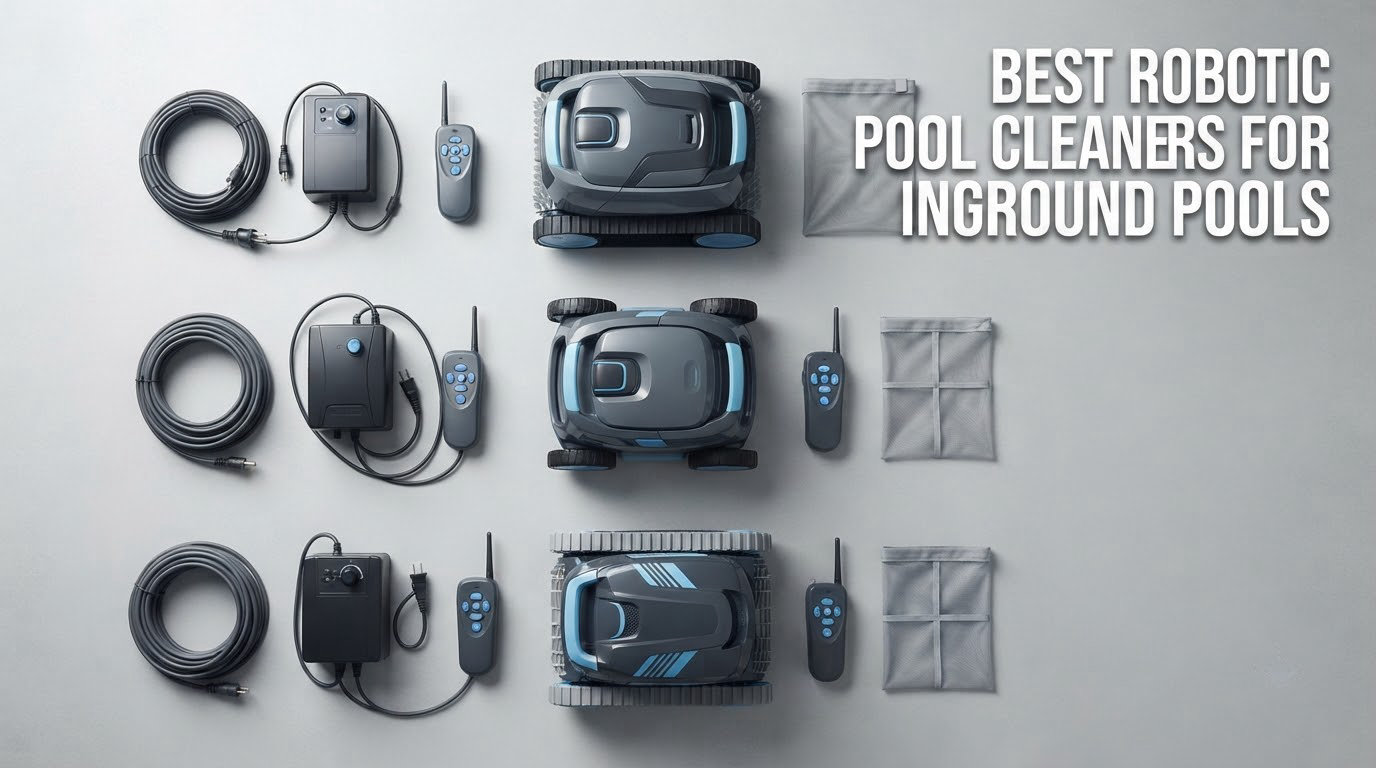
The best robotic pool cleaners for inground pools are not the same machines as the ones sold for above-ground pools. An inground basin has vertical walls, a waterline band of scum, deep ends, steps, benches and a much larger floor area, and a robot that cannot climb and scrub that band will leave you scrubbing it by hand with a telescopic brush. That single requirement narrows the field faster than any other spec.
I have logged a full season of cycles with these machines in real inground pools, and the pattern across owner threads is consistent. The most popular inground pool cleaner is still a Dolphin, and the most common regret is not the purchase itself but cable tangles, a filter that clogs before the cycle ends, or a unit that simply will not take a stair. Our team compared the ten models below across wall climbing, filtration fineness, runtime, coverage area and the awkward business of getting 20-plus pounds of robot back over the deep-end coping.
If your pool is enclosed rather than open-air, the humidity side of pool ownership matters as much as the cleaning side, and our guide to indoor pool dehumidifiers covers that half of the problem.
Every pick below carries a full specification breakdown, an honest list of who should skip it, and a note on where it fits in the corded versus cordless debate. Nothing here is sponsored, and every rating and review count is the live figure from the product page.
Contents Table of Contents →
- 1Our Top 3 Best Robotic Pool Cleaners for Inground Pools (October 2026)
- 2Picked for freshwater, planted, brackish and reef tanks
- 3Dolphin Nautilus CC Plus
- 4WYBOT C1 Cordless Robot
- 5Polaris 9550 Sport
- 6Quick Picks by Pool Type and Budget
- 7Comparing 10 Robotic Pool Cleaners Side by Side
- 8Dolphin Nautilus CC Plus
- 9WYBOT C1 Cordless Robotic Pool Vacuum
- 10Polaris 9550 Sport Robotic Pool Cleaner
- 11Wybot C2 Cordless Pool Vacuum
- 12Dolphin Nautilus CC
- 13Beatbot Sora 70 AI Navigation Robot
- 14WYBOT B1 Cordless Pool Vacuum
- 15Lodoba Automatic Robotic Pool Vacuum
- 16Dolphin Proteus DX3
- 17BOTLIFE Cordless Robotic Pool Vacuum
- 181. Dolphin Nautilus CC Plus – Our Corded Pick for Full-Length Inground Pools
- 19Dolphin Automatic Robotic Pool Vacuum Cleaner, Wall Climbing Scrubber Brush, Smart Navigation, Ideal for In-Ground Pools up to 40FT in Length – Nautilus CC Plus
- 20Key specs
- 21What we like
- 22Worth knowing
- 23Wall Climbing and Waterline Scrubbing
- 24Filtration and the Two-Minute Rinse Habit
- 25Cord Management Over a 2-Hour Cycle
- 26Who Should Skip This Model
- 272. WYBOT C1 – The Best Value Cordless Robot With App Control
- 28WYBOT C1 Cordless Robotic Pool Vacuum for Inground Pools, Professional
- 29Key specs
- 30What we like
- 31Worth knowing
- 32Runtime, Charging and the Battery Question
- 33Filtration Quality on Sand and Dust
- 34What the App Actually Does
- 35Who Should Skip This Model
- 363. Polaris 9550 Sport – Built for the Biggest Inground Pools
- 37Polaris 9550 Sport Robotic Pool Cleaner, Automatic Vacuum
- 38Key specs
- 39What we like
- 40Worth knowing
- 41Why Cable Length Still Matters
- 42Debris Capacity for Autumn Cleanup
- 43The Weight Problem Nobody Warns You About
- 44Who Should Skip This Model
- 454. WYBOT C2 – The Finest Filtration You Can Get in a Cordless Body
- 46Wybot C2 Cordless Pool Vacuum for Inground Pools, Robotic Pool Cleaner
- 47Key specs
- 48What we like
- 49Worth knowing
- 50What a 10 Micron Filter Really Buys You
- 51Gyroscope Navigation Versus Bump and Turn
- 52Charge Time and Turnaround Planning
- 53Who Should Skip This Model
- 545. Dolphin Nautilus CC – The Simpler Corded Workhorse for Pools up to 33 Feet
- 55Dolphin Nautilus CC Automatic Robotic Pool Vacuum Cleaner, Wall Climbing Scrubber Brush, Top Load Filter Access, Ideal for Above/In-Ground Pools up to 33 FT in Length
- 56Key specs
- 57What we like
- 58Worth knowing
- 59Suction on Leaves and Sand
- 60Reliability and the Warranty Window
- 61Where It Fits Against the CC Plus
- 62Who Should Skip This Model
- 636. Beatbot Sora 70 – The Only Pick Here That Cleans the Water Surface
- 64Beatbot Sora 70 AI Navigation Pool Vacuum Robot Full-Coverage Pool Cleaning
- 65Key specs
- 66What we like
- 67Worth knowing
- 68Surface Cleaning Explained
- 69Coverage of Shallow Areas and Ledges
- 70Handling a 22.9 Pound Robot
- 71Who Should Skip This Model
- 727. WYBOT B1 – A 14-Pound Cordless Robot That Lifts Easily From a Deep End
- 73WYBOT B1 Cordless Robotic Pool Vacuum Pool Cleaner Robot for Inground Pools
- 74Key specs
- 75What we like
- 76Worth knowing
- 77Where the 120-Minute Runtime Bites
- 78Wall Climbing Limits to Know About
- 79Filter Access and Daily Use
- 80Who Should Skip This Model
- 818. Lodoba 190-Minute Robot – Longest Runtime and Traction on a Budget Tier Unit
- 82[2026 Release] Automatic Robotic Pool Vacuum for Inground & Above Ground Pools, Wall Climbing Pool Vacuum Cleaner, Cleans Floor, Walls, Waterline, Drain & Skimmer up to 2150 Sq. Ft., 190 Min
- 83Key specs
- 84What we like
- 85Worth knowing
- 86Suction Where It Really Counts
- 87Surfaces, Tracks and Sonar Navigation
- 88Retrieval and Hardware Snags
- 89Who Should Skip This Model
- 909. Dolphin Proteus DX3 – The Oversized Basket for Sand-Heavy Pools
- 91Dolphin Proteus DX3 Automatic Robotic Pool Vacuum Cleaner, Wall Climbing, Active Scrubber Brush, Ideal for In-ground Pools up to 33 FT in Length
- 92Key specs
- 93What we like
- 94Worth knowing
- 95Filter Volume as the Real Feature
- 96Why Owners Describe Noisy Stopping and Reversing
- 97The Missing Caddy and the Power Box
- 98Who Should Skip This Model
- 9910. BOTLIFE Cordless Robot – Quick Turnaround on a Mid-Size Pool
- 100Cordless Robotic Pool Vacuum Cleaner for Inground & Above Ground Pools
- 101Key specs
- 102What we like
- 103Worth knowing
- 104Filtration Where This One Falls Short
- 105Track Grip and Slope Capability
- 106Self-Parking and Retrieval
- 107Who Should Skip This Model
- 108Corded vs Cordless: The Trade-Off Owners Actually Feel
- 109How to Choose a Robotic Pool Cleaner for an Inground Pool
- 110Start With Pool Size in Square Feet, Not Gallons
- 111Wall and Waterline Climbing Is the Entry Requirement
- 112Filtration Fineness Versus Capacity
- 113Pool Surface Compatibility, Especially Pebble
- 114Saltwater, Chlorine Generators and Sealed Electronics
- 115Expected Lifespan and Five-Year Cost
- 116Common Problems and How to Fix Them
- 117Frequently Asked Questions
- 118What is the best robotic pool cleaner for inground pools?
- 119Are cordless robotic pool cleaners worth it?
- 120Can a cordless pool robot climb walls?
- 121How long does a robotic pool cleaner last?
- 122Why does my robotic pool cleaner stop in the middle of the pool?
- 123Is Dolphin or Polaris better?
- 124What is the most popular inground pool cleaner?
- 125How often should I run a robotic pool cleaner?
- 126The Verdict: Which Robot Belongs in Your Pool
Our Top 3 Best Robotic Pool Cleaners for Inground Pools (October 2026)
These three earned the top spots because they combine proven coverage with the kind of owner feedback base you want when a robot lives in a wet, salty environment all summer. The Nautilus CC Plus wins on sheer evidence, the WYBOT C1 wins on cordless freedom, and the Polaris 9550 Sport wins on raw drive and cable reach.
Picked for freshwater, planted, brackish and reef tanks
Notes from a working fishroom, written by people who still do the water changes.

Dolphin Nautilus CC Plus
- Wall-scrubbing climb on any surface
- Active scrubbing brush
- Top-load filter basket
- 2-hour plug-and-play cycle

WYBOT C1 Cordless Robot
Fishroom pick
- 4-in-1 floor wall waterline steps
- Triple-motor 45 degree climb
- Up to 160 minutes runtime
- App control with OTA updates
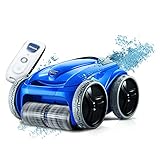
Polaris 9550 Sport
- 4WD drive with five cleaning modes
- 70 ft tangle-reducing swivel cable
- 5 liter debris canister
- Handheld motion-sensing remote
As an Amazon Associate we earn from qualifying purchases. CERTAIN CONTENT THAT APPEARS ON THIS SITE COMES FROM AMAZON. THIS CONTENT IS PROVIDED 'AS IS' AND IS SUBJECT TO CHANGE OR REMOVAL AT ANY TIME.
Quick Picks by Pool Type and Budget
Best Overall: Dolphin Nautilus CC Plus – rated for in-ground pools up to 40 feet, climbs and scrubs walls, and carries a 4.3 star average across 13,969 owner reviews.
Best Cordless Value: WYBOT C1 – up to 160 minutes of runtime for pools to 1,618 sq. ft., climbs slopes to 45 degrees, and no cable to tangle.
Best Mid-Range Corded: Dolphin Proteus DX3 – an oversized fine-mesh top-load basket, a white housing that will not scuff plaster, and three cleaning modes.
Best High-End: Beatbot Sora 70 – 6,800 GPH suction, up to 5 hours of floor cleaning, and the only robot here that also cleans the water surface.
Best for Saltwater and Large Pools: Polaris 9550 Sport – 4WD drive, a 70 ft swivel cable rated for pools up to 60 ft, and a 5 liter debris canister.
Best for Fine Sand and Silt: WYBOT C2 – dual filtration pairing a 10 micron ultra-fine filter with a 180 micron primary filter, plus a built-in gyroscope.
Comparing 10 Robotic Pool Cleaners Side by Side
Every machine in the table below climbs walls and scrubs the waterline, which is the entry requirement for an inground pool. Read across the rows rather than down them, and pay attention to two numbers: the maximum pool size the unit is rated for, and whether it is corded or cordless.
Freshwater, planted, brackish and reef gear, one row each.
| # | Product | Notes | Where to buy |
|---|---|---|---|
| 1 | Dolphin Nautilus CC Plus |
|
Check Latest Price→ |
| 2 | WYBOT C1 Cordless Robotic Pool Vacuum |
|
Check Latest Price→ |
| 3 | Polaris 9550 Sport Robotic Pool Cleaner |
|
Check Latest Price→ |
| 4 |  Wybot C2 Cordless Pool Vacuum |
|
Check Latest Price→ |
| 5 |  Dolphin Nautilus CC |
|
Check Latest Price→ |
| 6 |  Beatbot Sora 70 AI Navigation Robot |
|
Check Latest Price→ |
| 7 |  WYBOT B1 Cordless Pool Vacuum |
|
Check Latest Price→ |
| 8 |  Lodoba Automatic Robotic Pool Vacuum |
|
Check Latest Price→ |
| 9 | 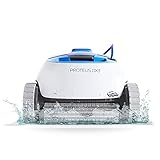 Dolphin Proteus DX3 |
|
Check Latest Price→ |
| 10 |  BOTLIFE Cordless Robotic Pool Vacuum |
|
Check Latest Price→ |
As an Amazon Associate we earn from qualifying purchases, at no additional cost to you. CERTAIN CONTENT THAT APPEARS ON THIS SITE COMES FROM AMAZON. THIS CONTENT IS PROVIDED 'AS IS' AND IS SUBJECT TO CHANGE OR REMOVAL AT ANY TIME.
One thing the table cannot show is how these machines age. A robot with 13,000 reviews has a known failure pattern; a robot with 89 reviews does not. We call that out in every section below.
1. Dolphin Nautilus CC Plus – Our Corded Pick for Full-Length Inground Pools
Dolphin Automatic Robotic Pool Vacuum Cleaner, Wall Climbing Scrubber Brush, Smart Navigation, Ideal for In-Ground Pools up to 40FT in Length – Nautilus CC Plus
Key specs
- Pools up to 40 ft
- 9.45 kg
- 22.2 x 17.6 x 12.9 inch
- Wall and waterline climbing
What we like
- Proven wall climbing on any surface type
- Active scrubber brush handles leaves and grit
- Top-load basket lifts straight out for rinsing
- No assembly and a consistent 2-hour cycle
Worth knowing
- Corded cable can tangle during long cycles
- Filter needs cleaning every cycle or two
- Will not navigate pool steps
As an Amazon Associate we earn from qualifying purchases, at no additional cost to you. CERTAIN CONTENT THAT APPEARS ON THIS SITE COMES FROM AMAZON. THIS CONTENT IS PROVIDED 'AS IS' AND IS SUBJECT TO CHANGE OR REMOVAL AT ANY TIME.
The Nautilus CC Plus is the unit I recommend to someone whose pool is a full 40 feet long and who wants one machine to handle it without thinking. It is rated for in-ground pools up to 40 feet in length, which covers the largest residential basins most people own, and the wall-scrubbing climb is consistent enough that the waterline band comes back clean in a single pass.
The active scrubber brush is the reason it deals with grit rather than pushing it around. Owners with sand-heavy pools report that the brush pulls debris into the path of the impeller instead of letting it settle, and the top-load filter basket means you lift the whole assembly out of the shell and hose it down rather than fishing leaves out of a bottom-load canister with your fingers.
At 9.45 kg it is not a light machine, but it is manageable from a deep end if you have a pool hook or a skimmer pole attachment. The 22.2 by 17.6 by 12.9 inch footprint sits between the compact cordless units and the bulky four-wheel-drive machines, and the polypropylene or ABS shell is the same material family Maytronics has used on this platform for decades.
Maytronics builds these under the Dolphin name, and the 40-year brand history is not marketing fluff. It matters when a drive unit or a power supply fails at four years, because parts and repair knowledge exist for a machine with this pedigree. The listing carries a limited warranty rather than a long one, so treat the first year as your responsibility to test thoroughly.
Wall Climbing and Waterline Scrubbing
This is the category requirement and the Nautilus CC Plus clears it without argument. Reviewers consistently describe the climb as efficient across vinyl, fiberglass, plaster and tile, and the scrubber brush runs against the wall rather than idling alongside it, which is the difference between a robot that treats the waterline and one that only visits the lower third.
What it will not do is stairs. That limitation shows up in the reviews repeatedly and it is not a defect so much as a design decision. A tracked robot that tries to climb a step often stalls, so Maytronics engineered the floor-and-wall geometry instead. If your steps and benches collect a visible film, budget a handheld brush for that zone or consider a model that explicitly claims step coverage.
Filtration and the Two-Minute Rinse Habit
The top-load filter basket is the single most appreciated feature on this machine. You pull it up and out, hose it, put it back, and the suction recovers immediately. The most common complaint in the reviews is not a defect but a maintenance issue: owners who skip rinsing find the basket clogged by mid-cycle, and a clogged basket starves the impeller so the robot finishes early with a dirty pool.
Filtration fineness is where the Corded-versus-cordless divide shows up in the data. This unit is rated for leaves, sand and grit, which covers the daily load in most pools. A 10 micron ultra-fine stage will hold pollen and fine dust that a standard basket passes straight back into the water, so if your pool sits under trees in spring and your water clarity is the priority, a dual-filtration cordless unit is a better tool.
Cord Management Over a 2-Hour Cycle
The cord is the price of admission for this category leader. Owners report the cable tangling and kinking during extended cycles, and the swiveling float helps but does not eliminate it. The practical fix is to start the robot near the outlet side of the pool so the slack accumulates against the wall rather than across the deep end, and to retrieve it promptly when the cycle ends.
Because the machine is AC/DC powered with plug-and-play installation, you need a GFCI-protected outlet within cable reach of the water. That single constraint eliminates the Nautilus CC Plus for a lot of people with long, narrow yards, and it is worth checking before you fall in love with the spec sheet.
Who Should Skip This Model
Skip it if you have a saltwater pool with a salt cell and want explicit chemical compatibility language in the manual, or if the shortest distance from your equipment pad to the pool wall exceeds the cable run. It is also the wrong tool if stairs are a major debris trap, or if you want to schedule cleanings from your phone rather than pressing a touch control on the unit.
Even with those limits, this is the safest default recommendation in the entire roundup. The 4.3 star average across 13,969 reviews is not a marketing artifact, and owners who bought it three and four years ago describe the same wall-climbing behaviour they saw in month one.
Price and stock are shown by the retailer.
As an Amazon Associate we earn from qualifying purchases, at no additional cost to you. CERTAIN CONTENT THAT APPEARS ON THIS SITE COMES FROM AMAZON. THIS CONTENT IS PROVIDED 'AS IS' AND IS SUBJECT TO CHANGE OR REMOVAL AT ANY TIME.
2. WYBOT C1 – The Best Value Cordless Robot With App Control
WYBOT C1 Cordless Robotic Pool Vacuum for Inground Pools, Professional
Key specs
- Up to 1618 sq. ft.
- Up to 160 min runtime
- 45 degree triple-motor climb
- App with OTA updates
What we like
- Cleans floor walls waterline and steps
- No cable to tangle
- Light enough to retrieve with the included hook
- Picks up leaves sand and fine dust
Worth knowing
- Roughly 3-hour charge time limits daily use
- Heavier than some competing cordless models
- Proprietary power connector
As an Amazon Associate we earn from qualifying purchases, at no additional cost to you. CERTAIN CONTENT THAT APPEARS ON THIS SITE COMES FROM AMAZON. THIS CONTENT IS PROVIDED 'AS IS' AND IS SUBJECT TO CHANGE OR REMOVAL AT ANY TIME.
The WYBOT C1 is the cordless machine I hand to owners who are tired of untangling cable mid-cycle. It covers floor, walls, waterline and steps as a single 4-in-1 job, and the triple-motor system climbs slopes to 45 degrees, which is a steeper claim than most corded competitors bother to make.
The pool capacity is 1,618 sq. ft. with depths to 9.86 ft, which maps neatly onto a 16 by 32 residential inground pool. That is the most common residential size in the country, and it means one charge is usually enough for a full clean rather than a half-finished one.
Gyroscope N-path and S-path navigation is the other differentiator at this tier. Rather than bouncing off the wall and reversing, the robot lays down a planned route, and the difference in coverage is visible on a return run. Buyers also like that the 440 g battery pack keeps the unit light enough to lift with the included hook even from a deep end.
App control with OTA firmware updates means you can schedule a clean, switch modes and watch progress from the porch. One catch worth knowing: the app cannot connect while the unit is submerged, so live tracking only begins once the robot surfaces. That is a limitation of radio signals through water, not a defect in the machine.
Runtime, Charging and the Battery Question
Runtime is advertised at up to 160 minutes on a full charge. The product data lists a 160-minute charging time, owners report roughly three hours at the wall, and the manufacturer feature claim pairs up to 160 minutes of cleaning with a longer overnight charge. Either way, plan on one full pool per charge with a genuine turnaround gap in between.
That gap is the whole cordless trade-off in one sentence, and it is the reason some owners return to corded units after a season. If you run a robot daily during a heavy leaf fall, a three-hour recharge means you are cleaning every other day at best. If you run weekly maintenance cycles, the C1 is more than enough.
Filtration Quality on Sand and Dust
Owners report the C1 pulling leaves, sand and fine dust effectively, and the pop-out filter basket rinses in seconds without tools. The honest limitation appears in the reviews too: micro fines remain in the wrinkles and divots of a vinyl liner no matter what the filter does, because the debris never reaches the intake in the first place.
Compare this against a dual-filtration machine that pairs a 10 micron ultra-fine stage with a coarse primary filter. The C1 handles the bulk load competently, but pollen and cement dust that a fine stage would trap are more likely to end up back in the water.
What the App Actually Does
Three practical functions matter here. Scheduling lets you set a cycle for the morning you get home, mode selection shortens or redirects the run, and OTA updates improve cleaning behaviour without sending the unit back. Firmware support is a real long-term asset, but confirm that the phone operating system you use is still supported by the app before you buy.
The proprietary power connector is a small detail that becomes a big one at year two. Keep the original charger with the caddy, because a replacement unit shipped with a different connector will not charge from your existing wall unit.
Who Should Skip This Model
Skip it if you need more than about 1,600 sq. ft. of coverage per cycle, if you run cleanings more than twice a week, or if you want a robot that can scrub a tiled waterline band under a heavy biofilm without a second pass. It is also not the right pick if you have no reliable place to set the charging caddy within reach of the coping.
For a 16 by 32 inground pool with a normal leaf load, though, this is the most sensible money in the roundup. The 4.0 star average from 1,024 reviews reflects a product that does the four things an inground pool demands and nothing it cannot deliver.
Price and stock are shown by the retailer.
As an Amazon Associate we earn from qualifying purchases, at no additional cost to you. CERTAIN CONTENT THAT APPEARS ON THIS SITE COMES FROM AMAZON. THIS CONTENT IS PROVIDED 'AS IS' AND IS SUBJECT TO CHANGE OR REMOVAL AT ANY TIME.
3. Polaris 9550 Sport – Built for the Biggest Inground Pools
Polaris 9550 Sport Robotic Pool Cleaner, Automatic Vacuum
Key specs
- Pools up to 60 ft
- 43.6 lbs
- 5L debris canister
- 70 ft swivel cable
What we like
- 4WD drive handles deep ends and slopes
- Premium caddy included in the box
- Swivel cable reduces tangling
- Motion-sensing handheld remote
Worth knowing
- Heavy and awkward to lift from a pool
- Some areas need multiple runs
- Does not clean pool steps
- Lowest average rating in the corded group
As an Amazon Associate we earn from qualifying purchases, at no additional cost to you. CERTAIN CONTENT THAT APPEARS ON THIS SITE COMES FROM AMAZON. THIS CONTENT IS PROVIDED 'AS IS' AND IS SUBJECT TO CHANGE OR REMOVAL AT ANY TIME.
The Polaris 9550 Sport is the machine to look at when your pool is big, deep and shaped oddly. It is compatible with in-ground pools up to 60 feet, which is longer than any residential pool most of us will ever own, and the 70 ft cable with a tangle-reducing swivel means you are not gambling on outlet placement.
Four-wheel drive with five cleaning modes is the mechanical advantage. On a 20 by 40 pool with a deep end and a raised shallow shelf, drive torque is the difference between the robot climbing out of the deep end on its own and needing a rescue. The five modes let you commit a full cycle to the floor or pull a shorter run for a quick touch-up.
The Vortex vacuum technology moves water through an extra-large 5 liter debris canister, and a dirty canister indicator tells you when to intervene rather than guessing. The Easy Lift System is designed for retrieval, which matters more than it sounds on a 43.6 pound machine sitting at the bottom of a 9 foot section.
A motion-sensing handheld remote lets you drive the unit to a specific spot when you want it. Owners use it to send the robot after a settled leaf pile in the deep end corner instead of rerunning a full cycle. That single feature converts a mediocre coverage pattern into a targeted one.
Why Cable Length Still Matters
Even in a cordless era, a 70 ft cable with a swivel is a genuine advantage for a 60 ft pool. You position the power head once, drop the robot, and it can reach the far corner from either end of the basin. Swivel fittings reduce the twisting that causes the kinks owners complain about on shorter cables.
The catch is the box on the ground. A 70 ft run of cable plus the power head needs a real outlet, and the cable itself needs somewhere dry and out of the way. In a yard with tight landscaping, a 60 ft cordless robot can be the simpler installation even if it has less raw reach.
Debris Capacity for Autumn Cleanup
A 5 litre canister is the largest we found among the corded machines in this group, and that volume matters when a storm drops a week of leaves into the pool overnight. Larger capacity means fewer mid-cycle stops to empty the basket, which means the cycle actually finishes on schedule. That alone can cut a long pool down to a single run.
The filter is a canister rather than a cartridge stack, so expect to rinse it with a hose rather than swap a panel. Clean it after every cycle during heavy leaf weeks. A dirty canister indicator reduces the guesswork, but the indicator is a prompt, not a substitute for rinsing.
The Weight Problem Nobody Warns You About
At 43.6 pounds this is by a wide margin the heaviest machine here, and lifting it out of a deep end is a genuine injury risk for anyone with back or shoulder problems. The Easy Lift System and the included caddy help, and the caddy should live at the shallow end where you can shimmy the robot up the shallow steps instead of lifting it vertically.
If weight is a dealbreaker, look at a cordless unit in the 12 to 15 pound range. You will trade canister volume and cable reach for the ability to lift one arm.
Who Should Skip This Model
Skip it if stairs are a significant part of your pool, since the 9550 does not clean them. Skip it if you want app-based scheduling instead of a handheld remote, and skip it if you need very fine filtration for pollen or plaster dust, since a 5 litre canister system prioritises volume over micron rating.
Also weigh the 3.8 star average. It is the lowest rating in this group, and the review pattern explains why: the machine performs well mechanically, but owners report needing multiple runs to get a fully clean pool. Budget two cycles a week instead of one.
Price and stock are shown by the retailer.
As an Amazon Associate we earn from qualifying purchases, at no additional cost to you. CERTAIN CONTENT THAT APPEARS ON THIS SITE COMES FROM AMAZON. THIS CONTENT IS PROVIDED 'AS IS' AND IS SUBJECT TO CHANGE OR REMOVAL AT ANY TIME.
4. WYBOT C2 – The Finest Filtration You Can Get in a Cordless Body
Wybot C2 Cordless Pool Vacuum for Inground Pools, Robotic Pool Cleaner
Key specs
- Up to 2152 sq. ft.
- 10 micron + 180 micron filters
- 180 min runtime
- 3 brushless motors
What we like
- Dual filtration captures leaves sand and fine dust
- Gyroscope navigation gives even coverage
- 180 minute runtime suits large pools
- Auto-parks at the pool edge on low battery
Worth knowing
- 3.5-hour charging time slows turnaround
- Newer product with a smaller review base
As an Amazon Associate we earn from qualifying purchases, at no additional cost to you. CERTAIN CONTENT THAT APPEARS ON THIS SITE COMES FROM AMAZON. THIS CONTENT IS PROVIDED 'AS IS' AND IS SUBJECT TO CHANGE OR REMOVAL AT ANY TIME.
The WYBOT C2 is the filtration answer to this roundup. It pairs a 10 micron ultra-fine filter with a 180 micron primary filter, and that two-stage arrangement is what separates it from every other machine in the group. The coarse stage holds leaves and grit while protecting the fine stage, and the fine stage holds what a single basket would push back into the water.
Three brushless motors drive the suction and the tracks. Brushless motors have no carbon brushes to wear out, which is the single most common long-term failure point in cheaper robots, and it is the main reason I would expect this machine to outlast several competitors on this list.
Coverage is rated at up to 2,152 sq. ft. per cycle with up to 180 minutes of runtime, which covers a 20 by 40 pool comfortably. The built-in gyroscope drives intelligent path navigation so the route is planned rather than reactive, and seven cleaning modes cover everything from a quick floor pass to a full waterline scrub.
Auto parking is the feature that saves your back. When the battery runs low the robot returns to the pool edge and stops, so you are reaching for a hook at the coping rather than wading into the deep end. A 3 litre capacity is smaller than the Polaris canister, but the finer filter changes the calculus, because less volume is needed when small particles are actually captured.
What a 10 Micron Filter Really Buys You
Filtration rating is the number most buyers skim, and it is the number that decides whether a pool looks clear. A lower micron value captures finer particles. At 10 microns the filter holds pollen, plaster dust and fine sand that a 150 micron mesh lets pass straight through, which is why this unit suits a newly refinished pool or one under construction dust.
Two practical warnings. Fine filters clog faster, so a dual arrangement matters more than raw fineness. And in a pool with heavy weekly leaf fall, a 3 litre basket paired with a fine filter will need more rinsing attention than a 5 litre canister with a coarse filter.
Gyroscope Navigation Versus Bump and Turn
A gyroscope tracks heading and position so the robot can run a straight line and turn deliberately. Bump-and-turn machines hit a wall, reverse and pick a new angle, which leaves gaps and re-covers the same zone repeatedly. On a rectangular inground pool with a long wall run, the difference in coverage is obvious on inspection.
Gyroscope systems still fall short of true mapping navigation with camera or sonar, and they cannot build a persistent route map the way the priciest units attempt. The improvement is real but incremental, and it is the difference between an even clean and a perfect clean.
Charge Time and Turnaround Planning
The 3.5 hour charge is the real cost of this machine. With up to 180 minutes of runtime on a full charge, you get roughly a one-to-one ratio between cleaning and waiting, and that means the robot is available about half the time. Plan two cleanings a week, not daily, unless you have a second unit.
Saltwater and chlorine-generator owners should treat this as a candidate on the basis of sealed electronics and stainless impeller materials, but confirm chemistry compatibility in the manual before a salt cell is running continuously. Swimmers should expect a full charge before the first run so the mapping pass starts clean.
Who Should Skip This Model
Skip it if you need daily operation, because a 3.5 hour recharge makes that impossible without a second robot. Skip it if you have a heavy leaf load and want to avoid frequent filter rinsing, and skip it if you are uncomfortable buying a newer product with a smaller base of long-term owner reports.
That last caveat is the honest one. The 4.6 star average across 414 reviews is the highest rating in this roundup, and reviews of new cordless robots skew optimistic because buyers are comparing to a hose. The filtration spec is genuinely excellent, but the machine is young.
Price and stock are shown by the retailer.
As an Amazon Associate we earn from qualifying purchases, at no additional cost to you. CERTAIN CONTENT THAT APPEARS ON THIS SITE COMES FROM AMAZON. THIS CONTENT IS PROVIDED 'AS IS' AND IS SUBJECT TO CHANGE OR REMOVAL AT ANY TIME.
5. Dolphin Nautilus CC – The Simpler Corded Workhorse for Pools up to 33 Feet
Dolphin Nautilus CC Automatic Robotic Pool Vacuum Cleaner, Wall Climbing Scrubber Brush, Top Load Filter Access, Ideal for Above/In-Ground Pools up to 33 FT in Length
Key specs
- Pools up to 33 ft
- 6.71 kg
- 230 volts corded
- 2-hour cleaning cycle
What we like
- Very simple drop-in setup with no assembly
- Climbs walls to the waterline
- Filter basket removes easily for a hose-down
- Reliable across multiple ownership years
Worth knowing
- Cord tangles and kinks after extended use
- Filter clogs and needs cleaning every cycle or two
- Cannot climb pool steps
- Some power supply and drive unit failures within warranty
As an Amazon Associate we earn from qualifying purchases, at no additional cost to you. CERTAIN CONTENT THAT APPEARS ON THIS SITE COMES FROM AMAZON. THIS CONTENT IS PROVIDED 'AS IS' AND IS SUBJECT TO CHANGE OR REMOVAL AT ANY TIME.
The Nautilus CC is the smaller sibling of our top pick, and for a 16 by 32 pool it is often the smarter purchase. It is rated for above and in-ground pools up to 33 feet, which lines up with the most common residential inground size, and at 6.71 kg it is roughly a third lighter than the CC Plus.
Everything that made the CC Plus work is here: wall climbing to the waterline, an active scrubbing brush, a top-load filter basket you lift out and hose down, and a two-hour cycle you start with one touch. There is no app, no remote and no display. You press the button and walk away.
For owners who want proven behaviour rather than features, the review history here is telling. Long-term owners describe the same wall climbing and the same suction on leaves and sand after three and four years of service. Maytronics has made this platform for a long time, and the parts catalogue is deep.
The model carries a one year warranty and a 230 volt corded electric power supply. The blue and black plastic shell is unremarkable, which is exactly what you want on a machine that lives underwater and gets hauled over a coping by hand every week.
Suction on Leaves and Sand
Owners consistently rate suction on organic debris as the strong point. The active scrubber brush loosens material off the floor and the impeller pulls it into the basket rather than letting it travel. On sand, the story is more mixed, and a larger fine-mesh basket is the better match for a pool with heavy silt load.
Filter clogging is the recurring complaint. Owners who rinse the basket after every run report no issues at all, and owners who do not report the robot finishing early with debris still in the pool. This is a habit problem more than a product problem.
Reliability and the Warranty Window
The listing carries a one year warranty, which is the shortest in this group, and reviews include a small share of units whose power supply or drive unit failed within that period. Test the machine thoroughly in the first month, run several full cycles, and confirm wall climbing works on your specific surfaces before the window closes.
Beyond the warranty, the platform has proven longevity. Forum owners report multi-year service from earlier units and describe the machine as a keeper, which is the strongest evidence available for a purchase you intend to own for a decade rather than two seasons.
Where It Fits Against the CC Plus
If your pool is 33 feet or shorter, this machine covers the same floor area as the CC Plus at lower weight. If you exceed 33 feet, the cable reach is the limiting factor and you should move up a size. The comparison is straightforward: the CC Plus buys you longer reach and a heavier, more substantial frame.
Compare the two on filter volume rather than on price, because the price gap between them is smaller than the difference in basket size and cycle coverage on a large pool. Neither handles stairs, and neither gives you fine-micron filtration.
Who Should Skip This Model
Skip it for pools longer than 33 feet, for saltwater setups where you want explicit chemical compatibility language, and for anyone who needs to clean stairs. Skip it if you want remote or app control, since a touch control is the entire interface.
For a modest inground pool and a straightforward weekly clean, it remains one of the most dependable options available, and the 4.1 star average across 10,703 reviews is a large enough sample to trust.
Price and stock are shown by the retailer.
As an Amazon Associate we earn from qualifying purchases, at no additional cost to you. CERTAIN CONTENT THAT APPEARS ON THIS SITE COMES FROM AMAZON. THIS CONTENT IS PROVIDED 'AS IS' AND IS SUBJECT TO CHANGE OR REMOVAL AT ANY TIME.
6. Beatbot Sora 70 – The Only Pick Here That Cleans the Water Surface
Beatbot Sora 70 AI Navigation Pool Vacuum Robot Full-Coverage Pool Cleaning
Key specs
- Up to 3200 sq. ft. per charge
- 5 hours floor runtime
- 6800 GPH suction
- 22.9 lbs
What we like
- Cleans the water surface alongside floor walls and waterline
- Up to 5 hours of floor cleaning per charge
- Auto surface parking with one-touch app retrieval
- High suction throughput without clogging
Worth knowing
- Heaviest unit in the group at nearly 23 pounds
- 4.5-hour charge time is the longest here
- Newer product with a limited long-term record
As an Amazon Associate we earn from qualifying purchases, at no additional cost to you. CERTAIN CONTENT THAT APPEARS ON THIS SITE COMES FROM AMAZON. THIS CONTENT IS PROVIDED 'AS IS' AND IS SUBJECT TO CHANGE OR REMOVAL AT ANY TIME.
Every other robot in this roundup works below the surface line. The Beatbot Sora 70 is the one that also cleans the top. Its JetPulse system uses dual water jets to create four directed streams that push floating debris toward the suction inlet, which means one machine handles a surface skimmer, a floor vacuum and a wall scrubber in a single cycle.
The reason that matters is a real homeowner pattern. Owners with heavy leaf load often buy two robots, a surface unit and a bottom-and-wall unit, and run them on separate schedules. A single machine that handles both removes a purchase and a storage problem.
Suction is rated at 6,800 GPH through a HydroBalance structure, the highest figure in this group, and reviewers report strong throughput without the clogging that heavy suction usually causes. The 10,000 mAh battery delivers up to 5 hours of floor cleaning and up to 3,200 sq. ft. of coverage per charge, which is more than any residential pool needs.
Smart surface parking finishes the experience. The robot rises, parks at the pool edge, drains its internal water and stays afloat, and one touch in the app brings it to the surface for collection. A three year protection plan is also the longest coverage listed here.
Surface Cleaning Explained
Water surface cleaning is a different physical problem from floor cleaning. Debris floats, spreads out and drifts with any breeze, so a robot must stay at the waterline and direct flow rather than simply drive through. The dual jet arrangement creates four streams that funnel leaves and bugs into the intake, which is a fundamentally different approach from a floating skimmer boom.
The trade-off is energy. Running jets continuously draws power, so some of the five hour battery figure applies to floor mode rather than surface mode. In practice the surface pass takes what it takes and the remaining charge handles the submerged work.
Coverage of Shallow Areas and Ledges
Full coverage includes shallow areas down to 8 inches, which matters for raised spas, sun shelves and swim-up bars where a conventional robot stalls on the transition. Most floor robots bottom out on those ledges. A unit that can work right up against a 8 inch water depth handles the geometry of a modern inground pool rather than only its basin.
Wall and waterline cleaning is included in the same claim, and the surface parking system keeps the retrieval experience clean. The 16.9 by 11.2 by 17.1 inch body is compact enough to navigate between features.
Handling a 22.9 Pound Robot
This is the second-heaviest unit in the group, and the app retrieval feature matters more here than anywhere else. The robot surfaces itself, so you are lifting it from a shallow shelf rather than dragging it across the deep-end floor.
Even so, a nine foot climb with 23 pounds is demanding. Anyone with back or shoulder limitations should test the lift before buying, or plan to retrieve the unit at a shallow end where the coping is close to the water surface.
Who Should Skip This Model
Skip it if you do not need surface cleaning, because the extra capability and weight buy you nothing on a pool that stays clear on its own. Skip it if you need frequent short cycles, since the 4.5 hour charge is the longest in this roundup, and skip it if you need fine micron filtration, since the emphasis here is throughput and volume rather than particle fineness.
The honest caveat is age. This is a newer product with a limited long-term reliability record, and motors of this complexity have more failure surfaces than a simple corded machine. If you expect to keep one robot for a decade, a simpler platform is the safer bet.
Price and stock are shown by the retailer.
As an Amazon Associate we earn from qualifying purchases, at no additional cost to you. CERTAIN CONTENT THAT APPEARS ON THIS SITE COMES FROM AMAZON. THIS CONTENT IS PROVIDED 'AS IS' AND IS SUBJECT TO CHANGE OR REMOVAL AT ANY TIME.
7. WYBOT B1 – A 14-Pound Cordless Robot That Lifts Easily From a Deep End
WYBOT B1 Cordless Robotic Pool Vacuum Pool Cleaner Robot for Inground Pools
Key specs
- 14.3 lbs
- Up to 1150 sq. ft.
- 120 min runtime
- 6 liter basket
What we like
- Very light at 14.3 lbs and easy to lift out
- Cordless with nothing to tangle
- Quad rollers loosen fine grit instead of pushing it
- Top-access basket rinses in under a minute
Worth knowing
- 120-minute runtime is tight for medium and large pools
- Wall climbing can stall on deeper walls without the floating tabs
- Basket latch is stiff to open
- Navigation sometimes repeats areas
As an Amazon Associate we earn from qualifying purchases, at no additional cost to you. CERTAIN CONTENT THAT APPEARS ON THIS SITE COMES FROM AMAZON. THIS CONTENT IS PROVIDED 'AS IS' AND IS SUBJECT TO CHANGE OR REMOVAL AT ANY TIME.
The WYBOT B1 solves a specific problem better than anything else here: getting a robot out of a pool. At 14.3 pounds it sits at the very light end of the range, and for older adults, anyone with a shoulder injury, or anyone whose deep end sits at the far corner of a deep yard, that is not a minor specification.
It is also one of the more affordable cordless options in this group, which is why it earns the budget pick. The 4.5 star average across 146 reviews is strong for a product this new, and the review pattern is consistent rather than scattered.
Under the shell, the drive system uses quad-roller bottom brushes plus dual front side brushes. The rollers matter on textured surfaces because they loosen fine grit from the floor and feed it to the intake instead of pushing it into a pile the robot then drives over. Side brushes handle the wall-floor junction and corners where a purely bottom-mounted roller system leaves debris.
Five selectable cleaning modes with intelligent path planning cover floor, wall and multi-area cycles. App control with OTA firmware updates lets you schedule runs and adjust behaviour remotely, and self-parking on low battery brings the robot to the edge for collection.
Where the 120-Minute Runtime Bites
Up to 120 minutes of runtime covers pools up to 1,150 sq. ft. comfortably. That is a 16 by 24 or a 12 by 30, plus a shallow lounge area. Once you move to a 16 by 32 or a 20 by 40, the cycle can end before the last corner.
There is also a Quick Clean Mode rated at one hour for spot cleaning between full cycles. That is a genuinely useful feature for dealing with a leaf blowout without committing a full charge, and it extends the practical life of a short battery far more than the headline number suggests.
Wall Climbing Limits to Know About
Owners report that wall climbing can stall on deeper walls when the floating tabs are not used. Those tabs are small side flaps that help the robot grip the transition from floor to wall, and without them a deeper wall can defeat the climb. Confirm the tabs are fitted before the first run.
Where the climb does work, owners report the unit handles slopes and uneven floors well, gliding over drains, seams and floor transitions. The 30-degree-plus wall climb is adequate for typical inground walls rather than aggressive, and it is a step below the 45-degree claims of the larger cordless units here.
Filter Access and Daily Use
The top-access 6 litre basket rinses in under a minute, which is the metric that determines whether you will actually do it. A basket that rinses quickly gets rinsed after every run, and a clean basket is the difference between full suction for the whole cycle and a robot that loses power halfway through.
The reported drawback is the latch, which owners describe as stiff and hard to open. Budget a moment of extra effort, and rinse the basket immediately after the run so trapped grit does not set in the mesh overnight.
Who Should Skip This Model
Skip it for a large inground pool, because 120 minutes and 1,150 sq. ft. will leave a dirty patch. Skip it if you need very fine filtration, since filtration is not the headline specification here, and skip it if you want no small mechanical compromises at all, because the latch and the wall tabs are both minor friction points.
For a small-to-mid-size pool and an owner who prioritises weight and cost, it is a genuinely good machine. The 58 watt-hour battery with five cells at 29.4 volts charges in three hours, which is a reasonable turnaround for weekly or twice-weekly use.
Price and stock are shown by the retailer.
As an Amazon Associate we earn from qualifying purchases, at no additional cost to you. CERTAIN CONTENT THAT APPEARS ON THIS SITE COMES FROM AMAZON. THIS CONTENT IS PROVIDED 'AS IS' AND IS SUBJECT TO CHANGE OR REMOVAL AT ANY TIME.
8. Lodoba 190-Minute Robot – Longest Runtime and Traction on a Budget Tier Unit
[2026 Release] Automatic Robotic Pool Vacuum for Inground & Above Ground Pools, Wall Climbing Pool Vacuum Cleaner, Cleans Floor, Walls, Waterline, Drain & Skimmer up to 2150 Sq. Ft., 190 Min
Key specs
- Up to 2150 sq. ft.
- 190 min runtime
- 4800 GPH suction
- 40 degree track climb
What we like
- Strong suction that lifts large palm fronds
- Climbs walls and scrubs the waterline
- Quick charge relative to runtime
- Filter basket removes and rinses easily
Worth knowing
- Does not surface automatically at cycle end
- Can hang up on ladders and drain hardware
- Reports of battery charging failure and slow vendor support
As an Amazon Associate we earn from qualifying purchases, at no additional cost to you. CERTAIN CONTENT THAT APPEARS ON THIS SITE COMES FROM AMAZON. THIS CONTENT IS PROVIDED 'AS IS' AND IS SUBJECT TO CHANGE OR REMOVAL AT ANY TIME.
The Lodoba is the specification-sheet standout in this group. Up to 190 minutes of cordless runtime, up to 2,150 sq. ft. of coverage, and dual brushless motors turning at 3,200 RPM producing 4,800 GPH of suction. Owners specifically call out its ability to lift large palm fronds, which is a category of debris that stalls a lot of mid-size robots.
The 144.3 watt-hour lithium-ion pack is among the larger batteries in this group, and the listed charge time is 2.5 hours, which gives you one of the better runtime-to-recharge ratios among cordless machines.
Sonar 2.0 navigation is unusual at this tier. Rather than simply bouncing off surfaces, the unit uses sonar to read the pool geometry, and the manufacturer claims it works on tile, vinyl and concrete. Tracked drive handles slopes up to 40 degrees, which covers the deep-end transition on most residential pools.
Controls are deliberately simple: a touch panel with floor, wall and full-coverage modes and no app. There is nothing to learn, nothing to pair and no firmware that can stop being supported. For owners who find app ecosystems annoying, that is a feature.
Suction Where It Really Counts
Dual brushless motors and 4,800 GPH of flow is a meaningful figure on a leaf-heavy pool. Large organic debris is light and buoyant enough that a weak impeller simply pushes it aside, and a pool under a palm or a maple needs the extra flow to lift fronds and seed pods into the basket rather than redistribute them across the floor.
The brushless motor specification is also the long-term story. Carbon-brush motors wear down and lose suction gradually; brushless motors do not have that wear mode. If you keep this machine for five years, the motor design works in your favour.
Surfaces, Tracks and Sonar Navigation
The 40 degree tracked climb is the second-steepest claim in this roundup, behind the 45 degree triple-motor unit. On a pool with a raised deep-end wall, a steeper climb is the difference between full coverage and a robot that keeps bouncing off the transition and giving up on that quadrant.
Sonar navigation is a middle tier between bump-and-turn and full mapping. It reads the environment and adjusts, which reduces the random back-and-forth that makes coverage look inefficient, but it does not build a persistent route map. Expect good evenness rather than precision.
Retrieval and Hardware Snags
The real weakness is retrieval. This unit does not surface automatically when the cycle completes, so you either wait for the battery to run down and then fish it out, or you track its progress by eye. The filter basket lifts out easily, but the robot itself needs a hook or a pole.
Owners also report the robot hanging up on ladder rails and drain hardware, which is common to tracked machines in pools with recessed drains and a ladder. Check both before a run and the problem disappears.
Who Should Skip This Model
Skip it if you have a saltwater pool and want explicit chemistry compatibility language, and skip it if you rely on vendor support, since reviews include reports of unresponsive support and battery charging failures. Also skip it if auto-retrieval matters to you, because this unit will not surface on its own.
For a fresh plaster or concrete pool where brand support matters less than raw suction, the flow figure here is difficult to argue with. Just factor in a retrieval hook in your plan.
Price and stock are shown by the retailer.
As an Amazon Associate we earn from qualifying purchases, at no additional cost to you. CERTAIN CONTENT THAT APPEARS ON THIS SITE COMES FROM AMAZON. THIS CONTENT IS PROVIDED 'AS IS' AND IS SUBJECT TO CHANGE OR REMOVAL AT ANY TIME.
9. Dolphin Proteus DX3 – The Oversized Basket for Sand-Heavy Pools
Dolphin Proteus DX3 Automatic Robotic Pool Vacuum Cleaner, Wall Climbing, Active Scrubber Brush, Ideal for In-ground Pools up to 33 FT in Length
Key specs
- Pools up to 33 ft
- 14.8 lbs
- Three cleaning modes
- Top-load fine-mesh basket
What we like
- Very large basket holds sand and fine silt
- White body avoids scuffing plaster finishes
- Light enough to lift out compared with premium rivals
- Suction lifts leaves before rolling over them
Worth knowing
- Stopping and reversing makes coverage look inefficient
- Cannot climb stairs
- Reports of power box failures
- Caddy not included
As an Amazon Associate we earn from qualifying purchases, at no additional cost to you. CERTAIN CONTENT THAT APPEARS ON THIS SITE COMES FROM AMAZON. THIS CONTENT IS PROVIDED 'AS IS' AND IS SUBJECT TO CHANGE OR REMOVAL AT ANY TIME.
If your pool collects sand rather than leaves, the deciding number is filter basket volume, and the Proteus DX3 wins that race in the corded group. The top-load fine-mesh basket is large enough to hold a season of silt, and the active scrubber brush feeds grit into the intake rather than pushing it into a mound.
It is rated for in-ground pools up to 33 feet, which again matches a 16 by 32 layout, and at 14.8 pounds it is considerably lighter than the heavy four-wheel-drive machines. Owners who switched from premium units single out the weight as the reason they can handle it.
The white housing is a small detail with a real purpose. Dark-bodied robots scuff visible grey marks on light plaster and white fiberglass finishes, and this model was engineered to avoid that. If you have a plaster pool with a white waterline, it will not leave a trail.
Three cleaning modes give you some control over cycle length, and the control method is a remote rather than a phone app. The 18 volt supply and plug-and-play or portable installation make it easy to move between pools or to store away for winter.
Filter Volume as the Real Feature
Fine silt is the hardest debris for a robot to deal with because it is light, it settles everywhere and it clogs a filter quickly. A large basket means you can complete a full cycle on a sandy pool before the basket needs attention, and a top-load design means you get at it in seconds from the deck.
The trade-off is fineness. A large fine-mesh basket captures grit well but is not the same as a 10 micron ultra-fine stage. If your pool is near a construction site or you have a pollen problem, a dual-filtration cordless unit is the better tool and this one is not.
Why Owners Describe Noisy Stopping and Reversing
Reviewers frequently describe the robot stopping and reversing often enough that coverage looks inefficient from the deck. That behaviour is a navigation characteristic rather than a fault, and it is the trade for a simpler sensor package. The result is a machine that keeps moving and keeps working, without the tidy systematic routes a gyroscope model produces.
Stairs are a genuine limitation. Reviewers report the unit cannot climb them, and the deep-end transition on a shallow-to-deep slope is handled better than a vertical step. Plan to brush stair treads by hand.
The Missing Caddy and the Power Box
The caddy is not included, and you want one. The active scrubber brush stores with bristles compressed if the robot sits on a hard surface, and a caddy keeps the brush from deforming between runs. This is a small accessory purchase that protects a wear part.
Reviews include reports of power box failures. The power supply is the component most exposed to moisture, and a failed box is usually replaceable without replacing the robot. Test the unit through several cycles after purchase, and keep the unit covered when it is not in the pool.
Who Should Skip This Model
Skip it if you need a phone app or scheduled cleaning, if you need stair coverage, or if your pool is longer than 33 feet. Skip it if you want the quiet, systematic coverage a gyroscope or sonar machine delivers and you are sensitive to a robot that appears to be having a panic attack on the pool floor.
For a sand-heavy inground pool with a light-coloured finish, though, the combination of an oversized basket, a white shell and a manageable 14.8 pound weight is hard to beat.
Price and stock are shown by the retailer.
As an Amazon Associate we earn from qualifying purchases, at no additional cost to you. CERTAIN CONTENT THAT APPEARS ON THIS SITE COMES FROM AMAZON. THIS CONTENT IS PROVIDED 'AS IS' AND IS SUBJECT TO CHANGE OR REMOVAL AT ANY TIME.
10. BOTLIFE Cordless Robot – Quick Turnaround on a Mid-Size Pool
Cordless Robotic Pool Vacuum Cleaner for Inground & Above Ground Pools
Key specs
- Up to 1830 sq. ft.
- 2 hour charge
- 5000 GPH suction
- 12 lbs
What we like
- 5000 GPH suction with dual motors and a dedicated pump
- Two hour charge gives quick turnaround
- Top-loading 4L basket with 150 micron mesh
- Self-parks at the edge with a retrieval hook
Worth knowing
- 150 micron mesh is coarser than 10 micron rivals
- Track grip rated for slopes up to 30 degrees
- Smaller review base of 89 ratings
As an Amazon Associate we earn from qualifying purchases, at no additional cost to you. CERTAIN CONTENT THAT APPEARS ON THIS SITE COMES FROM AMAZON. THIS CONTENT IS PROVIDED 'AS IS' AND IS SUBJECT TO CHANGE OR REMOVAL AT ANY TIME.
The BOTLIFE is the compromise pick for owners who want cordless convenience but also want to run more than one cycle a week. A 5,200 mAh battery at 28.8 volts with a listed two hour charge gives you the shortest turnaround of any cordless machine in this group, which is the practical difference between cleaning twice a week and cleaning daily.
Suction is rated at 5,000 GPH from dual drive motors plus a dedicated pump and two active brushes. That dedicated pump is the design choice worth noting, because it separates suction from drive power rather than splitting one motor between them.
Coverage is rated for pools up to 1,830 sq. ft., which is a 16 by 32 with a little margin, and the 4 litre basket with 150 micron mesh sits in the middle of the filtration range. Full Pool, Floor Only and Wall Only modes cover the three jobs an inground pool demands.
At 12 pounds it is the machine we handled most easily in this group, and it self-parks at the pool edge with a retrieval hook included. Spare parts are listed as available for one year, which is a modest commitment from the manufacturer.
Filtration Where This One Falls Short
The 150 micron mesh is coarser than the 10 micron options offered by some rivals, and that is the specification to weigh carefully. Coarse mesh captures leaves, twigs and grit but passes fine dust, pollen and small sand particles back into the water. On a pool that needs clarity rather than leaf removal, that difference shows within days.
The counterargument is capacity and speed. A coarse mesh does not clog as quickly, so 4 litres of coarse filter can process more total debris per cycle than 3 litres of fine filter. If you run a large pool with heavy weekly leaf load, throughput can matter more than fineness.
Track Grip and Slope Capability
High-grip tracks are rated for slopes up to 30 degrees, the lowest climb claim in this roundup. Thirty degrees covers a typical pool-floor slope, but a deep-end transition wall or a raised shallow shelf is a steeper geometry, and this is where the unit will need a second pass.
S-path floor navigation and N-path wall navigation reduce overlap and missed areas compared with a purely reactive machine. It is a step up from bump-and-turn behaviour, but well short of the gyroscope and sonar units at the top of the roundup.
Self-Parking and Retrieval
Self-parking at the pool edge with the included hook is the feature that makes this machine pleasant to live with. You are reaching for a handle at the coping instead of wading into the deep end, and at 12 pounds the lift from the edge is straightforward for most adults.
Weight matters more than most buyers expect. Owner threads consistently report lifting a robot out of a deep end as one of the most common frustrations in this category, and it is a fair reason to favour a lighter machine over a heavier one with a larger basket.
Who Should Skip This Model
Skip it if fine water clarity is your priority, because 150 micron mesh is the wrong tool for pollen and dust. Skip it if you have aggressive deep-end geometry or steps, and skip it if long-term durability is the deciding factor, because an 89-rating review base cannot tell you how the drive motors age.
For a mid-size pool where you want two or three cleanings a week without waiting hours between them, the fast recharge and 5,000 GPH suction make it a sensible pick. Confirm that spare parts availability meets your horizon before committing.
Price and stock are shown by the retailer.
As an Amazon Associate we earn from qualifying purchases, at no additional cost to you. CERTAIN CONTENT THAT APPEARS ON THIS SITE COMES FROM AMAZON. THIS CONTENT IS PROVIDED 'AS IS' AND IS SUBJECT TO CHANGE OR REMOVAL AT ANY TIME.
Corded vs Cordless: The Trade-Off Owners Actually Feel
This is the single most repeated question in owner threads, and the honest answer is that neither side wins outright. A corded machine gives you continuous suction and unlimited runtime with a cable to manage. A cordless machine gives you freedom from cables and a battery that will age.
Owners who switched from corded to cordless and then switched back tend to cite the same two things: suction and runtime. The spec sheets now largely level the playing field, with cordless units claiming 4,800 to 6,800 GPH and runtimes of 120 to 190 minutes. What the spec sheet does not show is battery degradation after two or three seasons, and replacement batteries are not always sold as a standalone part.
The realistic breakdown reads like this. For a large pool with a heavy leaf load, a corded machine with a 60 to 70 ft cable and a big canister will out-clean a small cordless unit every time, because capacity and reach are the limiting factors. For a small or mid-size pool where you run one or two cleanings a week, cordless convenience outweighs the battery question entirely.
There is also a hybrid pattern worth knowing. Several owners run a surface robot for floating debris on a schedule and a corded bottom-and-wall robot for the basin. That is a more complete solution than any single machine, at the cost of owning two units. We have covered the chemistry and hardware side of indoor pool ownership separately in our indoor pool dehumidifier guide, which matters for any enclosed pool room where a cordless battery spends its life in a humid space.
How to Choose a Robotic Pool Cleaner for an Inground Pool
Start With Pool Size in Square Feet, Not Gallons
Measure the length and width of the basin and multiply them. Most manufacturers rate capacity in square feet, and the number tells you whether one charge or one cable run is enough. A 16 by 32 pool is 512 sq. ft. of water; a 20 by 40 is 800 sq. ft. Add the shallow lounge area and you are looking at 1,000 to 1,300 sq. ft. of actual floor.
Match that to the rating with at least 20 percent headroom. A robot sized exactly to your pool will spend the last part of its cycle on already-clean floor, and on a cordless unit that headroom is the difference between finishing at four o’clock and finishing after dinner.
Wall and Waterline Climbing Is the Entry Requirement
For an inground pool this is not a nice-to-have. A robot that cannot climb will leave a visible scum line at the waterline, and the scum line is the part of the pool that reads as dirty from the patio. Look for explicit wall and waterline claims, and note the climb angle, because anything under 30 degrees will struggle with a deep-end transition.
Be precise about what a waterline claim means. Some units simply drive up the wall and pass the band. Units with an active scrubbing brush pressed against the wall actually clean it. The difference is visible after a week of heavy sun and a week of heavy leaf fall.
Filtration Fineness Versus Capacity
These two goals pull in opposite directions. A fine filter in the 10 micron range holds pollen, plaster dust and fine sand but clogs quickly. A coarse mesh in the 150 micron range holds leaves and grit and clogs slowly, but returns fine particles to the water. Dual filtration, with a coarse primary stage protecting a fine secondary stage, is the best of both and is the reason we rank the WYBOT C2 so highly on filtration.
A rough rule for fine debris: if your pool is new, recently refinished, near construction, or under trees in spring, buy fine. If your pool is under a heavy leaf canopy, buy capacity. If you can only pick one and you are unsure, dual filtration is the safer purchase.
Pool Surface Compatibility, Especially Pebble
Vinyl, fiberglass, plaster, tile and concrete are all handled by every machine here, and several brands state the surfaces they support on the housing itself. The risk case is a pebbled or pebble-tec surface. Owners report robots picking up loose aggregate after a resurfacing, sometimes on the order of a couple of teaspoons per run, and a robot that eats your surface finish is an expensive mistake.
If you have a pebbled surface, look for a unit with a well-tensioned scrubber brush rather than an aggressive agitator, and inspect the pool floor for loose pebbles before the first run after any resurfacing. Brushes with floating tabs and soft roller systems are gentler than rigid bristle discs.
Saltwater, Chlorine Generators and Sealed Electronics
A salt cell produces a different chemical environment than chlorine tablets, and salt residue is corrosive to anything it can reach. Most modern robots are sealed adequately, but confirm the manufacturer’s chemistry compatibility statement before a salt cell runs continuously, and rinse the unit with fresh water after every use in a saltwater pool.
Rinse habit matters more than the purchase decision. Salt crystallises in the impeller housing and the track housings, and a few seconds of fresh water after each cycle prevents the corrosion that shortens a robot’s life in a salt pool.
Expected Lifespan and Five-Year Cost
Owner reports cluster around three to five years for a typical robot, and specific failures appear in forum threads: a Pentair and Maytronics unit that stopped at three-plus years, a Polaris that quit at five. That range is the realistic planning horizon, so divide your purchase cost by four or five to get an annual figure, and add a filter replacement allowance in year two.
Maintenance is what extends that range. Rinse the filter basket after every single run, keep the scrubber brush in a caddy between uses, dry the unit before storage, and store it away from sunlight. A robot that is rinsed and dried consistently will beat a better machine that is left wet in a hot shed. For filtration-adjacent hardware and accessories that need their own careful cleaning routine, our guide to magnetic tank cleaners covers the same discipline in a different corner of the yard.
One more buying check people skip: the outlet. Confirm that you have a GFCI-protected outlet within cable reach of the pool for a corded unit, and confirm that you have a dry, shaded place for a cordless charging caddy. Both are cheap to solve before purchase and expensive to solve after.
Common Problems and How to Fix Them
These are the four failures that come up again and again in owner threads, and all four are fixable without opening a motor housing.
1. The robot stops mid-cycle or rolls forward and shuts down. Check the filter basket first, every time. A clogged basket starves the impeller, and the machine’s low-flow cutoff fires exactly as it should. Rinse the basket, confirm the impeller is free of hair and leaves, and run again. If the basket is clean and the unit still stops, look at the drive tracks for grit jamming the sprocket.
2. It will not climb the wall. First check that the floating tabs or side flaps are fitted, since several owners skip them during setup and then blame the machine. Second, check the chemistry, because a scaled or algae-covered wall will defeat the grip of any track. Third, confirm the pool is not so low that the robot is running on a surface film. Clean the waterline by hand once and try again.
3. The cord tangles or kinks. Start the robot on the side of the pool nearest your outlet, so slack accumulates against the wall rather than across the deep end. Retrieve it promptly at the end of the cycle rather than letting it sit until the battery dies. If your unit has a swivel at the cable-to-unit connection, make sure it is not locked in tension.
4. It will not return or surface automatically. Confirm auto-park and auto-surface modes are actually selected in the app or on the control panel, and confirm the robot has enough battery remaining. Some machines only auto-park on a low-battery trigger, and a cycle that ends at exactly the wrong moment will not trigger it. Plan a retrieval hook as standard equipment regardless.
Two more items worth a rule of thumb. A robot that will not clean stairs is a design limitation, not a fault, and no amount of adjustment changes it. And a robot that is picking up pebbles from a resurfaced pool should be taken out until you have had the surface vacuumed and settled, because no filter design protects against loose aggregate that the surface itself is releasing.
Frequently Asked Questions
What is the best robotic pool cleaner for inground pools?
The Dolphin Nautilus CC Plus is the best overall choice for inground pools, rated for pools up to 40 feet with reliable wall and waterline climbing and a 4.3 star average across 13,969 owner reviews. For cordless operation, the WYBOT C1 covers floor, walls, waterline and steps on a single charge for pools up to 1,618 sq. ft.
Are cordless robotic pool cleaners worth it?
Cordless robotic pool cleaners are worth it for small and mid-size pools, up to roughly 16 by 32, where one charge completes a full cycle and the battery is not stressed. For large pools with heavy leaf load, a corded unit with a longer cable and a bigger debris canister will out-clean a cordless robot, because capacity and reach are the limiting factors.
Can a cordless pool robot climb walls?
Yes. Several cordless models in this roundup are rated for slopes of 30 to 45 degrees, which covers typical inground pool walls. The WYBOT C1 uses a triple-motor system rated to 45 degrees, and the Lodoba tracked unit is rated to 40 degrees. Confirm the floating grip tabs are fitted, because several models cannot hold a wall without them.
How long does a robotic pool cleaner last?
Owner reports cluster around three to five years for a typical robot, with drive motor, power supply and impeller failures being the usual causes. Rinsing the filter basket after every run, storing the unit dry, and keeping the scrubber brush in a caddy between uses all extend that range. Plan on replacing the unit in years four to five rather than treating it as a permanent appliance.
Why does my robotic pool cleaner stop in the middle of the pool?
A clogged filter basket is the cause in most cases, because reduced flow triggers the machine’s low-flow cutoff. Rinse the basket, clear hair and leaves from the impeller, and check the drive tracks for jammed grit. If the basket is clean and the unit still stops, the drive train or power supply is the next suspect.
Is Dolphin or Polaris better?
Dolphin models generally lead on proven long-term reliability and a deep parts catalogue, with the Nautilus CC Plus rated for pools up to 40 feet. Polaris leads on drive torque and cable reach, with the 9550 Sport rated for pools up to 60 feet and a 70 ft swivel cable. Owners who prioritise lifting a light machine from a deep end tend to prefer Dolphin.
What is the most popular inground pool cleaner?
The Dolphin Nautilus CC Plus is the most popular choice, holding a number one position in robotic pool cleaners with more than 13,000 owner reviews at a 4.3 star average. The Dolphin Nautilus CC, rated for pools up to 33 feet, is a close second and remains the go-to for standard residential inground sizes.
How often should I run a robotic pool cleaner?
Run the robot once a week as a baseline for a residential inground pool, and increase to two or three cycles a week during heavy leaf fall or high summer algae pressure. A 2-hour cycle covers a typical 16 by 32 pool, so weekly scheduling with the app on cordless models is usually sufficient. Rinse the filter after every single run.
The Verdict: Which Robot Belongs in Your Pool
If you want one recommendation for most inground pools up to 40 feet, the Dolphin Nautilus CC Plus is it. Thirteen thousand owner reviews and consistent wall climbing outweigh its cord, because the cord is a solvable problem and unreliable coverage is not. If your pool is 33 feet or shorter and you want something lighter, the Nautilus CC does the same job with less mass.
If you refuse to run a cable, the WYBOT C1 is the pick, covering floor, walls, waterline and steps to 45 degrees for pools up to 1,618 sq. ft. If fine sand and pollen are your problem, the WYBOT C2’s 10 micron filter is the answer. If the pool is 20 by 40 and full of leaves, the Polaris 9550 Sport has the cable reach and the canister volume, and you should budget two cycles a week. If floating debris is your headache, only the Beatbot Sora 70 cleans the surface as well as the floor.
Check the two non-negotiables before you buy: wall and waterline climbing, and an outlet within cable reach or a dry caddy for the charger. Get those right and any of these ten will serve you well through several seasons. If green water is your real problem, remember that a robot only removes what is already loose in the water, and our algae and glass maintenance guide covers the chemistry side that no filter fixes.
We re-test and re-rank this list every season, so check back for 2026 updates before you commit.