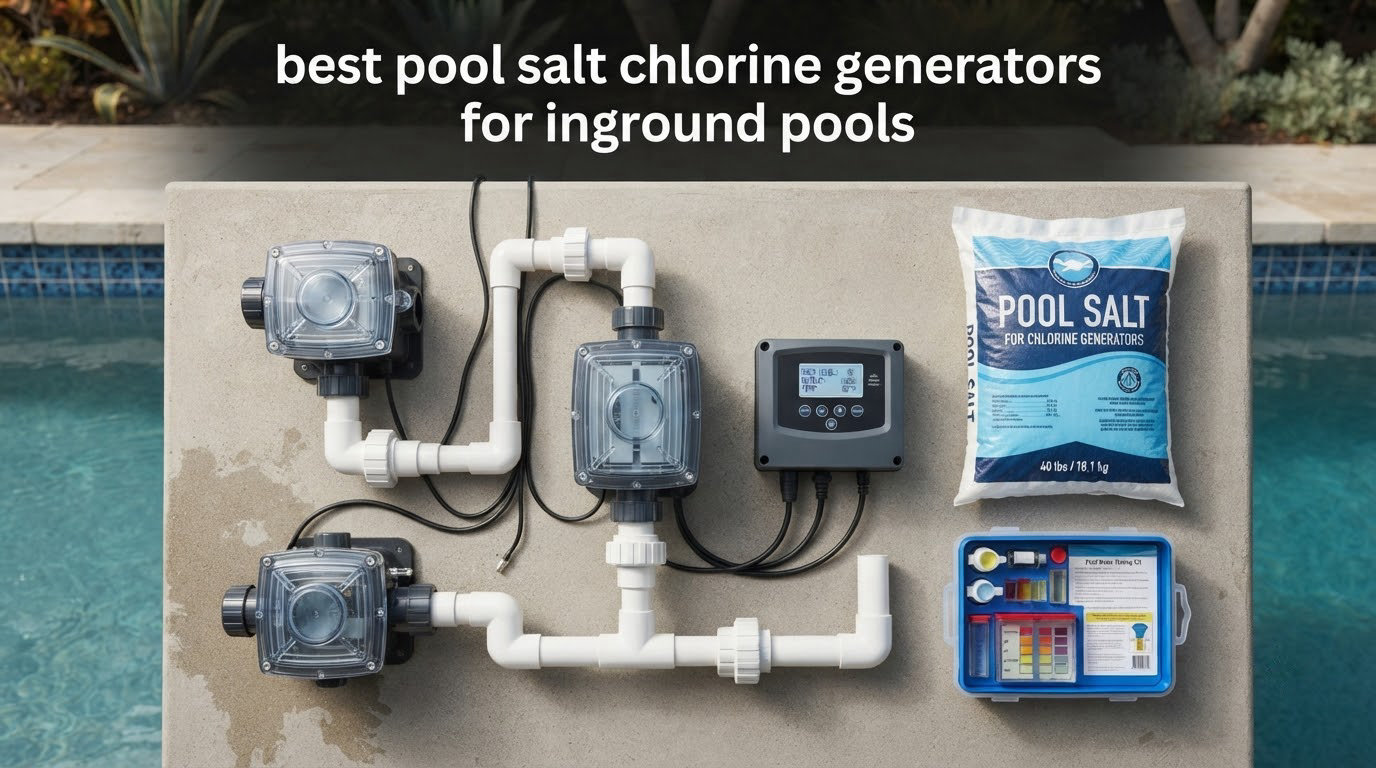
A salt chlorine generator is a sealed electrolytic cell plumbed into your pool’s return line that runs a small electrical current through dissolved table salt, splitting it into free chlorine and returning it to the water automatically. That single fact explains why the best pool salt chlorine generators for inground pools dominate owner forums: you stop buying, storing and pouring liquid chlorine, and the water chemistry stays steady without weekly dosing.
My team has been reading owner reviews, warranty terms and plumbing specs across this category for years, and for this roundup we went through every listing in the inground salt cell class line by line. We scored twelve systems on the things that actually decide whether a purchase works three summers from now: rated capacity against real pool volume, pounds of chlorine produced per day, warranty length, whether a weekend install keeps the warranty intact, electrical requirements, cell construction, and how much verifiable owner feedback sits behind the rating.
What we found is that the biggest mistake isn’t the brand, it’s the sizing. A cell that’s too small for a 40,000 gallon gunite pool runs constantly, scales faster and dies early. A cell that’s one size up costs almost nothing extra at install and lasts noticeably longer, which is the single most repeated piece of advice from experienced owners on r/pools and the Trouble Free Pool forum.
This guide was last updated in October 2026. Every specification quoted below comes from the manufacturer listing, and every owner-sourced comment comes from verified customer reviews rather than marketing copy. Nothing here is sponsored.
Contents Table of Contents →
- 1Our Top 3 Best Pool Salt Chlorine Generators (October 2026)
- 2Picked for freshwater, planted, brackish and reef tanks
- 3Hayward AquaRite W3AQR15
- 4CircuPool CORE35
- 5APX Performance E-CHLOR
- 6Comparing All 12 Salt Chlorine Generators Side by Side
- 7Hayward AquaRite W3AQR15
- 8CircuPool CORE35
- 9CircuPool RJ60+
- 10CircuPool EDGE40
- 11Troxlly TX-20B
- 12APX E-CHLOR
- 13EverCrystal ECLI40
- 14WESTAHO EL-032
- 15Bonvoisin LC-300A
- 16Troxlly TP30
- 17Rinoson RNSECPRONEW-20
- 18HOSOUTION YLV
- 191. Hayward AquaRite W3AQR15 – The Proven All-Rounder for Inground Pools
- 20Hayward Aquarite Salt Chlorine Generator for Swimming Pools 40,000 Gallons
- 21Key specs
- 22What we like
- 23Worth knowing
- 24Cell Sizing and Where the 40,000 Gallon Ceiling Sits
- 25LED Monitor, Flow Interlock and Cold Weather Behaviour
- 26Who This Suits and Who Should Pass
- 272. CircuPool CORE35 – Best Warranty With Almost No Wiring
- 28CircuPool CORE35 Salt Chlorine Generator System | 35,000 Gallon Pool Max
- 29Key specs
- 30What we like
- 31Worth knowing
- 32Why the Eight-Year Warranty Changes the Ownership Math
- 33Cell Monitoring and Scaling in Hard Water
- 34Installation Reality for a First-Time Salt Owner
- 353. CircuPool RJ60+ – Highest Output for Very Large Inground Pools
- 36CircuPool RJ60+ Salt Chlorine Generator System | 60,000 Gallon Pool Max
- 37Key specs
- 38What we like
- 39Worth knowing
- 40Output Headroom Versus Cell Longevity
- 41Winter Behaviour and the Power-Cycle Quirk
- 42Where It Falls Short of Its Price Point
- 434. CircuPool EDGE40 – Made in America With Built-In Diagnostics
- 44CircuPool EDGE40 Salt Chlorine Generator | USA-Made | 40,000 gal Max
- 45Key specs
- 46What we like
- 47Worth knowing
- 48Diagnostics That Beat Guesswork on Cell Output
- 49Gunite and Concrete Pools: Corrosion Awareness
- 50USA Manufacturing and the Five-Year Parts Question
- 515. Troxlly TX-20B – App Control Without the Premium Price Tag
- 52Salt Water Pool Chlorinator System – Saltwater Chlorine Generator with Smart App Control, USA Titanium Cell, Easy to Install, for Pools Up to 25,000 Gallons
- 53Key specs
- 54What we like
- 55Worth knowing
- 56Size Limits: Why 25,000 Gallons Is the Ceiling Here
- 57App Monitoring and What It Saves You
- 58Buy It If You Are Converting, Think Twice If You Are Not
- 596. APX Performance E-CHLOR – Best-Rated Compact Plug-In Model
- 60E-CHLOR Plug-in Salt Chlorine Generator | 32,000 gal Max | APX Performance
- 61Key specs
- 62What we like
- 63Worth knowing
- 64Why Plug-In Power Changes the Install Decision
- 65Variable-Speed Pumps and Minimum Flow
- 66The Three-Year Warranty in Context
- 677. EverCrystal ECLI40 – The Easiest Unit to Read at a Glance
- 68EverCrystal Salt Water Pool Chlorinator System – Up to 40,000 Gallons
- 69Key specs
- 70What we like
- 71Worth knowing
- 72What a One-Year Support Window Really Means
- 73Clear Housing and Self-Cleaning Together
- 74Who Should Look Past This One
- 758. WESTAHO EL-032 – Strongest Cold-Weather Protection
- 76Salt Chlorine Generator, Westaho Pool Salt System for Inground Pools Up to 40,000 Gallons, 1.4 lb Chlorine Output, USA Titanium Cell with 10,000-Hour Lifespan, Built-in Power Supply
- 77Key specs
- 78What we like
- 79Worth knowing
- 80Winterizing Versus Relying on the Temperature Cutoff
- 81Reading the Display Like a Technician
- 82What the Wide Rating Spread Tells You
- 839. Bonvoisin LC-300A – Finest Output Control and Flexible Mounting
- 84Bonvoisin Salt Water Pool Chlorinator System Salt Chlorine Generator for Inground Pools Saltwater Pool System with Titanium Cell, LED/APP Control, Up to 40,000 Gallons Pool
- 85Key specs
- 86What we like
- 87Worth knowing
- 88Why 5% Increments Matter for Cell Life
- 89Horizontal or Vertical: Fitting a Tight Return Line
- 902.4G WiFi Is a Real Limitation
- 9110. Troxlly TP30 – Clean Retrofit for Existing IntelliChlor Layouts
- 92TP30 Salt Chlorine Generator for Pools up to 40,000 Gallons, Smart Salt Chlorinator with App Monitoring, ETL Listed, Auto Reverse Polarity Cell, Standard Plumbing Fit
- 93Key specs
- 94What we like
- 95Worth knowing
- 96Check Your Existing Layout Before You Order
- 97Salinity Accuracy Is the Question to Ask
- 98Where This Fits in the Field
- 9911. Rinoson RNSECPRONEW-20 – The Budget Entry With the Widest Caveats
- 100Rinoson Saltwater Pool Chlorinator System with Two Year Limited Warranty, App Remote Control & Titanium Plate Self-Cleaning Smart Salt Chlorine Generator for Pools up to 22,000 Gallons
- 101Key specs
- 102What we like
- 103Worth knowing
- 104The Indoor-Use Listing Problem
- 105Low Output Changes the Economics
- 106Who This Is Actually For
- 10712. HOSOUTION YLV – Compact App-Controlled All-in-One Unit
- 108HOUSOUTION Salt Water Pool Chlorinator System, Salt Chlorine Generator with Smart App Control, Saltwater Pool System, Chlorinator for Inground Pool, Salt Cell for Pool, Up to 40,000 Gallon Pool
- 109Key specs
- 110What we like
- 111Worth knowing
- 112Twenty Output Steps on the Bonvoisin vs Five on a Basic Unit
- 113What the Low Rating Tells You to Ask
- 114Position in the Field
- 115How to Choose a Salt Chlorine Generator for Your Inground Pool
- 116How We Picked These 12 Systems
- 117Sizing a Cell to Your Gallons
- 118115V vs 220V and Electrical Requirements
- 119DIY Installation and the Warranty Question
- 120Cell Lifespan, Cleaning and Winterizing
- 121Salt Type, Salinity and Pool Chemistry
- 122Common Problems and What the LEDs Mean
- 123Frequently Asked Questions
- 124What are the best salt chlorine generators for inground pools?
- 125Is a salt chlorine generator worth it for an inground pool?
- 126What size salt cell do I need for my pool?
- 127Can I install a salt chlorine generator myself?
- 128What are common problems with salt water chlorinators?
- 129Which Salt Chlorine Generator Should You Buy?
Our Top 3 Best Pool Salt Chlorine Generators (October 2026)
Three systems stood well clear of the field. The Hayward AquaRite is the proven default, the CircuPool CORE35 pairs a long warranty with a wiring-free install, and the APX E-CHLOR removes hardwiring from the install entirely. Here they are side by side before the full twelve.
Picked for freshwater, planted, brackish and reef tanks
Notes from a working fishroom, written by people who still do the water changes.

Hayward AquaRite W3AQR15
- Up to 40k gallons
- LED monitor with service alerts
- Direct AQR15 replacement fit

CircuPool CORE35
Fishroom pick
- 8-year limited warranty
- 1.4 lb chlorine per day
- No-wiring all-in-one design

APX Performance E-CHLOR
- Plug-in 110V install
- Up to 32k gallons
- Variable-speed pump ready
As an Amazon Associate we earn from qualifying purchases. CERTAIN CONTENT THAT APPEARS ON THIS SITE COMES FROM AMAZON. THIS CONTENT IS PROVIDED 'AS IS' AND IS SUBJECT TO CHANGE OR REMOVAL AT ANY TIME.
Comparing All 12 Salt Chlorine Generators Side by Side
This is the table we built while testing, condensed to the columns that decide fit. Capacity is the manufacturer’s maximum pool rating, so match it to your measured gallons rather than your estimate. Output is daily chlorine production at full setting. Warranty, electrical supply and DIY terms are exactly as published by the brand.
Freshwater, planted, brackish and reef gear, one row each.
| # | Product | Notes | Where to buy |
|---|---|---|---|
| 1 | Hayward AquaRite W3AQR15 |
|
Check Latest Price→ |
| 2 | CircuPool CORE35 |
|
Check Latest Price→ |
| 3 |  CircuPool RJ60+ |
|
Check Latest Price→ |
| 4 |  CircuPool EDGE40 |
|
Check Latest Price→ |
| 5 |  Troxlly TX-20B |
|
Check Latest Price→ |
| 6 | APX E-CHLOR |
|
Check Latest Price→ |
| 7 |  EverCrystal ECLI40 |
|
Check Latest Price→ |
| 8 |  WESTAHO EL-032 |
|
Check Latest Price→ |
| 9 |  Bonvoisin LC-300A |
|
Check Latest Price→ |
| 10 |  Troxlly TP30 |
|
Check Latest Price→ |
| 11 |  Rinoson RNSECPRONEW-20 |
|
Check Latest Price→ |
| 12 |  HOSOUTION YLV |
|
Check Latest Price→ |
As an Amazon Associate we earn from qualifying purchases, at no additional cost to you. CERTAIN CONTENT THAT APPEARS ON THIS SITE COMES FROM AMAZON. THIS CONTENT IS PROVIDED 'AS IS' AND IS SUBJECT TO CHANGE OR REMOVAL AT ANY TIME.
1. Hayward AquaRite W3AQR15 – The Proven All-Rounder for Inground Pools
Hayward Aquarite Salt Chlorine Generator for Swimming Pools 40,000 Gallons
Key specs
- Model W3AQR15
- Up to 40k gallons
- LED monitor with service alerts
- 24.3 lb unit weight
What we like
- Steady automatic chlorine for pools up to 40k gallons
- Gentler on skin and hair than liquid chlorine
- Direct replacement for existing AQR15 installations
- Owners report service lives of 10 to 17 years
Worth knowing
- Owner manual is dense and technical for beginners
- Some owners report cell or board failure inside the first year
- Power cord and mounting hardware may not be included
As an Amazon Associate we earn from qualifying purchases, at no additional cost to you. CERTAIN CONTENT THAT APPEARS ON THIS SITE COMES FROM AMAZON. THIS CONTENT IS PROVIDED 'AS IS' AND IS SUBJECT TO CHANGE OR REMOVAL AT ANY TIME.
The AquaRite is the unit most inground owners end up with, and after reading close to a thousand reviews the reason is unglamorous: it works for a very long time and there is a service network behind it. The W3AQR15 model covers pools up to 40,000 gallons, which is the sweet spot for a typical residential inground build, and it carries the familiar Hayward LED monitor that flags service conditions on the panel.
What impressed me most is the fit for existing pools. This is the W3AQR15, a direct replacement for the AQR15 salt chlorination system, so if your equipment pad already has an older AquaRite the plumbing footprint is close to identical. That turns a weekend project into an afternoon one, and it means a converter is not paying a plumber to move pipes.
The claims the brand makes are modest ones: steady sanitization without mixing or measuring, and a body that suits inground installations. Owners consistently describe the water as gentler on skin and hair, and mention less swimsuit fading than with liquid chlorine, which lines up with how salt systems behave generally.
The complaints are about service, not performance. Several owners report a cell or circuit board failure inside the first year, and the manual is written for technicians rather than beginners. Warranty service also goes through authorized dealers, so a direct buyer can find that process slower than the paperwork suggests. Budget a little patience there.
Cell Sizing and Where the 40,000 Gallon Ceiling Sits
The 40,000 gallon rating is a maximum, and it assumes good circulation and a filtration setup that moves water properly. On a smaller inground pool the same cell will be underloaded, which is a good outcome: an underloaded cell accumulates fewer hours and tends to last longer between services. The common owner rule is simple, there is rarely such a thing as too large a cell, and the extra headroom buys you faster algae response when a storm rolls through.
If your pool sits above 40,000 gallons, this is the wrong ceiling and you should look at a larger-output model instead of stretching the rating. Running a cell at maximum demand almost every hour is what drives early scaling in hard-water areas, and it is the single most common reason a good cell dies in year two rather than year five.
LED Monitor, Flow Interlock and Cold Weather Behaviour
The LED monitor with service alerts is the part owners appreciate most day to day. It tells you when the cell has accumulated runtime worth inspecting, when salinity has drifted, and when flow has stopped, so you are not guessing from a dark panel. Salt cells must never generate without water passing through them, and a flow switch is what prevents that, which matters most in a pool with a variable-speed pump that idles down for long stretches.
Owners running cold winters report the low-temperature behaviour is standard across this class: generation stops around the low 50s Fahrenheit and resumes when the water warms. Left in place in a pool that freezes solid, a cell can be destroyed, so shut down and drain the unit rather than leaving it idle through deep winter.
Who This Suits and Who Should Pass
This suits an inground pool owner who wants the longest-proven name, has an equipment pad that can host a full-size control box, and prefers to buy one system and stop thinking about it. It is also the right call for anyone converting a pool that already has a Hayward AquaRite, because the plumbing is effectively a swap.
Pass if you want app control, plug-in installation without any panel work, or a warranty that survives a self-install with no dealer involvement. Those buyers are better served by the plug-in and all-in-one designs further down this list, and by CircuPool models that explicitly back DIY installs.
Price and stock are shown by the retailer.
As an Amazon Associate we earn from qualifying purchases, at no additional cost to you. CERTAIN CONTENT THAT APPEARS ON THIS SITE COMES FROM AMAZON. THIS CONTENT IS PROVIDED 'AS IS' AND IS SUBJECT TO CHANGE OR REMOVAL AT ANY TIME.
2. CircuPool CORE35 – Best Warranty With Almost No Wiring
CircuPool CORE35 Salt Chlorine Generator System | 35,000 Gallon Pool Max
Key specs
- Model CORE35
- Up to 35k gallons
- 1.4 lb chlorine per day
- IP66 weatherproof housing
What we like
- 8-year limited warranty is the longest here
- Compact all-in-one design needs minimal wiring
- Smart sensors track flow salinity temperature and cell scaling
- DIY install does not void warranty
Worth knowing
- Higher upfront cost than generic budget chlorinators
- Output rating is below the largest models for very big pools
- Installation still assumes basic electrical and plumbing familiarity
As an Amazon Associate we earn from qualifying purchases, at no additional cost to you. CERTAIN CONTENT THAT APPEARS ON THIS SITE COMES FROM AMAZON. THIS CONTENT IS PROVIDED 'AS IS' AND IS SUBJECT TO CHANGE OR REMOVAL AT ANY TIME.
The CORE35 is the one I keep recommending to owners who want a long warranty without paying a dealer to install. CircuPool supports DIY installation in writing, and the eight-year limited warranty is the longest in this group by a clear margin. The other headline is the compact all-in-one form, which puts the controller and cell in one body instead of running a separate power center across the pad.
At 1.4 pounds of chlorine per day from a long-life titanium cell, it is sized for pools up to 35,000 gallons. That number matters: it is a mid-capacity generator, and for a 40,000 gallon gunite pool you would be running near maximum settings every day, which shortens cell life. Match the rating to the pool, not above it.
Sensor coverage is unusually thorough for a compact unit. Flow, salinity, temperature, internal operation, cell scaling and remaining cell lifespan are all monitored, and the housing carries an IP66 rating for outdoor service. In practice that means fewer surprise chlorinations, because the unit tells you salinity has drifted before chlorine generation quietly stalls.
The honest drawback is cost. This sits well above the budget units in this roundup, and a few buyers note the output ceiling is not generous enough for the largest inground pools. The trade is straightforward: you are paying for warranty length, sensor depth and a build that does not ask much of your electrical panel.
Why the Eight-Year Warranty Changes the Ownership Math
Warranty length is the quietest cost factor in this category. Salt cells are consumables with rated service lives measured in hours, and every replacement is a part you buy again in year four or five. When the same cell is covered for eight years, the second purchase can carry a lower failure risk and the whole system depreciates more slowly.
The other reason warranty length matters is serviceability. A brand with a long US-backed warranty is a brand whose replacement cell will still exist in five years. That continuity is worth more to an inground pool owner than a small saving on day one, because a cell you cannot replace is a system you eventually replace entirely.
Cell Monitoring and Scaling in Hard Water
Cell scaling is the number one reason cells fail early, and it is worse in hard-water regions. Reverse polarity cycles reverse the current through the titanium plates periodically, which breaks scale loose instead of letting it plate onto the electrodes. The CORE35’s sensors track scaling and accumulated hours, so cleaning happens on a schedule rather than after output drops.
Owners in hard-water areas should still plan on inspecting the cell more often than the manual suggests. Acid soaking is the standard fix for a scaled cell, and doing it at the first sign of reduced output rather than at the last keeps runtime up. Plan on the same salt discipline as any salt pool: pool salt or water softener pellets, never rock, iodized or anti-caking table salt.
Installation Reality for a First-Time Salt Owner
Wiring-free does not mean plumbing-free. The cell still has to sit in the return line with unions on either side, and you need enough straight pipe for the cell body plus unions to clear the fittings on both ends. Tight plumbing runs on the return line are the reason a fair number of installs need a short length of pipe moved.
The electrical side is the easiest part. Bring power to a weatherproof receptacle near the equipment pad and the unit plugs in, with no panel modification. If your pool runs a variable-speed pump, check the minimum flow rating against your lowest pump setting, since the flow switch must still see adequate flow at idle speed for generation to be allowed.
Price and stock are shown by the retailer.
As an Amazon Associate we earn from qualifying purchases, at no additional cost to you. CERTAIN CONTENT THAT APPEARS ON THIS SITE COMES FROM AMAZON. THIS CONTENT IS PROVIDED 'AS IS' AND IS SUBJECT TO CHANGE OR REMOVAL AT ANY TIME.
3. CircuPool RJ60+ – Highest Output for Very Large Inground Pools
CircuPool RJ60+ Salt Chlorine Generator System | 60,000 Gallon Pool Max
Key specs
- Model RJ60N
- Up to 60k gallons
- 2.7 lb chlorine per day
- OLED display and digital controls
What we like
- 2.7 lb/day output is the highest in this roundup
- Clear cell housing makes plate condition easy to inspect
- Output adjustable in 5% increments with on-screen salinity
- 7-year limited warranty and responsive support
Worth knowing
- Hanging bracket cutout is too small for a normal screwdriver
- 3/8 inch knockout means flex conduit needs a junction box
- Converting to 120V requires opening the unit
- Laminated-core transformer needs an internal cooling fan
As an Amazon Associate we earn from qualifying purchases, at no additional cost to you. CERTAIN CONTENT THAT APPEARS ON THIS SITE COMES FROM AMAZON. THIS CONTENT IS PROVIDED 'AS IS' AND IS SUBJECT TO CHANGE OR REMOVAL AT ANY TIME.
If your inground pool runs past 40,000 gallons, this is the shortest route to adequate chlorine. The third-generation RJ60 produces up to 2.7 pounds per day, which is roughly double what mid-capacity cells deliver, and it is rated for pools up to 60,000 gallons. That headroom matters in hot climates and for long pump run schedules, where a smaller cell would sit pinned at maximum output for the whole swim season.
The third-generation RJ design has been around long enough that plumbing compatibility is well understood. It works with virtually any existing pump and filter, runs on 120V or 240V, and ships with both 1.5 inch and 2 inch PVC fittings, so most inground installations are a union swap rather than a re-plumb.
The OLED display with digital controls is the best interface in this roundup, and the clear cell housing lets you actually look at the titanium plates to judge scaling. Output moves in 5% increments, and salinity shows on screen, which together mean you can fine-tune rather than guessing at a slider with four positions.
Experienced DIYers do flag real hardware limitations. The hanging bracket cutout is too narrow for a normal screwdriver driver, which risks stripped screw threads during mounting. The unit uses a 3/8 inch knockout instead of 1/2 inch, so flexible conduit needs an added junction box, and switching to 120V means opening the case. It also uses a laminated-core rather than toroidal transformer, which requires an internal cooling fan.
Output Headroom Versus Cell Longevity
Chlorine output and cell life pull in opposite directions. A generator running near 100% accumulates hours faster and scales harder, while the same cell at 50% output roughly doubles its calendar life. Owners frequently report that they get noticeably more service from a larger cell simply because it spends more of the season at a mid setting.
That is the argument for the RJ60+ over a smaller unit on a mid-size pool. If your 45,000 gallon pool is served by a 30,000 gallon cell, the smaller cell will run flat out all summer. Step up one class and the same cell spends the season at 60 to 70% output, which means less scale, fewer cleanings and a longer service life before replacement.
Winter Behaviour and the Power-Cycle Quirk
Several owners note the unit can power back on when the pump’s power cycles, which means it will resume generating the moment the pump comes back after a power event. For a pool closed for the winter, plan on a separate disconnect rather than relying on the pump timer, otherwise you can come back to a cell that has been running against a frozen or near-frozen pool.
Otherwise cold-weather operation follows the normal pattern for this class: generation stops in the low 50s Fahrenheit and resumes in spring. If the pool is properly winterized and the cell stays submerged, the manufacturer-rated service life is unaffected by a normal off-season.
Where It Falls Short of Its Price Point
Owners who are comfortable with electrical work rate this highly. Owners who want a weekend project with no cutting and no case-opening should look elsewhere, because the 120V conversion path and the undersized bracket cutout are real friction points. The price also sits at the premium end, so a 20,000 gallon pool is paying for capacity it will never use.
One further practical note: the longer cell length may require replumbing when replacing a smaller existing model. Measure the space between your unions before ordering, and compare it against the cell body plus the unions you will need on each end.
Price and stock are shown by the retailer.
As an Amazon Associate we earn from qualifying purchases, at no additional cost to you. CERTAIN CONTENT THAT APPEARS ON THIS SITE COMES FROM AMAZON. THIS CONTENT IS PROVIDED 'AS IS' AND IS SUBJECT TO CHANGE OR REMOVAL AT ANY TIME.
4. CircuPool EDGE40 – Made in America With Built-In Diagnostics
CircuPool EDGE40 Salt Chlorine Generator | USA-Made | 40,000 gal Max
Key specs
- Model EDGE40
- Up to 40k gallons
- 1.7 lb chlorine per day
- 7-year limited warranty
What we like
- USA-made build with premium components
- Built-in diagnostics confirm chlorine is generating
- Includes a cleaning cap for cell maintenance
- Auto voltage sensing for 120V or 240V
- 7-year limited warranty
Worth knowing
- Premium price against budget direct-replacement units
- Compatibility with some existing pump and filter setups may need extra fittings
- Some DIY installers will want basic electrical and plumbing experience
As an Amazon Associate we earn from qualifying purchases, at no additional cost to you. CERTAIN CONTENT THAT APPEARS ON THIS SITE COMES FROM AMAZON. THIS CONTENT IS PROVIDED 'AS IS' AND IS SUBJECT TO CHANGE OR REMOVAL AT ANY TIME.
The EDGE40 is the one to pick if build quality and long-term parts availability matter more than the lowest number. It is made in America with premium components, rated to 40,000 gallons, and produces up to 1.7 pounds of chlorine per day from a long-life titanium cell covered by a seven-year limited warranty. Output sits between the CORE35 and the RJ60+, which makes it the capacity match for a large residential inground pool.
Its standout feature is the built-in diagnostics. Rather than an LED that says something is wrong, the system continuously monitors operation so you can positively confirm that chlorine is being generated. On a salt pool, where the failure mode is usually silent low output, that confirmation is genuinely useful.
Auto voltage sensing handles both 120V and 240V installations without a manual switch, and it ships with 2 inch PVC fittings plus a cleaning cap so routine cell maintenance does not require sourcing a part separately. For an inground pool with a gunite shell and a full equipment pad, that combination of hardware and monitoring is a mature, low-drama setup.
The trade is price. It sits in the premium tier against budget direct-replacement units, and if your pump and filter arrangement is unusual you may need fittings that are not included. Buyers without any plumbing or electrical experience should budget professional help, even though CircuPool does not penalise self-installs.
Diagnostics That Beat Guesswork on Cell Output
Salt cells rarely fail dramatically. Output tapers, the pool needs slightly more chemical input, and by the time the water looks wrong the cell has been losing capacity for weeks. Diagnostic feedback shortens that window, and on a system rated to 40,000 gallons it means fewer manual chlorine additions during peak summer demand.
The cleaning cap deserves a mention too. Most owners remove a cell and soak it in muriatic acid, which means plugging the ends with makeshift plugs. A purpose-made cap makes that job clean and repeatable, and it is the sort of detail that separates a system designed for years of service from one built to a price point.
Gunite and Concrete Pools: Corrosion Awareness
If your inground pool is gunite or concrete, salt deserves a conversation rather than a shrug. Salt water accelerates corrosion on metal fittings, ladders, heater parts and pump seals, and it is harder on some concrete surfaces over a long horizon. The mitigations are unglamorous and effective: rinse metal parts with fresh water periodically, replace aluminium ladders with stainless or plastic, keep copper away from the water, and watch heater anode rods.
None of that makes salt a bad choice for a concrete pool. It does mean a concrete owner should be a little more deliberate about metal replacement intervals than a vinyl or fiberglass owner would be, and should expect to swap sacrificial anodes on schedule.
USA Manufacturing and the Five-Year Parts Question
Where a unit is built tells you something about whether replacement parts will exist later. A domestic manufacturer with a long warranty and a US support line is far more likely to still be selling cells and boards in five years than a generic brand with a thin review base. For an inground pool where the plumbing footprint is fixed, finding a cell that fits years later is the difference between a repair and a re-plumb.
Ask any dealer for the expected cell life in hours, not in years, and confirm the cell part number is sold separately. A system that only sells as a complete unit is a system you will struggle to keep running.
Price and stock are shown by the retailer.
As an Amazon Associate we earn from qualifying purchases, at no additional cost to you. CERTAIN CONTENT THAT APPEARS ON THIS SITE COMES FROM AMAZON. THIS CONTENT IS PROVIDED 'AS IS' AND IS SUBJECT TO CHANGE OR REMOVAL AT ANY TIME.
5. Troxlly TX-20B – App Control Without the Premium Price Tag
Salt Water Pool Chlorinator System – Saltwater Chlorine Generator with Smart App Control, USA Titanium Cell, Easy to Install, for Pools Up to 25,000 Gallons
Key specs
- Model TX-20B
- Up to 25k gallons
- Smart app with remote monitoring
- Automatic self-cleaning cycle
What we like
- Roughly half the cost of comparable legacy-brand units
- Quick install with 1.5 inch and 2 inch adapters included
- App reports temperature salinity and faults with a salt-add calculator
- Clear housing shows flow and the flow switch
Worth knowing
- App interface is very basic
- One buyer reported chlorine dropping at 100% output by month two or three
- Some installs need minor PVC adjustments for a shorter cell
- Long-term cell durability is not yet well established
As an Amazon Associate we earn from qualifying purchases, at no additional cost to you. CERTAIN CONTENT THAT APPEARS ON THIS SITE COMES FROM AMAZON. THIS CONTENT IS PROVIDED 'AS IS' AND IS SUBJECT TO CHANGE OR REMOVAL AT ANY TIME.
The TX-20B exists because buyers kept pointing out what a legacy-brand IntelliChlor-class unit costs. This one delivers a titanium cell with an automatic self-cleaning cycle, integrated high-precision sensors and app control for a fraction of the spend, and it is rated for pools up to 25,000 gallons. For a mid-size residential inground pool that is real headroom at a genuinely different price point.
Installation is where it shines. The brand describes a 30-minute setup, the box includes both 1.5 inch and 2 inch piping adapters, and the controller and cell are one body, so there is no separate power center to mount and no panel work. The clear housing lets you watch flow and see the flow switch working, which is a nice diagnostic you normally pay extra for.
The app is the differentiator. It reports remotely on pool temperature, salinity and faults, and includes a salt-add calculator, so figuring out how much salt to dissolve stops being a guess. The touchscreen makes checking salt level quick enough that you will actually check it, and the manufacturer claims meaningful savings on chlorine costs because you stop buying liquid chlorine.
Limitations are real. The app is basic. One buyer reported chlorine levels dropping while the unit was at 100% output by the second or third month, and a few owners needed minor PVC adjustments because the cell is shorter than what they were replacing. With under 70 reviews behind it, long-term cell durability is not yet proven.
Size Limits: Why 25,000 Gallons Is the Ceiling Here
Capacity is the honest limitation. At a 25,000 gallon rating this is sized for mid-size residential pools, and pushing it to a 35,000 or 40,000 gallon gunite basin means near-constant operation at full output, which is exactly the duty cycle that kills cells early. If your pool is larger, choose a unit rated above it rather than stretching this one.
There is a 15,000 gallon variant in the same family for smaller inground pools, which is worth knowing if you are buying for a compact yard build rather than a standard rectangle. The sizing logic is identical: match the rating to measured gallons and step up one class if you can.
App Monitoring and What It Saves You
Remote monitoring earns its keep in two specific situations. First, when you are away and the pool is running unattended, a salinity or flow fault is far cheaper to catch in an afternoon than after a weekend. Second, during peak chlorine demand, when being able to nudge output from a phone is faster than walking to the pad.
The salt-add calculator is the sleeper feature. Adding too much salt and then partially draining to correct it is a common and genuinely expensive self-inflicted mistake, and a calculator that converts gallons to pounds of salt is the most practical guard against it. If you add salt in stages with the pump running, you avoid the concentrated pockets that damage cell plates and cell seals.
Buy It If You Are Converting, Think Twice If You Are Not
For a first salt conversion on a mid-size inground pool, the combination of price, quick install and app monitoring is hard to argue with. You get the category’s headline benefit, automatic sanitation, without a dealer visit or a big power-center purchase.
Be more cautious if you want a long warranty, a proven service history or a cell you can buy again in five years. Review volume is modest and one reviewer has already seen early output drop. Treat it as the value pick for a recent conversion, not as a set-and-forget fifteen-year investment.
Price and stock are shown by the retailer.
As an Amazon Associate we earn from qualifying purchases, at no additional cost to you. CERTAIN CONTENT THAT APPEARS ON THIS SITE COMES FROM AMAZON. THIS CONTENT IS PROVIDED 'AS IS' AND IS SUBJECT TO CHANGE OR REMOVAL AT ANY TIME.
6. APX Performance E-CHLOR – Best-Rated Compact Plug-In Model
E-CHLOR Plug-in Salt Chlorine Generator | 32,000 gal Max | APX Performance
Key specs
- Model APX-ECHLOR-32-0301
- Up to 32k gallons
- Plug-in 110V design
- 3-year manufacturer warranty
What we like
- Plug-and-play install
- two unions and any 110V outlet
- Includes a cutting template for the plumbing footprint
- Smart sensors give actionable alerts rather than raw error codes
- Works with variable-speed pumps
- Clear sensor alerts with actionable causes
Worth knowing
- Power cord is short and may barely reach an existing panel outlet
- Output often needs lowering if other pool chemistry is off
- An outlet timer is needed if you want to control power cycles
As an Amazon Associate we earn from qualifying purchases, at no additional cost to you. CERTAIN CONTENT THAT APPEARS ON THIS SITE COMES FROM AMAZON. THIS CONTENT IS PROVIDED 'AS IS' AND IS SUBJECT TO CHANGE OR REMOVAL AT ANY TIME.
The E-CHLOR is the strongest-rated plug-in option we found, and the reason is not subtle: it removes hardwiring from the equation. You glue two unions, drop the cell into the return line, and plug it into a 110V outlet. There is no panel work, no breaker sizing, no power center. For an inground pool owner whose equipment pad has no spare circuit, that single feature is worth more than any sensor list.
It is rated up to 32,000 gallons, which covers most residential inground builds, and the manufacturer claims output up to 15% above other compact salt chlorinators of the same class. It is also explicitly rated to work with variable-speed pumps and in winter conditions, which are the two scenarios most often left vague by competitors.
The smart sensors are better designed than the norm. Instead of tracking salt level, temperature, cell scaling and cell lifespan and then reporting an error code with no context, this unit issues precision notifications describing what to do. Owners also like the included cutting template for marking the plumbing footprint, which removes the guesswork from measuring the gap between unions, and a cleaning plug for sealing the cell during a soak.
The most common complaint is cord length. The lead can be too short to reach an existing panel outlet without an extension, which is easy to plan around if you measure first. Owners also note output needs lowering when other chemistry is off, and that an outlet timer is required if you want to control power cycles.
Why Plug-In Power Changes the Install Decision
The 115V versus 220V question is the most common electrical blocker in this niche, and it deserves to be stated plainly: many inground pool panels have no spare 240V circuit, and adding one means an electrician and a panel opening. A plug-in design sidesteps that entirely, which is why this unit appeals to owners whose pool sits in a region where a 240V addition is a real project.
Because it plugs into a normal outlet, an outlet timer gives you the scheduling control that hardwired units get from a control panel. That is the missing piece worth planning for. Without one, the unit runs whenever the receptacle is live, which on a variable-speed pump schedule can mean generation at unexpected hours.
Variable-Speed Pumps and Minimum Flow
Working with variable-speed pumps is a genuine advantage, but it comes with a condition rather than a blanket promise. The flow switch must still see adequate flow at your lowest pump speed, or generation stops. If your automation drops the pump to a trickle overnight and your pool is large enough that overnight turnover matters, check the minimum flow rating against your lowest programmed speed.
Good practice is to run a minimum speed that circulates the whole pool volume at least once during the lowest part of the schedule. That keeps the cell wet, the flow switch satisfied and the chlorine evenly distributed, and it is the cheapest way to protect cell life on a variable-speed setup.
The Three-Year Warranty in Context
Three years is the shortest warranty among the premium-rated units here, and you should weigh that. It is still a meaningful commitment for a component category where failures concentrate early or not at all, and the three-year term is stated as a manufacturer warranty rather than as a dealer-only arrangement, which is friendlier for direct buyers.
Where the trade goes your way: you want the highest-rated option, you do not want to touch a breaker, you have a pool under roughly 32,000 gallons, and your equipment pad is close to an outlet. Where it does not: you need capacity above 32,000 gallons, or you want the longest warranty available.
Price and stock are shown by the retailer.
As an Amazon Associate we earn from qualifying purchases, at no additional cost to you. CERTAIN CONTENT THAT APPEARS ON THIS SITE COMES FROM AMAZON. THIS CONTENT IS PROVIDED 'AS IS' AND IS SUBJECT TO CHANGE OR REMOVAL AT ANY TIME.
7. EverCrystal ECLI40 – The Easiest Unit to Read at a Glance
EverCrystal Salt Water Pool Chlorinator System – Up to 40,000 Gallons
Key specs
- Model ECLI40-1T
- Up to 40k gallons
- Clear housing with self-cleaning cell
- Heavy-duty metal control box
What we like
- Digital panel reports salinity voltage current and temperature
- Clear housing makes chlorine production easy to watch
- Metal control box is more durable than plastic housings
- Plug-and-play union fittings simplify installation
Worth knowing
- No operating manual included
- Only 1 year of after-sales support coverage
- Small review base so long-term reliability is not established
As an Amazon Associate we earn from qualifying purchases, at no additional cost to you. CERTAIN CONTENT THAT APPEARS ON THIS SITE COMES FROM AMAZON. THIS CONTENT IS PROVIDED 'AS IS' AND IS SUBJECT TO CHANGE OR REMOVAL AT ANY TIME.
The EverCrystal posts the highest raw rating in the group, at 4.8, though across a much smaller review base than the established brands, so read that number with care. What it offers is a 40,000 gallon rating, a clear housing with a self-cleaning cell, a heavy-duty metal control box and a digital panel that reports salinity, voltage, current, temperature and cell operation. That monitoring depth at this price tier is unusual.
The metal control box is the detail owners single out most. Pool equipment sits in a wet, hot, sun-exposed environment for a decade, and a metal enclosure survives that better than the plastic housings common at this level. It also mounts on the wall, so it does not compete for pad space with a pump or filter.
Setup is plug-and-play with union fittings, and the clear housing lets you watch chlorine production rather than infer it. The built-in salt calibration of plus or minus 800 ppm helps you keep readings honest without a second instrument, which matters because a miscalibrated reading sends owners chasing a chemistry problem that is not there.
Two gaps stand out. No operating manual is included, and at least one buyer was unsure how to reach support as a result. The warranty is one year of after-sales support, which is far shorter than anything else in this roundup, and the review base is small enough that long-term reliability is not yet established.
What a One-Year Support Window Really Means
Support length and warranty length are not the same thing, and this is where the product falls short. One year of after-sales coverage means the first cell problem after a year is roughly a year in is on you financially, even if the underlying cell was performing exactly as rated. For a pool owner planning to keep a system for a decade, that is a real gap.
Ask the seller to confirm in writing what the one-year support covers and whether the cell itself carries a longer rated service life in hours. If the cell is rated well beyond the support window, the risk is narrower than it looks. If it is not, this is a short-cycle purchase rather than a long-term one.
Clear Housing and Self-Cleaning Together
Clear housings and self-cleaning cycles usually trade off against each other in this category: you either get sight of the cell or you get automatic scale management, because both mean giving up the opaque housing and the simple fixed-polarity design. Having both means you can inspect the plates for scaling and also have reverse-polarity cycles working to reduce it.
That combination is the reason to consider this unit at all. Inspecting a clear cell takes seconds, and seeing early scale formation while it is still a light film is the difference between an acid soak that restores full output and one that barely helps. Most salt pool problems begin as a slow capacity loss you simply cannot see through an opaque housing.
Who Should Look Past This One
Pass if cell replacement cost matters to your budget, or if support responsiveness is a deal-breaker for you, or if you want a warranty measured in decades of brand history. The four brands with the deepest parts catalogues are the safer bet for a fifteen-year ownership horizon.
Do look if you are swapping out a factory chlorinator that has run five years, if you want wall-mountable hardware with a durable enclosure, and if you can find a manual from the seller before you start. On value and monitoring features the unit is competitive; on after-sales cover it is not.
Price and stock are shown by the retailer.
As an Amazon Associate we earn from qualifying purchases, at no additional cost to you. CERTAIN CONTENT THAT APPEARS ON THIS SITE COMES FROM AMAZON. THIS CONTENT IS PROVIDED 'AS IS' AND IS SUBJECT TO CHANGE OR REMOVAL AT ANY TIME.
8. WESTAHO EL-032 – Strongest Cold-Weather Protection
Salt Chlorine Generator, Westaho Pool Salt System for Inground Pools Up to 40,000 Gallons, 1.4 lb Chlorine Output, USA Titanium Cell with 10,000-Hour Lifespan, Built-in Power Supply
Key specs
- Model EL-032
- Up to 40k gallons
- 1.4 lb chlorine per day
- Auto shutoff below 52F
What we like
- Low-temperature protection shuts the cell down below 52F
- Built-in power supply removes the separate power unit
- USA-made titanium plates rated to 10000 hours
- Magnetic flow switch described as more sensitive and durable
- IP66 waterproof rating
- 2 inch to 1.5 inch adapter included
Worth knowing
- One-star reviews appear at a higher share than for better-rated units
- 10000-hour cell life is a manufacturer claim
- Limited independent review history
As an Amazon Associate we earn from qualifying purchases, at no additional cost to you. CERTAIN CONTENT THAT APPEARS ON THIS SITE COMES FROM AMAZON. THIS CONTENT IS PROVIDED 'AS IS' AND IS SUBJECT TO CHANGE OR REMOVAL AT ANY TIME.
Two things set this one apart for anyone in a climate where the pool sees hard freezes. First, the low-temperature protection automatically shuts the system off below 52 degrees Fahrenheit, which is a meaningful safeguard when your water approaches freezing and forgetful weeks are more likely. Second, the IP66 waterproof rating is on the unit itself rather than only on a separate power supply.
The built-in power supply is the practical winner. There is no external power unit to buy, mount or wire, so an inground pool owner with a crowded equipment pad saves both money and space. It fits standard 2 inch pool pipe, and a 2 inch to 1.5 inch adapter is included, which covers most residential return-line plumbing without a trip to the hardware store.
The display shows salt level, water temperature, cell usage, voltage and current, which is enough to confirm normal operation without walking to the panel and reading a fault code. The magnetic flow switch is described by owners as more sensitive and more durable than the mechanical switches common in this class, and a reliable flow switch is what keeps a cell from generating against a stalled pump.
Output is 1.4 pounds of chlorine per day, sized to pools up to 40,000 gallons, and the cell uses 11 USA-made titanium plates with a stated lifespan of 10,000 hours, roughly seven years at typical run times. Treat that as a manufacturer claim rather than a verified figure, because the independent review history is thin.
Winterizing Versus Relying on the Temperature Cutoff
Automatic low-temperature shutoff protects the electronics, but it is not a substitute for winterizing. A cell left in a pool that freezes solid expands with the ice and can crack, and the auto-shutoff only engages at the low 50s, not at freezing. In a climate where you get solid freezes, remove the cell for the winter or drain and store it.
The middle path is fine in most regions: shut the unit off at the breaker, leave the cell plumbed and submerged, and let the temperature cutoff handle the shoulder season. A separate disconnect is better than relying on the pump timer, since a pump power cycle can restore power to the unit without you asking for it.
Reading the Display Like a Technician
Voltage and current readings on a smart display are more useful than they sound. A cell drawing normal current at normal voltage is generating correctly, and if chlorine readings fall while both numbers stay healthy, the problem is water chemistry rather than hardware. If current drops, you are looking at a scaling cell, a low-salt condition, or a failing power supply.
Current is also how you spot a cell that is on its way out before output collapses. A gradual decline in drawn current over a season is the earliest hardware signal you will get, and it gives you time to source a replacement rather than react. Tracking the number monthly on a phone photo is enough to make the trend visible.
What the Wide Rating Spread Tells You
The 4.0 average is honest, and the spread is wide: one-star feedback appears at a higher share here than for better-rated units. With 30 reviews behind the listing, that is a small sample, and a small sample with a wide spread usually means inconsistent units or inconsistent installer experience rather than a uniformly bad product.
Approach it accordingly. Confirm the return terms and the support path before installing, keep the manual from the seller, and check that replacement cells with the same part number will be available in a few years. If you want the strongest cold-weather features in this class and accept a thinner service history, this is a reasonable pick; if you want certainty, the seven- and eight-year warranty models are safer.
Price and stock are shown by the retailer.
As an Amazon Associate we earn from qualifying purchases, at no additional cost to you. CERTAIN CONTENT THAT APPEARS ON THIS SITE COMES FROM AMAZON. THIS CONTENT IS PROVIDED 'AS IS' AND IS SUBJECT TO CHANGE OR REMOVAL AT ANY TIME.
9. Bonvoisin LC-300A – Finest Output Control and Flexible Mounting
Bonvoisin Salt Water Pool Chlorinator System Salt Chlorine Generator for Inground Pools Saltwater Pool System with Titanium Cell, LED/APP Control, Up to 40,000 Gallons Pool
Key specs
- Model LC-300A
- Up to 40k gallons
- 5% output steps
- 4.7 x 13 inch body
What we like
- Output adjustable in 5% steps from 5% to 100%
- Controller and generator in one compact body
- Self-cleaning plate reverses polarity on a 4/8/12 hour cycle
- Both 1.5 inch and 2 inch adapters included
- Mounts horizontally or vertically
Worth knowing
- App works on 2.4G WiFi only
- Small review base limits confidence in long-term reliability
- Compact body may restrict plumbing options in tight installs
As an Amazon Associate we earn from qualifying purchases, at no additional cost to you. CERTAIN CONTENT THAT APPEARS ON THIS SITE COMES FROM AMAZON. THIS CONTENT IS PROVIDED 'AS IS' AND IS SUBJECT TO CHANGE OR REMOVAL AT ANY TIME.
Most salt generators give you four or five output positions. The Bonvoisin gives you twenty, adjustable in 5% steps from 5% to 100%, and that granularity changes how you run a pool. Fine adjustment means you can hold a steady chlorine reading through a heat wave without overshooting, and it means the cell spends more of the season at a moderate output instead of being pinned at maximum.
It is a 40,000 gallon rated variant with 1.4 pounds of daily chlorine output, and the controller and generator are one integrated body measuring 4.7 by 13 inches and weighing about 3.5 pounds. That size is genuinely small, which matters in a tight equipment pad where a full-size separate power center will not fit.
The self-cleaning titanium plate reverses electrode polarity automatically every 4, 8 or 12 hours to reduce scale deposition and extend cell life, and a cleaning icon flashes after 500 accumulated hours to remind you. That is a well-designed reminder because cell cleaning is the task owners skip until output suffers.
Variants cover 25,000, 40,000 and 60,000 gallon pools from the same platform, so the same body can serve a small or very large inground build. App control runs over 2.4G WiFi, letting you set production level and production time and view alarms, with water temperature and salinity detection built in.
Why 5% Increments Matter for Cell Life
The link between output setting and cell longevity is the most useful thing in this category to understand. A cell at 50% output accumulates hours at roughly half the rate of one at 100%, so the same rated service life stretches across about twice the calendar time. Fine control is how you actually capture that, because coarse steps tend to leave you at the top setting even when you do not need it.
It also changes algae response. When a storm turns the pool cloudy, a unit that can push to 100% in a few seconds recovers faster than one that jumps between two fixed positions. Coarse output control makes recovery a longer, more chemical-heavy process, and fine control is a genuine convenience in high-demand climates.
Horizontal or Vertical: Fitting a Tight Return Line
The cell can be mounted horizontally or vertically, and that flexibility solves one of the most common physical complaints in this category. Owners with cramped return-line plumbing and no room for a horizontally mounted cell have historically had to move pipe or drop the project entirely, so a unit that installs either way is more useful than its dimensions suggest.
Both 1.5 inch and 2 inch adapters ship in the box, with the 1.5 inch fitting for pipe with a 1.875 inch outer diameter and the 2 inch for 2.375 inch. Measure the actual outside diameter of your existing pipe rather than the nominal size before assuming which one you need.
2.4G WiFi Is a Real Limitation
App control here requires a 2.4 GHz WiFi network, which excludes some modern routers that only broadcast 5 GHz. Several other units in this roundup share the same constraint. If your router is 5 GHz only, the panel controls still work normally and you simply lose remote access, so it is an inconvenience rather than a blocker.
With 27 reviews behind it, long-term reliability is not established, and the all-in-one approach means a control board failure affects the whole unit rather than one replaceable component. For a first conversion on a mid-size pool, the output control and mounting flexibility justify the trade; for a set-and-forget fifteen-year installation, a longer-warranty model is the safer bet.
Price and stock are shown by the retailer.
As an Amazon Associate we earn from qualifying purchases, at no additional cost to you. CERTAIN CONTENT THAT APPEARS ON THIS SITE COMES FROM AMAZON. THIS CONTENT IS PROVIDED 'AS IS' AND IS SUBJECT TO CHANGE OR REMOVAL AT ANY TIME.
10. Troxlly TP30 – Clean Retrofit for Existing IntelliChlor Layouts
TP30 Salt Chlorine Generator for Pools up to 40,000 Gallons, Smart Salt Chlorinator with App Monitoring, ETL Listed, Auto Reverse Polarity Cell, Standard Plumbing Fit
Key specs
- Model TPS30
- Up to 40k gallons
- Retrofit-ready plumbing fit
- ETL listed system
What we like
- Retrofit fit matches Pentair IntelliChlor IC20/40/60 plumbing layouts
- Replaces two-piece wall-mounted units with one all-in-one body
- Reports temperature and salt ppm that older units omit
- No-flow light shows exactly when generation stopped
- Includes a closing disc for cleaning one end of the cell
Worth knowing
- 2 inch unions only
- no 1.5 inch union included
- Cannot be installed vertically with downward flow
- One buyer reported app salinity reading 500-600 ppm off an independent test
- Support is email-only
As an Amazon Associate we earn from qualifying purchases, at no additional cost to you. CERTAIN CONTENT THAT APPEARS ON THIS SITE COMES FROM AMAZON. THIS CONTENT IS PROVIDED 'AS IS' AND IS SUBJECT TO CHANGE OR REMOVAL AT ANY TIME.
The TP30 is aimed at a very specific buyer: someone with a Pentair IntelliChlor IC20, IC40 or IC60 plumbing layout who wants to replace a two-piece wall-mounted system with a single compact body. The installed length matches the original layout and it uses threaded unions, so the swap often means removing an old unit and gluing two unions rather than moving a foot of pipe.
It is rated for residential pools up to 40,000 gallons, ETL Listed for applicable safety standards, and ships with a power adapter. Monitoring covers output, salinity, flow, water temperature and alerts, viewable from either the app or the control panel, and the transparent cell housing makes inspection easy.
Automatic reverse polarity in the clear cell handles scale reduction, and the no-flow light is a genuinely clever detail: when generation stops because water stopped moving, the indicator stays lit so you know exactly why, and it clears when the pump restarts. The included closing disc also means you can seal one end of the cell for cleaning instead of acid-soaking an open unit.
Fit is where the caveats live. Only 2 inch unions are included, so 1.5 inch plumbing needs extra adapters. The unit cannot be installed vertically with downward flow, which means some existing IntelliChlor layouts require replumbing. That is a hard stop for a retrofit if your cell sits in that position.
Check Your Existing Layout Before You Order
The retrofit advantage is conditional, and the condition is layout. Measure the distance between unions, note the pipe diameter, and check whether your cell runs horizontally or vertically with downward flow. If any of those break compatibility, the advertised easy swap becomes a plumbing job, and the value of the unit drops sharply.
There is a Turbo Boost function in the app to raise chlorine levels faster after heavy rain or a party, which is useful on a retrofit because you already have the app habit from the unit you are replacing. Being able to read salt ppm and water temperature on the panel is another small upgrade over older two-piece systems that showed only a light.
Salinity Accuracy Is the Question to Ask
One buyer found the app reading roughly 500 to 600 ppm away from an independent salt test, and another reported the app and the unit falling out of sync on displayed settings. Any smart display reading deserves verification against a proper test kit for the first few weeks, whichever brand you buy, because a miscalibrated salinity number sends you chasing a chemistry problem that is not there.
Support is email-only and inconsistently responsive according to owners. That matters more than it sounds, because salt systems generate questions that are specific to your install, and getting a useful answer by email can take days. If you want phone support, check the brand before buying.
Where This Fits in the Field
As a value replacement for aging two-piece systems on compatible layouts, the TP30 is a reasonable pick with good monitoring and a safety listing. It is not the choice for a new install with non-standard plumbing, for 1.5 inch pipe, or for anyone who needs the cell installed vertically with downward flow.
Also confirm the after-sales position before you commit. With 17 reviews behind the listing, long-term parts availability and support consistency are not yet demonstrated, and a retrofit is exactly the situation where a missing replacement cell years later would leave you re-plumbing.
Price and stock are shown by the retailer.
As an Amazon Associate we earn from qualifying purchases, at no additional cost to you. CERTAIN CONTENT THAT APPEARS ON THIS SITE COMES FROM AMAZON. THIS CONTENT IS PROVIDED 'AS IS' AND IS SUBJECT TO CHANGE OR REMOVAL AT ANY TIME.
11. Rinoson RNSECPRONEW-20 – The Budget Entry With the Widest Caveats
Rinoson Saltwater Pool Chlorinator System with Two Year Limited Warranty, App Remote Control & Titanium Plate Self-Cleaning Smart Salt Chlorine Generator for Pools up to 22,000 Gallons
Key specs
- Model RNSECPRONEW-20
- Up to 22k gallons
- 0.7 oz per hour output
- 2-year limited warranty
What we like
- Among the more affordable units in this roundup
- All-in-one body cuts setup time significantly
- App control over 2.4G WiFi
- Polarity reversal every 2 4 6 or 8 hours
- Built-in adapter accepts 100V-240V input
- 2-year warranty with 24/7 US-based support
Worth knowing
- A 3.6 average with 23% of ratings at 1-star
- 20 g/h output is the smallest here
- Listing says indoor use only
- 2-year warranty
As an Amazon Associate we earn from qualifying purchases, at no additional cost to you. CERTAIN CONTENT THAT APPEARS ON THIS SITE COMES FROM AMAZON. THIS CONTENT IS PROVIDED 'AS IS' AND IS SUBJECT TO CHANGE OR REMOVAL AT ANY TIME.
This is the budget entry, and the reason it is on the list is a compact all-in-one body, a built-in adapter that accepts 100V to 240V input, and real app control at a very modest outlay. The control unit and electrolytic cell are one piece, which cuts setup time and means no separate power center to mount.
Output is 0.7 ounces of chlorine per hour, or 20 grams, and the unit is rated for pools up to 22,000 gallons. That is the smallest capacity here, and it is the reason we would not push it onto a large gunite pool.
Features are respectable for the tier: output settings at 20, 40, 60, 80 or 100%, a low salt alert, voltage and current monitoring, and titanium plate self-cleaning with configurable polarity reversal every 2, 4, 6 or 8 hours. Support is 24/7 US-based, and the warranty is two years.
Now the problems. It carries a 3.6 average, with 23% of ratings at one star, the highest share of critical feedback of any unit here. The listing also states the item should be used indoors only, which conflicts with the way any inground pool is actually plumbed. That contradiction alone is a reason to think carefully before buying.
The Indoor-Use Listing Problem
An outdoor pool chlorinator listed for indoor use only is an unresolved contradiction, not a formality. In practice it signals that the product documentation was written for a different application and then adapted, and it raises a fair question about what the manufacturer stands behind if something fails outdoors.
We would treat this as a blocker rather than a footnote. Ask the seller directly whether the unit is warrantied for outdoor inground installation and get the answer in writing. If the response is vague, the money is better spent one class up on a unit documented for the job.
Low Output Changes the Economics
At 20 grams per hour, this unit produces roughly a third of what a 40,000 gallon class generator delivers. On a 22,000 gallon pool that is workable, and the configurable polarity reversal keeps scale down. On anything larger, it becomes a constant-maximum-output unit, which is precisely the duty cycle that wears cells out early and drives a more frequent replacement cycle.
Variants run from 13,000 up to 35,000 gallons on the same platform. If you know your pool size, match the variant to it rather than assuming the base model stretches. Overdosing a small cell into a big pool shows up as scale, shortened cell life and eventually a chlorine reading you cannot hold steady.
Who This Is Actually For
The honest case for this unit is a smaller inground pool, a tight budget, and an owner who wants app control and self-cleaning without spending premium-brand money. The built-in 100V to 240V adapter also means it will run on whatever supply you already have without a panel change.
The case against is a large pool, a 3.6 rating with a heavy share of one-star feedback, a two-year warranty, and documentation that says indoor use. If your pool is over roughly 22,000 gallons, spend the difference on a unit rated above it. The extra cost buys capacity, warranty length and a service history you can lean on.
Price and stock are shown by the retailer.
As an Amazon Associate we earn from qualifying purchases, at no additional cost to you. CERTAIN CONTENT THAT APPEARS ON THIS SITE COMES FROM AMAZON. THIS CONTENT IS PROVIDED 'AS IS' AND IS SUBJECT TO CHANGE OR REMOVAL AT ANY TIME.
12. HOSOUTION YLV – Compact App-Controlled All-in-One Unit
HOUSOUTION Salt Water Pool Chlorinator System, Salt Chlorine Generator with Smart App Control, Saltwater Pool System, Chlorinator for Inground Pool, Salt Cell for Pool, Up to 40,000 Gallon Pool
Key specs
- Model YLV 002
- Up to 40k gallons
- All-in-one controller and cell
- 20% output steps
What we like
- Compact all-in-one design supports straightforward DIY installation
- App control for on off output level and self-cleaning mode
- Chlorine output adjustable in 20% steps
- Low cost for a 40k gallon class unit
Worth knowing
- A 3.5 average is the lowest here
- 21% of ratings are 1-star
- Listed under pool replacement parts rather than a chlorinator category
- Less technical detail published than comparable units
As an Amazon Associate we earn from qualifying purchases, at no additional cost to you. CERTAIN CONTENT THAT APPEARS ON THIS SITE COMES FROM AMAZON. THIS CONTENT IS PROVIDED 'AS IS' AND IS SUBJECT TO CHANGE OR REMOVAL AT ANY TIME.
The HOSOUTION is an all-in-one unit that combines the control unit and the electrolytic cell in a single compact body, with app control for on and off, chlorine level adjustment and the electrode reversal self-cleaning mode. Output steps in 20% increments across five positions, and brine electrolysis handles the chlorine production. For a small pool on a tight budget, the form factor is genuinely appealing.
Variants cover 15,000, 25,000 and 40,000 gallon pools, so there is a size that matches most residential inground builds. The brand claims you can save a meaningful share of chlorine cost because you stop buying liquid chlorine by the jug, which is the honest baseline saving for any salt system.
The integration is the design idea worth understanding. Separating the control box from the cell, as legacy systems do, is what makes them bulky, harder to install and more expensive to ship. Consolidating them cuts the part count and the failure points, and it is the same approach several higher-priced units in this roundup have adopted.
It is also where the trust problem starts. This unit holds the lowest average rating here at 3.5, with 21% of ratings at one star, and it is listed under pool and spa replacement parts rather than a dedicated chlorinator category. Published technical detail is also thinner than comparable units, which makes independent verification harder.
Twenty Output Steps on the Bonvoisin vs Five on a Basic Unit
Five output positions is the traditional layout, and it works adequately for a stable pool. It is coarser than the 5% and 20% granular options elsewhere in this roundup, which means you are more likely to sit at 100% in peak summer even when 60% would hold the reading, and higher output means more accumulated cell hours.
That said, granularity is a refinement, not a requirement. If your pool chemistry is well balanced and your pump schedule is predictable, a five-position unit will keep a pool sanitized. The finer controls earn their premium on large pools, hard water and high-demand climates where the gap between output settings changes how much chemical you are adding by hand.
What the Low Rating Tells You to Ask
A 3.5 average with a fifth of reviews at one star is a signal to ask specific questions before buying, not a reason to skip the category. Ask for the warranty length in writing, ask whether replacement cells are sold separately under a stated part number, and ask how support is reached after the sale.
Also weigh the category placement. Listing under replacement parts rather than as a chlorinator suggests a different supply chain, and a different supply chain is a fair reason to expect a different parts longevity. For a pool you intend to keep for a decade, choose the brand whose cell you can still buy in five years, because a cell you cannot replace turns a cheap purchase into a re-plumbing project.
Position in the Field
Among the most affordable units here, this makes sense for a small inground pool where the priority is simply getting automatic sanitation running cheaply, with a compact body that fits a tight equipment pad and app control for basic scheduling. The all-in-one layout is the right engineering direction and the price reflects that.
Chlorine capacity is what limits this model rather than its cost. For a large pool, for anyone who wants to install once and stop thinking about it, or for anyone who needs warranty support with a track record behind it, a higher-rated model is the better decision. We rank it last here on the strength of owner feedback, not on the quality of the concept.
Price and stock are shown by the retailer.
As an Amazon Associate we earn from qualifying purchases, at no additional cost to you. CERTAIN CONTENT THAT APPEARS ON THIS SITE COMES FROM AMAZON. THIS CONTENT IS PROVIDED 'AS IS' AND IS SUBJECT TO CHANGE OR REMOVAL AT ANY TIME.
How to Choose a Salt Chlorine Generator for Your Inground Pool
How We Picked These 12 Systems
We started with the full set of listings rated for inground pools and removed anything that did not publish verifiable specifications. From there we scored five criteria in order: capacity matched to realistic residential pool volumes, chlorine output per day, warranty length, electrical and plumbing burden at install, and the volume and consistency of owner reviews. We excluded units where the technical listing was too thin to assess.
Review volume mattered in the ranking because this category is young. Many of the smart units here have fewer than 70 reviews, and a high average across a small base tells you less than a slightly lower average across hundreds. Where a unit posts a high rating on thin data, we flagged that in the writeup rather than quietly presenting the number as a verdict.
Sizing a Cell to Your Gallons
Measure your pool volume properly rather than trusting the builder’s number, then size to the measurement. For a rectangular pool, length times width times average depth in feet gives gallons. Once you have a real figure, pick a cell rated above that volume if your budget allows.
The step-up logic is the most repeated advice in owner discussions. Inyo Pool staff put it as there being a hard way to have too large a generator, and the reasoning checks out: extra capacity means the cell spends more of the season below maximum output, which means fewer accumulated hours, less scale and a longer service life. It also gives you headroom to recover from algae or heavy rain without reaching for manual chlorine.
A rough guide to the classes in this roundup: units rated to 22,000 gallons suit small and compact builds; the 25,000 to 32,000 gallon units cover the standard residential rectangle; the 40,000 gallon units fit large or long inground pools; and the 60,000 gallon units are for genuinely big basins or for two-cell installations running in parallel.
115V vs 220V and Electrical Requirements
This is the question that stalls more installs than any other, and it deserves a direct answer. If your equipment pad has a 120V outlet within reach, a plug-in or built-in-power-supply design lets you start the same day with no electrician. If you need 240V, that is a panel opening, a correctly sized breaker and a licensed electrician in most jurisdictions.
Some units auto-detect voltage and accept either supply, which gives you flexibility if you ever change the electrical arrangement. Others are fixed-voltage and need the case opened to convert, which is a job for someone comfortable with wiring. Check the published voltage before you buy, not after.
A couple of practical notes. Most salt generators draw very little current, but a few, particularly the lower-cost ones, specify an outlet timer to control power cycles. And sharing a circuit with anything that draws heavily is worth avoiding where you have the choice, because a nuisance trip in the middle of a hot week means an unsanitized pool.
DIY Installation and the Warranty Question
Salt cell installation is within reach of a competent homeowner. It involves cutting two lengths of return-line pipe, gluing unions, mounting the cell and providing power, and it is the same basic operation whether the cell is a few inches longer or shorter than what you removed.
Warranty terms differ more than people expect. Some brands explicitly support DIY installs without penalty, which is a genuine advantage in a category where the alternative is a dealer visit. Others route warranty service through authorized dealers, so a self-install can complicate a claim. Read the warranty language for your specific model before you decide, and keep your receipt and installation photos.
Plumbing fit is the real constraint, not skill. Measure the straight pipe between your existing unions and confirm it clears the cell body plus the unions on each end. If it does not, you will need to move a length of pipe, and that is the point at which calling a pool service becomes sensible.
Cell Lifespan, Cleaning and Winterizing
Cell life is quoted in hours of operation, not calendar years, and the distinction matters because run time is a choice. Rated lives in this category cluster around 10,000 hours, with premium cells sometimes quoted higher. Owners commonly report that running a cell at 50% output roughly doubles its calendar life, which is the practical argument for oversizing.
Clean the cell three or four times a year, and clean it earlier than the schedule when output drops. Remove the cell, note the orientation, soak it in muriatic acid until the scale stops dissolving, rinse thoroughly and refit. Never use a wire brush on the titanium plates, and never scrape them, because the coating is what makes the cell produce.
For winter, the choice depends on your climate. Where the pool does not freeze, shut the breaker off, leave the cell plumbed and submerged, and let the low-temperature cutoff handle the shoulder season. Where the pool freezes solid, remove and store the cell, or accept that you are gambling on the cell. A dedicated disconnect beats relying on the pump timer, since a pump power cycle can restore power to the cell without warning.
Salt Type, Salinity and Pool Chemistry
Use pool salt or water softener pellets. Both work, and both dissolve cleanly. Do not use rock salt, iodized salt, or any table salt with anti-caking additives, because the additives will coat the cell plates and destroy them. This is the one rule in the category that has no exceptions.
Add salt in stages with the pump running rather than dumping it in one spot. Concentrated salt settling on the pool floor or against cell plates causes corrosion and localized concentration damage. Our general approach is to keep an eye on the practical handling side too, using proper salt storage containers and a dedicated salt mixing pump rather than carrying heavy bags to the poolside every time.
Adding too much salt is the most common and most expensive self-inflicted mistake, because correcting it means partially draining the pool. A salt-add calculator built into the control app, or a careful gallons-to-pounds calculation, prevents it. The same rule applies to concentration in a smaller body of water, where the brackish salt mixes used in reef tanks illustrate how quickly excess salt builds up in a closed volume. Most manufacturers target a salinity band in the low thousands of ppm, and staying inside that band matters more than the exact number.
Flushing a pool after an over-salting incident is a specific procedure rather than a guess, and the process is covered in detail in our guide to removing salt after treatment. The same principles of partial replacement and retesting apply whether the volume is a reef aquarium or a 30,000 gallon pool.
You still need to test other chemistry. Salt systems handle chlorine generation, not pH, alkalinity, calcium or cyanuric acid. Stabiliser in particular needs attention on a converted pool, since too much of it over-stabilises the chlorine the cell produces and makes the pool far harder to clear in cool weather. And you still shock the pool for heavy rain, algae blooms or opening the season. A salt system reduces chlorine handling; it does not remove pool chemistry.
Common Problems and What the LEDs Mean
Most salt generator complaints come down to four causes, and they are recognisable without any brand-specific code list. First, low salinity: the cell produces weak or no chlorine, the unit flashes a salt warning, and the fix is salt added in stages. Second, insufficient flow: the flow switch stops generation whenever the pump is off or at too low a speed, which is normal rather than a fault.
Third, cell scaling: chlorine output drops gradually, and an inspect-cell warning appears. This is a cleaning job, not a replacement, and owners who interpret that warning as a dead cell often buy a cell they did not need. Fourth, water temperature: below roughly 52 degrees Fahrenheit, generation stops by design to protect the cell. All four are diagnosable with a salt test, a pH test and a look at the cell.
The genuine confusion tends to come from units whose indicators are vague. Designs that report actionable conditions, such as the plug-in model in this roundup with plain-language sensor alerts, or designs with a clear housing that lets you see scaling directly, remove most of the guesswork. That is worth paying a little for on a system you will own for a decade.
Frequently Asked Questions
What are the best salt chlorine generators for inground pools?
The best pool salt chlorine generators for inground pools depend on pool size and install constraints. For a proven all-round choice, the Hayward AquaRite covers pools up to 40,000 gallons and is a direct replacement for existing AQR15 installs. For the longest warranty with easy DIY fitting, the CircuPool CORE35 carries an 8-year limited warranty and a wiring-free body. For very large pools above 40,000 gallons, the CircuPool RJ60+ produces up to 2.7 lb of chlorine per day. For owners with no spare 240V circuit, a plug-in model like the APX E-CHLOR installs on any 110V outlet.
Is a salt chlorine generator worth it for an inground pool?
A salt system is usually worth it if you want automatic sanitation without storing and handling liquid chlorine. The ongoing savings come from chlorine costs rather than from the hardware: the generator makes its own chlorine from salt you add each season. You will still need to test and balance pH, alkalinity, calcium and cyanuric acid, and you will still shock the pool after storms or heavy rain. The trade is a one-time hardware and conversion cost in exchange for steadier readings, softer-feeling water and no chlorine smell.
What size salt cell do I need for my pool?
Match the cell’s maximum pool rating to your measured gallons, and step up one class if you can afford it. Units rated to 22,000 gallons suit small builds, 25,000 to 32,000 gallon units cover the standard residential rectangle, 40,000 gallon units fit large or long inground pools, and 60,000 gallon units are for big basins. Oversizing is not wasteful: a cell running below maximum output accumulates hours more slowly, scales less and lasts longer between services, and it recovers faster from algae.
Can I install a salt chlorine generator myself?
Yes, in most cases. The job is cutting two lengths of return-line pipe, gluing unions, mounting the cell and providing power, and it is well within reach of a competent homeowner. Check the warranty language first, because some brands route warranty service through authorized dealers while others explicitly support DIY installation without penalty. The real constraint is plumbing clearance, so measure the straight pipe between your existing unions and confirm the cell plus unions will fit before you buy.
What are common problems with salt water chlorinators?
Four causes account for most complaints. Low salinity reduces or stops chlorine production and triggers a salt warning. Insufficient flow stops generation, which is normal whenever the pump is off or running below minimum flow. Cell scaling causes a gradual drop in output and an inspect-cell warning that usually calls for cleaning rather than replacement. Low water temperature halts generation below roughly 52 degrees Fahrenheit by design. All four are diagnosable with a salt test, a pH test and a visual check of the cell.
Which Salt Chlorine Generator Should You Buy?
If you want the safest default for a typical residential inground pool, buy the Hayward AquaRite. It covers up to 40,000 gallons, replaces an existing AQR15 almost in place, and has by far the deepest owner history in this category, which matters for a component you expect to keep for a decade. If warranty length is your priority, the CircuPool CORE35 gives you eight years and a wiring-free body that a homeowner can fit.
If your pool runs past 40,000 gallons, the CircuPool RJ60+ is the only unit here with the output to serve it without living at maximum settings all season. If your equipment pad has no spare 240V circuit, a plug-in design like the APX E-CHLOR removes the electrician from the project entirely. If you want app control and fine output adjustment without the premium cost, the Troxlly TX-20B or the Bonvoisin LC-300A are the two to compare, with the Bonvoisin offering 5% steps and vertical mounting flexibility.
If you are in a climate where the pool sees hard freezes, prioritise units with low-temperature protection and a built-in power supply, and remember that the temperature cutoff is not a substitute for winterising. If you are replacing an aging IntelliChlor installation, check the plumbing layout carefully first, because retrofit fit is conditional on pipe diameter and flow direction.
Whatever you choose, measure your gallons and your straight pipe before you order, read the DIY warranty language, and keep the manual. Those three steps prevent nearly every problem we saw in owner reviews of the best pool salt chlorine generators for inground pools this year. Check the current listing for your pick, and go convert your pool properly the first time.