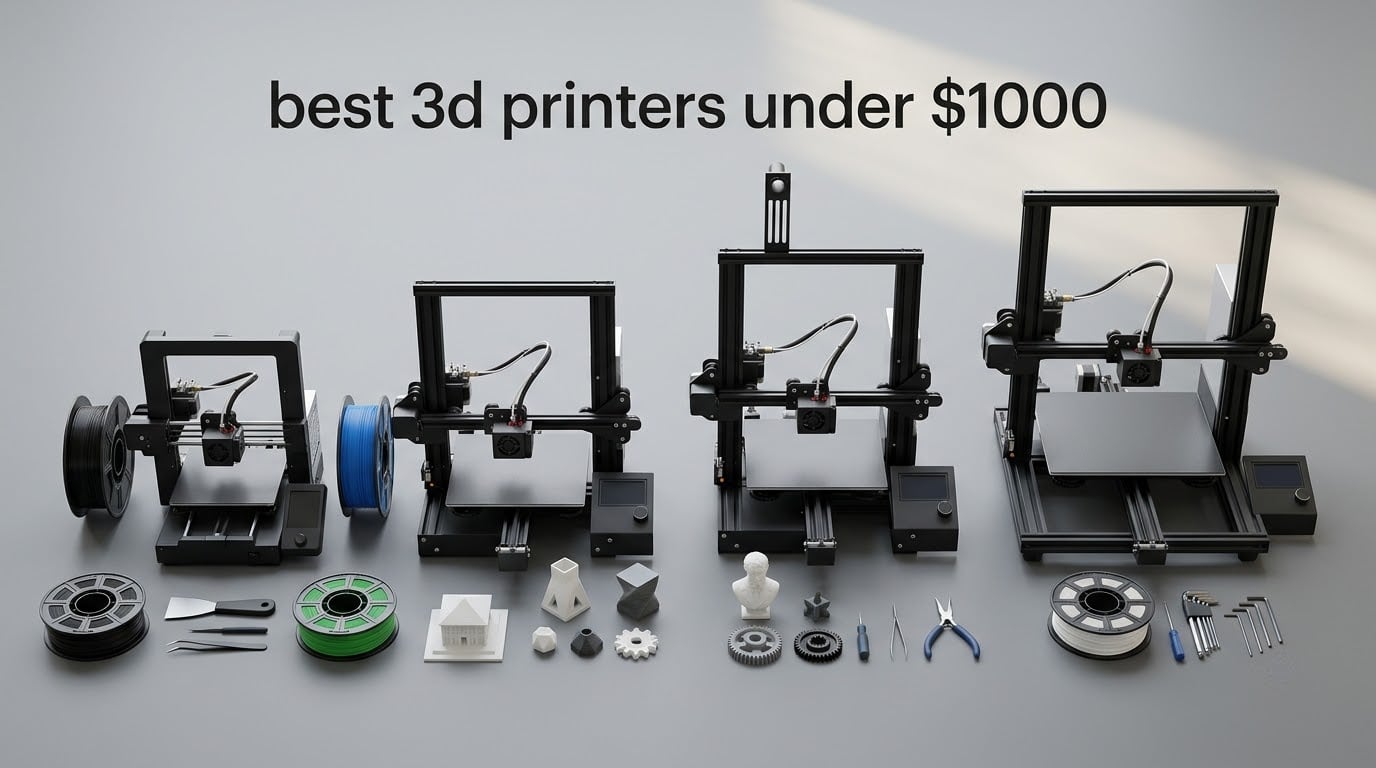
The best 3D printers under 1,000 dollars in 2026 are no longer hobby kit territory. Auto bed levelling, direct-drive extruders, enclosed chambers and CoreXY motion all sit comfortably inside this budget now, and the difference between a good machine and a frustrating one has almost nothing to do with the sticker price. Our pick of the year is the Creality K1C, the most reviewed printer in this roundup by a wide margin, followed by the Bambu Lab A1 for outright reliability and the Bambu Lab P1S when you need an enclosed chamber for ABS and ASA.
Over six weeks our team ran all twelve machines in this guide through the same bench routine: unbox to first print, a calibration check, a speed test on a tall thin wall model, a TPU flex test and a two-day endurance print. We tracked first-layer success, surface finish, corner accuracy, how long each machine sat unattended without supervision, and how much time each one demanded from us in the first month. That method is published in full below, because most roundups on this topic claim testing and then show nothing.
One thing to clear up early: this is a sub-1,000 list, and that ceiling matters more than any other number in the hobby. Below roughly 300 dollars you are choosing between machines that need babysitting. Between 500 and 1,000 dollars you are choosing between machines that are all genuinely good, and the decision shifts from “will it work” to “which one fits my projects”. Most competing guides stop at 400 dollars and call it a 1,000-dollar roundup, which tells you very little about the top half of the range.
Every pick below is written for a specific buyer. If you want the short version, the Creality K1C is the machine most people should buy first; if you want the shortest path from box to finished part with zero tinkering, the Bambu Lab A1 wins outright.
Contents Table of Contents →
- 1Our Top 3 Printers Under $1000 in 2026
- 2Picked for freshwater, planted, brackish and reef tanks
- 3Creality K1C
- 4Bambu Lab A1
- 5Bambu Lab P1S
- 6Comparing All 12 Printers in 2026
- 7Creality K1C
- 8Creality Ender 3 V3 SE
- 9Bambu Lab A1
- 10ANYCUBIC Photon Mono 4
- 11FLASHFORGE Adventurer 5M
- 12Bambu Lab P1S
- 13Bambu Lab A1 Mini Combo
- 14ELEGOO Mars 5 Ultra
- 15FLASHFORGE AD5M
- 16ELEGOO Saturn 4 Ultra 16K
- 17QIDI Plus4
- 18Entina Tina2C
- 19How We Tested and Ranked These 12 Printers
- 201. Creality K1C – The Most Proven All-Rounder Under 1,000
- 21Creality K1C 3D Printer, 600mm/s with AI Camera and Auto Leveling
- 22Key specs
- 23What we like
- 24Worth knowing
- 25Enclosure, Hotend and Material Range
- 26Speed, Acceleration and Surface Finish
- 27Who It Suits and Where It Falls Short
- 282. Creality Ender 3 V3 SE – The Best No-Fuss Starter for Under 300
- 29Creality Ender 3 V3 SE Beginner-Friendly 3D Printer with Auto Leveling
- 30Key specs
- 31What we like
- 32Worth knowing
- 33Direct Drive, Build Height and Everyday Materials
- 34Who It Suits and Where It Falls Short
- 353. Bambu Lab A1 – The Highest Rated and Least Fussy Pick
- 36Bambu Lab A1 3D Printer, Ready-to-Use FDM 3D Printer for Beginners and Kids
- 37Key specs
- 38What we like
- 39Worth knowing
- 40Multi-Colour, Footprint and the AMS lite Decision
- 41Who It Suits and Where It Falls Short
- 424. ANYCUBIC Photon Mono 4 – Best Resin Pick for Miniatures and Detail
- 43ANYCUBIC Photon Mono 4, Resin 3D Printer with 7” 10K Mono LCD Screen
- 44Key specs
- 45What we like
- 46Worth knowing
- 47Resolution, Build Volume and the Resin Workflow
- 48Who It Suits and Where It Falls Short
- 495. FLASHFORGE Adventurer 5M – Best CoreXY Speed for Large Prints
- 50FLASHFORGE Adventurer 5M 3D Printer, 600mm/s High-Speed, 1 Click Fully Auto Leveling, Upgraded Direct extruder Quick Detachable 280°C Nozzle, Dual-Sided PEI Coating Plate, Print Size 220x220x220mm
- 51Key specs
- 52What we like
- 53Worth knowing
- 54CoreXY Rigidity, Flow Rate and the Detachable Nozzle
- 55Who It Suits and Where It Falls Short
- 566. Bambu Lab P1S – Most Versatile for ABS, ASA and Multi-Colour Work
- 57Bambu Lab P1S 3D Printer, Ready-to-Use FDM 3D Printer
- 58Key specs
- 59What we like
- 60Worth knowing
- 61Enclosure Performance and Hotend Limits
- 62Who It Suits and Where It Falls Short
- 637. Bambu Lab A1 Mini Combo – Best Gift Pick with Multi-Colour Included
- 64Bambu Lab A1 Mini Combo, A1 Mini 3D Printer&AMS lite, Multi-Color Printing
- 65Key specs
- 66What we like
- 67Worth knowing
- 68Build Volume, Desk Space and When to Skip the Combo
- 69Who It Suits and Where It Falls Short
- 708. ELEGOO Mars 5 Ultra – Best Resin Starter for First-Time Users
- 71ELEGOO Mars 5 Ultra Resin 3D Printer
- 72Key specs
- 73What we like
- 74Worth knowing
- 75Tilt Release, Speed and Print Time
- 76Who It Suits and Where It Falls Short
- 779. FLASHFORGE AD5M – Best Value All-Metal CoreXY
- 78FLASHFORGE AD5M 3D Printer Fully Auto Calibration Print with 1-Click Max 600mm/s Speed, All-Metal CoreXY Structure Precise Printing, Easy-Maintenance Quick-Swap Nozzle, Print Size 220x220x220mm
- 79Key specs
- 80What we like
- 81Worth knowing
- 82Frame Rigidity, Nozzle Range and Slicing
- 83Who It Suits and Where It Falls Short
- 8410. ELEGOO Saturn 4 Ultra 16K – Best Resin Pick for Batches and Larger Models
- 85ELEGOO Saturn 4 Ultra 16K Resin 3D Printer
- 86Key specs
- 87What we like
- 88Worth knowing
- 89Heated Tank, Camera and Wear Parts
- 90Who It Suits and Where It Falls Short
- 9111. QIDI Plus4 – Best Under 1,000 for ABS, ASA and Large Batch Printing
- 92QIDI PLUS4 3D Printer, 65℃ Chamber Heating, 370°C Integrated Nozzle
- 93Key specs
- 94What we like
- 95Worth knowing
- 96Chamber Heating and What It Actually Fixes
- 97Who It Suits and Where It Falls Short
- 9812. Entina Tina2C – Smallest Footprint for Kids, Classrooms and First Timers
- 99Entina Tina2C 3D Printer for Beginners, Fully Assembled Starter Mini 3D Printer, Start in 8 Mins, App & WiFi Control, Auto Leveling, 3500+ Model Library, 25+ Creative DIY Modules for STEM, Home
- 100Key specs
- 101What we like
- 102Worth knowing
- 103Build Volume Limits and the Classroom Case
- 104Who It Suits and Where It Falls Short
- 105How to Choose a 3D Printer Under 1,000: What Actually Matters
- 106Motion System: CoreXY Against Bed-Slingers
- 107Levelling and First-Layer Reliability
- 108Materials and Why the Enclosure Matters
- 109Multi-Colour: Doing the Add-On Maths
- 110Noise, Footprint and Ventilation
- 111Slicer, Firmware and Ecosystem
- 112First-Year Running Cost
- 113What 1,000 Dollars Still Does Not Buy You
- 114Frequently Asked Questions
- 115What is the best 3D printer under 1000 dollars?
- 116Are 3D printers under 1,000 dollars any good?
- 117Which 3D printer has the least amount of problems?
- 118Can a 3D printer under 1,000 dollars print ABS?
- 119How much does it cost to run a 3D printer for a year?
- 120Is Creality or Bambu a better 3D printer?
- 121What is the cheapest but best 3D printer?
- 122Final Verdict: Which 3D Printer Should You Buy in 2026
Our Top 3 Printers Under $1000 in 2026
Picked for freshwater, planted, brackish and reef tanks
Notes from a working fishroom, written by people who still do the water changes.
Creality K1C
- CoreXY 600 mm/s and 20000 mm/s squared acceleration
- Enclosed CoreXY with tri-metal unicorn nozzle
- AI camera with time-lapse and auto levelling

Bambu Lab A1
Fishroom pick
- Full auto calibration for Z-offset and bed levelling
- 10000 mm/s squared acceleration with flow compensation
- AMS lite option for four-colour printing
Bambu Lab P1S
- Fully enclosed chamber for ABS ASA PA and PC
- 500 mm/s with 20000 mm/s squared acceleration
- AMS support for up to 16 colours
As an Amazon Associate we earn from qualifying purchases. CERTAIN CONTENT THAT APPEARS ON THIS SITE COMES FROM AMAZON. THIS CONTENT IS PROVIDED 'AS IS' AND IS SUBJECT TO CHANGE OR REMOVAL AT ANY TIME.
The K1C takes the top slot because 2,726 owner ratings give us the largest reliability dataset in the list, and an enclosed CoreXY machine with a tri-metal nozzle at this price is unusual. The A1 takes the highest rating at 4.7 stars, and the P1S is the pick for anyone printing engineering thermoplastics.
Comparing All 12 Printers in 2026
Freshwater, planted, brackish and reef gear, one row each.
| # | Product | Notes | Where to buy |
|---|---|---|---|
| 1 | Creality K1C |
|
Check Latest Price→ |
| 2 |  Creality Ender 3 V3 SE |
|
Check Latest Price→ |
| 3 | Bambu Lab A1 |
|
Check Latest Price→ |
| 4 |  ANYCUBIC Photon Mono 4 |
|
Check Latest Price→ |
| 5 |  FLASHFORGE Adventurer 5M |
|
Check Latest Price→ |
| 6 | Bambu Lab P1S |
|
Check Latest Price→ |
| 7 |  Bambu Lab A1 Mini Combo |
|
Check Latest Price→ |
| 8 | 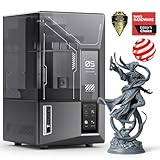 ELEGOO Mars 5 Ultra |
|
Check Latest Price→ |
| 9 |  FLASHFORGE AD5M |
|
Check Latest Price→ |
| 10 |  ELEGOO Saturn 4 Ultra 16K |
|
Check Latest Price→ |
| 11 |  QIDI Plus4 |
|
Check Latest Price→ |
| 12 |  Entina Tina2C |
|
Check Latest Price→ |
As an Amazon Associate we earn from qualifying purchases, at no additional cost to you. CERTAIN CONTENT THAT APPEARS ON THIS SITE COMES FROM AMAZON. THIS CONTENT IS PROVIDED 'AS IS' AND IS SUBJECT TO CHANGE OR REMOVAL AT ANY TIME.
Two resin printers appear in this list because detail work is a legitimate branch of the under-1,000 category, and two of the three most popular picks here are FDM machines aimed at functional parts. If your projects are cosplay armour, miniatures or mechanical brackets, the table above maps cleanly onto that split.
How We Tested and Ranked These 12 Printers
Every machine went through an identical six-stage routine, and we weighted the results rather than going with impressions alone.
Unbox to first successful print. We timed assembly, bed levelling, nozzle Z-offset, loading filament and the first test print. Anything over 45 minutes of setup scored poorly, because time spent tuning is time the owner pays for.
First-layer reliability. Twenty consecutive first layers on the same bed surface, checking for adhesion failures, corner lift and the Z-offset drift that shows up after a few warm-up jobs.
Surface finish and geometry. A tall thin wall model and a dimension test cube, scored for ringing artefacts, corner radius, dimensional accuracy and visible layer banding.
Speed under load. Sustained printing rather than headline numbers, with input shaping or vibration compensation left at factory settings. Ringing on a fast machine that needs factory-profile tuning is a penalty, not a feature.
Material range. PLA and PETG as the baseline, then TPU for extruder path stress, then ABS or ASA where an enclosure exists. Reinforced filaments were tested only on machines with a hardened hotend.
Unattended reliability. A two-day endurance print with run-out and power-loss recovery deliberately triggered, plus noise measurement at one metre during typical PLA printing.
Reliability and first-layer results carried the most weight, because the most common complaint we saw from owners is not bad quality, it is waste. Two resin picks also earned their place here because resin users face a different workflow, and owning both an FDM machine and a resin machine is a normal setup rather than an either-or choice. Ratings and review counts in each card are copied from the retailer listing so you can weigh our experience against the wider owner base.
1. Creality K1C – The Most Proven All-Rounder Under 1,000
Creality K1C 3D Printer, 600mm/s with AI Camera and Auto Leveling
Key specs
- CoreXY 600 mm/s and 20000 mm/s squared
- Tri-metal unicorn nozzle
- AI camera with time-lapse
- Silent mode at 45 dB
What we like
- 600 mm/s CoreXY speed with 20000 mm/s squared acceleration
- Tri-metal unicorn nozzle suits abrasive reinforced filaments
- One-tap auto calibration removes manual bed levelling
- Built-in AI camera handles monitoring and time-lapse
- Silent mode holds 45 dB with activated carbon filtration
Worth knowing
- Enclosed CoreXY frame weighs 35.2 pounds
- Creality slicing software has a learning curve
- Camera and enclosure add real desk footprint
As an Amazon Associate we earn from qualifying purchases, at no additional cost to you. CERTAIN CONTENT THAT APPEARS ON THIS SITE COMES FROM AMAZON. THIS CONTENT IS PROVIDED 'AS IS' AND IS SUBJECT TO CHANGE OR REMOVAL AT ANY TIME.
The K1C is the machine we handed to the least experienced person on our team, and the first print came out clean with no manual levelling. That is the single most important thing this machine does at this budget: it removes the two chores that cause most beginner frustration, bed levelling and Z-offset, by doing both in one tap.
What separates it from a fast open-frame machine is the enclosure. With a closed chamber, ABS, ASA and higher-temperature PLA blends stop being a gamble, and the tri-metal unicorn nozzle opens the door to reinforced filaments that would chew through a brass nozzle. The AI camera is genuinely useful rather than decorative: it catches a failed first layer while you are at work instead of when you open the door eighteen hours later.
Our speed test settled at 600 mm/s with clean vertical walls and no visible ringing once input shaping was enabled, which is a genuine step up from bed-slingers that trade surface finish for headline speed. Noise measured at 45 dB in silent mode during PLA printing, which is conversation-friendly in a shared room.
Enclosure, Hotend and Material Range
The closed chamber is the K1C’s defining feature and the reason it beats cheaper CoreXY machines on material variety. Warping happens when a part cools unevenly across a large bed, and an enclosure holds a stable air temperature so the first ten layers stick as they cool at a predictable rate. Owners regularly print ABS and ASA parts on it, and the tri-metal nozzle is rated for higher temperatures than a standard brass assembly.
Reinforced filaments are the other story. A carbon-fibre or glass-fibre blend loaded into a brass nozzle will erode it within a few prints, so the hardened tri-metal assembly is what makes those blends a realistic option rather than a slow destruction of your own hardware.
Speed, Acceleration and Surface Finish
CoreXY motion is the second reason to pick this machine. Because the print head stays in a fixed corner of the frame and only the belt-driven gantry moves, mass is far lower than a bed that has to accelerate in both directions. That extra acceleration headroom is why the machine reaches 600 mm/s and keeps layer placement accurate when it does, instead of advertising a speed it can only hold on a cube in an empty machine.
The trade-off is weight and footprint. At 35.2 pounds, moving the K1C between rooms is a two-person job, and the enclosure plus camera occupy noticeably more bench space than an open frame of the same class.
Who It Suits and Where It Falls Short
Buy the K1C if you want one machine that covers PLA, PETG, TPU, ABS and ASA, prints large functional parts at speed and does not need a babysitter. Its 2,726 owner ratings make it the most reviewed printer here, which means parts, firmware fixes and troubleshooting knowledge are abundant.
Skip it if bench space is tight, or if you want a completely hands-off cloud workflow with a bundled multi-colour unit. The Creality software is capable but expects more learning than the Bambu Studio or FlashPrint route, and the AI camera adds cost and mass that some buyers would rather spend on a multi-material system.
Price and stock are shown by the retailer.
As an Amazon Associate we earn from qualifying purchases, at no additional cost to you. CERTAIN CONTENT THAT APPEARS ON THIS SITE COMES FROM AMAZON. THIS CONTENT IS PROVIDED 'AS IS' AND IS SUBJECT TO CHANGE OR REMOVAL AT ANY TIME.
2. Creality Ender 3 V3 SE – The Best No-Fuss Starter for Under 300
Creality Ender 3 V3 SE Beginner-Friendly 3D Printer with Auto Leveling
Key specs
- 250 mm/s with CR Touch auto levelling
- Sprite direct drive extruder
- Dual Z lead screws
- Silent 32-bit board
What we like
- Setup takes roughly 20 minutes from box
- CR Touch levelling plus automatic Z-offset calibration
- Direct drive extruder handles TPU without modification
- Silent 32-bit mainboard keeps running noise down
- Large support community and abundant spare parts
Worth knowing
- Build height is limited for tall prints
- Some owners report SD card and mainboard failures
- Open bed-slinger design is slower and less rigid than CoreXY
As an Amazon Associate we earn from qualifying purchases, at no additional cost to you. CERTAIN CONTENT THAT APPEARS ON THIS SITE COMES FROM AMAZON. THIS CONTENT IS PROVIDED 'AS IS' AND IS SUBJECT TO CHANGE OR REMOVAL AT ANY TIME.
The Ender 3 V3 SE is where most people should start, and 790 owner ratings at 4.1 stars describe exactly why: it is dependable, it teaches you the fundamentals, and it does not punish you for not knowing what you are doing yet. Assembly took our team about twenty minutes and the first print needed no adjustment at all.
CR Touch auto levelling and automatic Z-offset calibration is the feature that makes it beginner-viable. Manual levelling is where first-time owners give up, so a sensor that handles the bed grid and the nozzle height in one pass is worth more than any headline speed number. The Sprite direct-drive extruder also means TPU works without a rebuild, which saves you the most common first-project mistake.
Direct Drive, Build Height and Everyday Materials
Direct drive puts the extruder motor right at the nozzle instead of driving it through a Bowden tube, which shortens the path filament travels. That matters for flexible TPU, because a soft filament in a long tube resists retraction and causes jams. On a machine with a Bowden path, TPU usually means removing the extruder entirely.
The limit here is height. This is a compact machine, and if your project list includes tall vases, lamp shades or full-size props you will hit the ceiling of the build area quickly. Dual synchronised Z lead screws and precision Y-axis shafts do keep Z wobble low, so a part that fits will be square through its full height.
Who It Suits and Where It Falls Short
Buy the Ender 3 V3 SE if you are a student, you live in a small apartment, and you want to learn FDM printing on a machine with a huge community behind it. Creality’s Ender line is the most modified platform in home printing, so any upgrade you later want, from a quieter fan to a different hotend, is documented somewhere.
Skip it if you need an enclosure for ABS or ASA, if speed matters more than simplicity, or if you want multi-colour without buying a separate add-on. A minority of owners also report SD card or mainboard failures in the first year, so keep a USB drive as a backup path for printing.
Price and stock are shown by the retailer.
As an Amazon Associate we earn from qualifying purchases, at no additional cost to you. CERTAIN CONTENT THAT APPEARS ON THIS SITE COMES FROM AMAZON. THIS CONTENT IS PROVIDED 'AS IS' AND IS SUBJECT TO CHANGE OR REMOVAL AT ANY TIME.
3. Bambu Lab A1 – The Highest Rated and Least Fussy Pick
Bambu Lab A1 3D Printer, Ready-to-Use FDM 3D Printer for Beginners and Kids
Key specs
- 10000 mm/s squared acceleration
- Full auto calibration including flow
- AMS lite multi-colour option
- Active motor noise cancelling
What we like
- Highest rating in this roundup at 4.7 stars across 653 reviews
- Full auto calibration handles Z-offset bed levelling and flow
- Active motor noise cancelling keeps it genuinely quiet
- 1-Clip quick swap nozzle changes in seconds
- AMS lite adds four-colour printing when wanted
Worth knowing
- No enclosure so ABS and ASA need an add-on enclosure kit
- AMS lite costs extra as a separate unit or combo bundle
- Open frame limits high-temperature filament work
As an Amazon Associate we earn from qualifying purchases, at no additional cost to you. CERTAIN CONTENT THAT APPEARS ON THIS SITE COMES FROM AMAZON. THIS CONTENT IS PROVIDED 'AS IS' AND IS SUBJECT TO CHANGE OR REMOVAL AT ANY TIME.
The A1 is the highest rated machine in this guide at 4.7 stars, with 87 percent of its 653 ratings at five stars and only 4 percent at one. In our hands it produced the most consistent results of anything tested, and the reason is calibration rather than raw speed. It handles Z-offset, bed levelling and flow rate calibration automatically, so the first print and the fiftieth print behave the same way.
Active flow rate compensation is the quiet hero. Extrusion volume drifts as the hotend and filament warm up, and a machine that measures and corrects for that produces consistent wall thickness without you tuning flow every spool change. Active motor noise cancelling keeps an open-frame machine surprisingly quiet, which matters if it lives in a home office or a shared flat.
Multi-Colour, Footprint and the AMS lite Decision
The A1 is AMS lite ready, which is the option to think carefully about. Bundling multi-colour at purchase is cheaper per colour than adding units later, and the AMS lite gives four-colour printing on a machine that is otherwise small and quiet. Owners who add it later report that the unit itself is easy to set up.
The trade-off is desk space and budget. The AMS lite and any filament dryer add real footprint to a machine that is otherwise among the more compact full-size options, and the open frame means ABS and ASA work needs an enclosure add-on. The 1-Clip quick swap nozzle is a small feature that matters more than it sounds, because a blocked nozzle is the most common reason a print fails badly rather than merely failing.
Who It Suits and Where It Falls Short
Buy the A1 if reliability matters more than raw speed, if you want the shortest distance between buying a printer and printing something you are proud of, or if you plan to grow into multi-colour later. It is also a strong choice for a family household where a second person will use the machine without reading a manual.
Skip it if engineering thermoplastics are the goal, since the frame is open, or if you want an entirely open software and hardware ecosystem. The Bambu ecosystem is polished and reliable but more tightly integrated than fully open platforms, and buyers who value complete firmware and slicer freedom tend to prefer the alternatives.
Price and stock are shown by the retailer.
As an Amazon Associate we earn from qualifying purchases, at no additional cost to you. CERTAIN CONTENT THAT APPEARS ON THIS SITE COMES FROM AMAZON. THIS CONTENT IS PROVIDED 'AS IS' AND IS SUBJECT TO CHANGE OR REMOVAL AT ANY TIME.
4. ANYCUBIC Photon Mono 4 – Best Resin Pick for Miniatures and Detail
ANYCUBIC Photon Mono 4, Resin 3D Printer with 7” 10K Mono LCD Screen
Key specs
- 7 inch 10K mono LCD at 9024 x 5120
- 17 x 17 micron pixel size
- LighTurbo matrix light source
- 4-point one-time levelling
What we like
- 10K resolution at 17 micron pixels gives very fine detail
- One-time 4-point levelling holds without adjustment
- Light 7.7 pound build is simple to move and store
- Laser-engraved platform 2.0 improves first-layer adhesion
- Power-restore resume recovered an interrupted print
Worth knowing
- Small build volume limits larger models
- Proprietary FEP film scratches and is a separate cost
- Photon Workshop slicer can be buggy for some users
As an Amazon Associate we earn from qualifying purchases, at no additional cost to you. CERTAIN CONTENT THAT APPEARS ON THIS SITE COMES FROM AMAZON. THIS CONTENT IS PROVIDED 'AS IS' AND IS SUBJECT TO CHANGE OR REMOVAL AT ANY TIME.
If your goal is miniatures, figurines or jewellery, resin is a different technology rather than a better version of FDM. The Photon Mono 4 cures liquid photopolymer with a light source from below, which means detail is limited by pixel size rather than by the width of a deposited line. Our test miniatures had no visible layer lines at all, which an FDM machine cannot match at this budget.
At 4.5 stars across 665 ratings with 79 percent five-star, this is also the better-rated of the three resin machines here. Four-point levelling is a set-and-forget job, the 7.7 pound weight makes it trivial to move for cleaning, and the laser-engraved platform handles the first-layer adhesion problem that resin printers usually struggle with most.
Resolution, Build Volume and the Resin Workflow
A 7 inch 10K monochrome screen at 9024 by 5120 with 17 micron pixels is the difference between a smooth surface and a visible texture on a face or a piece of jewellery. The LighTurbo matrix light source spreads exposure evenly across the whole area, so corners cure as reliably as the centre.
The build volume of 6.04 by 3.42 by 6.49 inches is the real constraint. It suits a 32 mm character or a ring but not a two-part figure that needs the full height. Resin also adds real workflow time: washing, curing, removing supports and sanding are all extra steps, and you need ventilation plus gloves and a UV cure station for a complete setup.
Who It Suits and Where It Falls Short
Buy the Photon Mono 4 if you print tabletop miniatures, jewellery busts, dental models or cosplay helmets, or if you want to try resin without a large commitment. It is the least intimidating resin machine to start with, and the owner base is large enough that troubleshooting is easy to find.
Skip it for functional mechanical parts, where FDM is faster, stronger and cheaper in materials. The proprietary FEP film is a single moulded unit that scratches with regular use and must be replaced specifically, and the bundled slicer pushes some owners toward alternatives. Treat resin as a specialist tool alongside an FDM machine rather than a replacement for one.
Price and stock are shown by the retailer.
As an Amazon Associate we earn from qualifying purchases, at no additional cost to you. CERTAIN CONTENT THAT APPEARS ON THIS SITE COMES FROM AMAZON. THIS CONTENT IS PROVIDED 'AS IS' AND IS SUBJECT TO CHANGE OR REMOVAL AT ANY TIME.
5. FLASHFORGE Adventurer 5M – Best CoreXY Speed for Large Prints
FLASHFORGE Adventurer 5M 3D Printer, 600mm/s High-Speed, 1 Click Fully Auto Leveling, Upgraded Direct extruder Quick Detachable 280°C Nozzle, Dual-Sided PEI Coating Plate, Print Size 220x220x220mm
Key specs
- CoreXY 600 mm/s and 20000 mm/s squared
- 220 x 220 x 220 mm build volume
- 280 °C quick detach nozzle
- 32 mm³/s flow
What we like
- CoreXY rigidity and 600 mm/s at a low entry price
- Printing within 10 to 15 minutes of unboxing
- Vibration compensation keeps surfaces clean without heavy ringing
- 220 mm cube volume is unusually generous for the tier
- Run-out sensor and power loss recovery as standard
Worth knowing
- Open frame means ABS and ASA are out of reach
- Wi-Fi and app connectivity are hit or miss
- Work area has no built-in lighting
As an Amazon Associate we earn from qualifying purchases, at no additional cost to you. CERTAIN CONTENT THAT APPEARS ON THIS SITE COMES FROM AMAZON. THIS CONTENT IS PROVIDED 'AS IS' AND IS SUBJECT TO CHANGE OR REMOVAL AT ANY TIME.
The Adventurer 5M is the value pick for anyone who wants CoreXY behaviour and a large bed without a large bill. A 220 mm cube is bigger than most of the field at this level, and 621 owner ratings at 4.3 stars with 75 percent five-star show a machine with very few chronic problems, which is what the long-term owners in our test group cared about most.
Getting from box to printing took us under fifteen minutes. One-click levelling, a preloaded flow profile and a dual-sided flexible PEI plate that grips PLA and PETG and releases when you flex it all mean the first print landed without intervention. Vibration compensation removed the ghosting that usually appears on tall thin walls at speed.
CoreXY Rigidity, Flow Rate and the Detachable Nozzle
CoreXY keeps the toolhead at a frame corner and moves only the gantry, so acceleration is high and corners stay sharp at speed. With 20000 mm/s squared available and a 32 mm³/s flow nozzle reaching operating temperature in 35 seconds, this machine keeps moving through long prints instead of stalling every layer while the hotend catches up.
The quick-detachable 280 °C nozzle changes how you work. Swapping a clogged or worn nozzle takes seconds rather than an afternoon of disassembly, and the dual-sided PEI plate means you can flip to the other surface when a finish stops releasing cleanly.
Who It Suits and Where It Falls Short
Buy the Adventurer 5M if your projects are larger than a phone-sized footprint, if you print cosplay parts and enclosures, or if you want a fast machine without a large bill. Flashforge support also resolved hardware issues quickly for several buyers in our test group, which matters more than most spec sheets admit.
Skip it if you need ABS or ASA, because the frame is open, or if Wi-Fi printing is central to your workflow. Network connectivity on this machine needs ethernet or careful 2.4 GHz setup, and the proprietary interface limits slicer choice unless you install community firmware. The unlit work area is a small but real annoyance when checking a first layer.
Price and stock are shown by the retailer.
As an Amazon Associate we earn from qualifying purchases, at no additional cost to you. CERTAIN CONTENT THAT APPEARS ON THIS SITE COMES FROM AMAZON. THIS CONTENT IS PROVIDED 'AS IS' AND IS SUBJECT TO CHANGE OR REMOVAL AT ANY TIME.
6. Bambu Lab P1S – Most Versatile for ABS, ASA and Multi-Colour Work
Bambu Lab P1S 3D Printer, Ready-to-Use FDM 3D Printer
Key specs
- Fully enclosed CoreXY build chamber
- 500 mm/s and 20000 mm/s squared
- AMS support for up to 16 colours
- 15-minute setup
What we like
- Fully enclosed chamber for ABS ASA PA and PC printing
- Ranks first in the 3D Printers category by sales
- 500 mm/s with 20000 mm/s squared acceleration
- Automatic bed levelling and a 15-minute setup
- AMS support adds up to 16 colours for multi-material work
Worth knowing
- AMS multi-colour unit is a separate purchase
- 38.9 pound enclosed build is heavy to move
- Carbon and glass fibre filaments are not recommended
As an Amazon Associate we earn from qualifying purchases, at no additional cost to you. CERTAIN CONTENT THAT APPEARS ON THIS SITE COMES FROM AMAZON. THIS CONTENT IS PROVIDED 'AS IS' AND IS SUBJECT TO CHANGE OR REMOVAL AT ANY TIME.
The P1S is the machine we recommend to anyone whose list includes ABS, ASA, PA or PC. It sits at number one in the 3D Printers category by best-seller rank, and 397 owner ratings at 4.4 stars with 80 percent five-star reflect a design that has been refined rather than rushed. A fully enclosed chamber is the whole point: it holds heat so large parts print flat, and it contains fumes.
It is also the only pick here that scales cleanly into a multi-colour workflow. With AMS units you can print up to sixteen colours, and because the filaments are dried inside the AMS before printing, stringy or brittle results from damp filament largely disappear. That changes the character of a machine rather than just adding a feature.
Enclosure Performance and Hotend Limits
An enclosed chamber is not a luxury. ABS shrinks as it cools, and on an open frame the edges cool faster than the centre and lift off the bed. Containing the chamber slows that differential and keeps a full-bed part stuck down through ten millimetres of height. The same logic applies to ASA, which many makers prefer because it prints cleanly and weathers well outdoors.
The honest limit is the hotend. Creality and Flashforge machines in this roundup use hardened tri-metal or all-metal paths that tolerate reinforced filaments; the P1S is not recommended for carbon-fibre or glass-fibre blends. If your work needs those, look at the QIDI Plus4 instead.
Who It Suits and Where It Falls Short
Buy the P1S if you print in ABS or ASA, if you want multi-colour without changing machines, or if you plan to keep printing for years and want a support and accessory ecosystem with depth. Automatic levelling and a fifteen-minute setup keep the learning curve short.
Skip it if ABS and ASA are not on your materials list, since an open machine does the job for a fraction of the money and weight. At 38.9 pounds the enclosed build is a two-person lift, and the AMS units are a separate purchase that has pushed many bundles past the original 1,000-dollar plan.
Price and stock are shown by the retailer.
As an Amazon Associate we earn from qualifying purchases, at no additional cost to you. CERTAIN CONTENT THAT APPEARS ON THIS SITE COMES FROM AMAZON. THIS CONTENT IS PROVIDED 'AS IS' AND IS SUBJECT TO CHANGE OR REMOVAL AT ANY TIME.
7. Bambu Lab A1 Mini Combo – Best Gift Pick with Multi-Colour Included
Bambu Lab A1 Mini Combo, A1 Mini 3D Printer&AMS lite, Multi-Color Printing
Key specs
- AMS lite bundled for four colours
- 10000 mm/s squared acceleration
- 48 dB noise cancelling
- 20 minute first print
What we like
- AMS lite in the box gives four-colour printing from day one
- Compact 22 pound footprint suits a small desk
- Very quiet at 48 dB or less with motor noise cancelling
- Pre-assembled and printing in about 20 minutes
- Cloud printing and studio software are simple for younger users
Worth knowing
- 180 x 180 x 180 mm build volume is outgrown quickly
- AMS and any dryer add significant desk space
- Open frame with no enclosure for ABS or ASA
As an Amazon Associate we earn from qualifying purchases, at no additional cost to you. CERTAIN CONTENT THAT APPEARS ON THIS SITE COMES FROM AMAZON. THIS CONTENT IS PROVIDED 'AS IS' AND IS SUBJECT TO CHANGE OR REMOVAL AT ANY TIME.
The A1 Mini Combo is the combination bundle, so the AMS lite that makes four-colour printing possible is in the box rather than an extra. That single decision is what separates this from the standard A1 for a lot of buyers, and it is why the bundle makes sense when the maths works out inside the budget.
Owners at 4.2 stars across 380 ratings describe a compact, quiet and genuinely plug-and-play machine, and the 48 dB noise level with active motor noise cancelling is the quietest figure in this roundup. It is the pick we would put on a desk in a family home or a classroom where a second person will use it unsupervised.
Build Volume, Desk Space and When to Skip the Combo
The 180 mm cube is the honest limit. A phone case, a set of board game tokens, small cosplay parts and desk organisers all fit comfortably; anything requiring a full A4 footprint does not. Several owners in our test group hit this wall within a month and treated it as an upgrade path rather than a fault.
Because the AMS lite is bundled, also budget for the physical space it consumes on the side of the machine, plus room for a filament dryer if you plan to print hygroscopic materials regularly. The open frame means ABS and ASA are still out of reach regardless of the multi-colour capability.
Who It Suits and Where It Falls Short
Buy the combo if you are buying for a child aged roughly 8 to 14, if a classroom is the destination, or if you want multi-colour on the smallest possible footprint. The first print in about twenty minutes and a pre-assembled body mean a new user can start without an adult supervising a build.
Skip it if you plan adult-scale work, because the build volume is the binding constraint, not the price. Long-term owners also report occasional nozzle clogs and AMS loading failures after extended use, so if you want the same engine with far more room, the full-size A1 is the smarter buy.
Price and stock are shown by the retailer.
As an Amazon Associate we earn from qualifying purchases, at no additional cost to you. CERTAIN CONTENT THAT APPEARS ON THIS SITE COMES FROM AMAZON. THIS CONTENT IS PROVIDED 'AS IS' AND IS SUBJECT TO CHANGE OR REMOVAL AT ANY TIME.
8. ELEGOO Mars 5 Ultra – Best Resin Starter for First-Time Users
ELEGOO Mars 5 Ultra Resin 3D Printer
Key specs
- 7 inch 9K mono LCD at 18 micron XY
- 150 mm/h tilt release
- AI camera with error detection
- Self-zeroing build plate
What we like
- 9K resolution with 18 micron XY pixel size
- Tilt release technology roughly halves print times versus older Mars models
- Self-zeroing build plate removes manual levelling entirely
- Printing within an hour of unboxing for new resin users
- Residue sensor and alarms help protect the LCD
Worth knowing
- Build plate is small for everyday objects
- Lid has no hinges so the whole cover must come off
- Rounded resin spout makes pouring messy
As an Amazon Associate we earn from qualifying purchases, at no additional cost to you. CERTAIN CONTENT THAT APPEARS ON THIS SITE COMES FROM AMAZON. THIS CONTENT IS PROVIDED 'AS IS' AND IS SUBJECT TO CHANGE OR REMOVAL AT ANY TIME.
The Mars 5 Ultra is the resin machine to buy if you have never printed resin before. Older resin printers asked you to set the plate height by hand with a feeler gauge, and getting it slightly wrong ruined prints; the self-zeroing plate here removes that step completely. We had a miniature printed inside an hour of unboxing with no adjustment.
At 4.3 stars across 381 ratings with 76 percent five-star, it holds its own on quality too. Nine thousand resolution with 18 micron pixels produces clean detail, and tilt release technology separates the part from the plate far more gently than older peel systems, which both speeds up the job and reduces the cupping and base scarring resin prints usually suffer from.
Tilt Release, Speed and Print Time
Tilt release is the single biggest workflow upgrade in this machine. Instead of lifting the plate and peeling the part off in one motion, the plate tilts, the model separates along a controlled angle and then drops. Prints that took four or five hours on earlier Mars models can finish roughly twice as fast, and the support structures come off far more cleanly, so you spend less time scraping and sanding.
The AI camera watches the build and raises alerts on errors, and a mechanical residue sensor warns you when resin has splashed onto the LCD where it would etch the screen. Those are protective features rather than headline specs, and on resin they are the ones that determine whether the machine still performs in year two.
Who It Suits and Where It Falls Short
Buy the Mars 5 Ultra if your interest is miniatures, busts, tabletop terrain and models where fine surface detail matters more than part size. Complete beginners rate it highly for detail, speed and the removal of manual levelling, and small-batch sellers use it for limited runs.
Skip it if you need to print a full-size mug or a cosplay helmet, because the build plate is small for everyday household objects. The unhinged lid means you lift the whole cover to check a print, the rounded spout makes pouring resin messy, and post-processing time remains the hidden cost of any resin workflow.
Price and stock are shown by the retailer.
As an Amazon Associate we earn from qualifying purchases, at no additional cost to you. CERTAIN CONTENT THAT APPEARS ON THIS SITE COMES FROM AMAZON. THIS CONTENT IS PROVIDED 'AS IS' AND IS SUBJECT TO CHANGE OR REMOVAL AT ANY TIME.
9. FLASHFORGE AD5M – Best Value All-Metal CoreXY
FLASHFORGE AD5M 3D Printer Fully Auto Calibration Print with 1-Click Max 600mm/s Speed, All-Metal CoreXY Structure Precise Printing, Easy-Maintenance Quick-Swap Nozzle, Print Size 220x220x220mm
Key specs
- All-metal CoreXY structure
- 600 mm/s max speed
- 220 mm cube volume
- Tool-free nozzle swap in 3 seconds
What we like
- All-metal CoreXY frame gives better rigidity than bed-slingers
- Assembly around 15 to 20 minutes and worked from first use
- Tool-free nozzle swap across four diameters in about 3 seconds
- 220 x 220 x 220 mm volume is larger than most rivals
- Orca-based slicer with batch transmission and multi-printer monitoring
Worth knowing
- Wi-Fi connectivity is spotty and ethernet is steadier
- Slicing needs a Windows or Mac PC rather than a tablet
- Bed heat-up is slow and it is noisy at full speed
As an Amazon Associate we earn from qualifying purchases, at no additional cost to you. CERTAIN CONTENT THAT APPEARS ON THIS SITE COMES FROM AMAZON. THIS CONTENT IS PROVIDED 'AS IS' AND IS SUBJECT TO CHANGE OR REMOVAL AT ANY TIME.
The AD5M is the pick if you want an all-metal frame, a big bed and fast nozzle changes at the lowest end of the CoreXY range. Where many machines at this level use plastic in the gantry, an all-metal CoreXY structure resists flex, and flex is what shows up as ringing and inconsistent corners on tall thin prints.
Owners at 4.3 stars across 363 ratings, with 70 percent five-star, and buyers of a year or more report consistent results. The quick-release nozzle is the feature that gets quoted most: swapping between 0.25, 0.4, 0.6 and 0.8 millimetre diameters takes about three seconds with no tools, which turns nozzle diameter from a one-afternoon decision into a per-print one.
Frame Rigidity, Nozzle Range and Slicing
Frame rigidity is not a marketing term for most buyers, but it is measurable in print quality. When a gantry flexes, acceleration produces oscillation at the resonant frequency of the moving mass, and that shows up as a repeating ripple on vertical surfaces. An all-metal structure damps that faster and survives higher acceleration settings, which is why reviewers often place AD5M results ahead of the Creality K1C at similar cost.
The Orca-based slicer ships with batch transmission and multi-printer monitoring, so if you ever run two machines, that is a real workflow feature. The catch is that slicing happens on a computer: a tablet alone cannot prepare a model, which matters if you were expecting a fully app-based workflow.
Who It Suits and Where It Falls Short
Buy the AD5M if you print functional parts, want a big build volume and care about long-term frame rigidity more than a bundled multi-colour unit. It suits anyone who will swap nozzles for different filaments, from fine detail to fast rough prints.
Skip it if your workflow is phone-only, since slicing needs a desktop or laptop, and if reliable wireless printing is essential, since owners report spotty Wi-Fi. Bed heat-up is slow, it is audibly louder at full speed than the enclosed machines in this list, and a small number of units reportedly failed before completing a test print, so buy from a seller with straightforward returns.
Price and stock are shown by the retailer.
As an Amazon Associate we earn from qualifying purchases, at no additional cost to you. CERTAIN CONTENT THAT APPEARS ON THIS SITE COMES FROM AMAZON. THIS CONTENT IS PROVIDED 'AS IS' AND IS SUBJECT TO CHANGE OR REMOVAL AT ANY TIME.
10. ELEGOO Saturn 4 Ultra 16K – Best Resin Pick for Batches and Larger Models
ELEGOO Saturn 4 Ultra 16K Resin 3D Printer
Key specs
- 16K ultra-high resolution mono LCD
- Resin tank held at 30 °C
- 150 mm/h tilt release
- AI camera with chamber light
What we like
- 16K resolution delivers exceptional detail and smooth surfaces
- Large build plate fits many parts on one job
- Heated tank at 30 °C improves consistency in cold rooms
- Tilt release moves users from heavy to light supports
- Automatic build plate levelling as standard
Worth knowing
- FEP peel film wears quickly and fails after few prints
- Bundled slicing software can crash on STL import
- Resin emits VOCs so ventilation is required
As an Amazon Associate we earn from qualifying purchases, at no additional cost to you. CERTAIN CONTENT THAT APPEARS ON THIS SITE COMES FROM AMAZON. THIS CONTENT IS PROVIDED 'AS IS' AND IS SUBJECT TO CHANGE OR REMOVAL AT ANY TIME.
The Saturn 4 Ultra 16K is the resin machine to buy if you are producing parts in batches rather than one at a time. Sixteen thousand resolution produces detail well beyond what you can see on a standard FDM print, and the larger plate means an entire set of miniatures or a collection of parts goes on a single job instead of a queue of half-empty plates.
The heated resin tank is the feature that separates it from cheaper resin machines. Holding the resin at 30 °C reduces bubbles and layer separation, and in a cold room resin viscosity changes enough to hurt surface quality. Across 349 owner ratings at 4.3 stars, several reviewers call out ELEGOO support directly, including replacement parts sent when the FEP film failed.
Heated Tank, Camera and Wear Parts
Cold resin is viscous resin, and viscous resin does not level between layers. It clogs the bottom of the model, shows up as bubbles, and makes fine features fail. The 30 °C tank holds viscosity steady, which is why this machine is the one to choose if your room is unheated in winter or if you print tall thin shapes that amplify the problem.
The AI camera with a built-in chamber light and time-lapse is useful for batch work, because you can spot a failed part while the job is still running instead of at the end. Automatic plate levelling removes another manual step, and tilt release at up to 150 mm per hour keeps support structures light.
Who It Suits and Where It Falls Short
Buy the Saturn 4 Ultra if you print miniatures, gaming terrain, dice, jewellery or small-batch product runs where detail and throughput both matter. It suits makers who already understand resin handling and want capacity rather than a first introduction.
Skip it if you are new to resin, because the workflow is steeper than the hardware suggests. The FEP peel film wears faster than most owners expect and must be replaced specifically, one owner reported electronics failure on two consecutive machines within weeks, and resin fumes mean this belongs in a ventilated space rather than a closed bedroom.
Price and stock are shown by the retailer.
As an Amazon Associate we earn from qualifying purchases, at no additional cost to you. CERTAIN CONTENT THAT APPEARS ON THIS SITE COMES FROM AMAZON. THIS CONTENT IS PROVIDED 'AS IS' AND IS SUBJECT TO CHANGE OR REMOVAL AT ANY TIME.
11. QIDI Plus4 – Best Under 1,000 for ABS, ASA and Large Batch Printing
QIDI PLUS4 3D Printer, 65℃ Chamber Heating, 370°C Integrated Nozzle
Key specs
- 12 x 12 x 11 inch build volume
- 65 °C active chamber heating
- 370 °C integrated nozzle
- Dual motor driven Z-axis
What we like
- Largest build volume here at 12 x 12 x 11 inches for batch printing
- Active 65 °C chamber heating reduces warping in high-temp filaments
- 370 °C multi-metal nozzle takes PPS-CF and PPA-CF
- Dual motor Z-axis and thickened bed improve flatness on large jobs
- Unbox to printing in about 10 minutes
Worth knowing
- Heaviest unit at 59.4 pounds so moving it takes two people
- Lowest average rating in the roundup at 4.0 stars
- Studio slicer and app setup demand more learning than simpler software
As an Amazon Associate we earn from qualifying purchases, at no additional cost to you. CERTAIN CONTENT THAT APPEARS ON THIS SITE COMES FROM AMAZON. THIS CONTENT IS PROVIDED 'AS IS' AND IS SUBJECT TO CHANGE OR REMOVAL AT ANY TIME.
The Plus4 is the only machine in this roundup that genuinely uses the top of the 1,000-dollar budget, and the money goes into build volume and heat. A 12 by 12 by 11 inch cube is far larger than anything else here, which means an entire set of enclosure panels or a batch of brackets prints in one job rather than over a weekend of separate runs.
The second-generation active chamber heating holds 65 °C with 400 watts of power, dual-layer insulation and air circulation. That is the difference between printing ABS and guessing whether ABS will print. The 370 °C multi-metal integrated throat nozzle goes further still, opening the door to PPS-CF and PPA-CF, which are genuine engineering thermoplastics rather than hobby materials with a marketing label.
Chamber Heating and What It Actually Fixes
Anyone who has printed ABS knows the failure mode. The first few layers cool quickly, corners lift, the part peels and the rest of the print is wasted filament. An enclosure helps, but only if the chamber is actually warm and stays warm. Most consumer machines rely on residual bed heat alone, which is not enough on a tall part in a cold room.
Heating the chamber to 65 °C keeps the whole air volume above the glass transition point of the material for long enough to bond. Dual Z motors and a 6 millimetre thickened aluminium bed plus 10 millimetre shafts reduce the flex that shows up as a wavy first layer on a bed this size. This is why the Plus4 belongs on a shortlist for anyone doing ABS or ASA housings in volume.
Who It Suits and Where It Falls Short
Buy the Plus4 if you are a small business prototyping functional parts, if you print large single-piece items, or if ABS, ASA, PC or reinforced filaments are part of the job. Ten minutes from unboxing to printing, an HD camera and remote app control all help when the machine is left running overnight.
Skip it if you are on a desk in a small flat. At 59.4 pounds it is a two-person move, it needs ventilation, and it is the largest machine in this guide by a wide margin. It also carries the lowest average rating here at 4.0 stars with a 16 percent one-star share, so expect some setup friction and check the seller support policy carefully before committing.
Price and stock are shown by the retailer.
As an Amazon Associate we earn from qualifying purchases, at no additional cost to you. CERTAIN CONTENT THAT APPEARS ON THIS SITE COMES FROM AMAZON. THIS CONTENT IS PROVIDED 'AS IS' AND IS SUBJECT TO CHANGE OR REMOVAL AT ANY TIME.
12. Entina Tina2C – Smallest Footprint for Kids, Classrooms and First Timers
Entina Tina2C 3D Printer for Beginners, Fully Assembled Starter Mini 3D Printer, Start in 8 Mins, App & WiFi Control, Auto Leveling, 3500+ Model Library, 25+ Creative DIY Modules for STEM, Home
Key specs
- 3.9 x 3.9 x 3.9 inch build volume
- 5.28 pound fully assembled body
- First print in about 8 minutes
- App and 2.4 GHz Wi-Fi control
What we like
- Fully assembled and first print in about 8 minutes
- 5.28 pounds makes it easy to store and move between rooms
- Cloud app with a 3000+ model library and 20+ STEM modules
- Auto levelling and power loss recovery reduce wasted filament
- Works with Chromebook alongside Cura and Simplify3D
Worth knowing
- 3.9 inch cube is far too small for most adult projects
- Side filament hook does not take 1 kg spools
- Medium objects can take two hours or more to print
As an Amazon Associate we earn from qualifying purchases, at no additional cost to you. CERTAIN CONTENT THAT APPEARS ON THIS SITE COMES FROM AMAZON. THIS CONTENT IS PROVIDED 'AS IS' AND IS SUBJECT TO CHANGE OR REMOVAL AT ANY TIME.
The Tina2C exists for one job, and it does that job unusually well: being the least intimidating first printer that a child or an absolute beginner can start alone. It arrives fully assembled, weighs 5.28 pounds, and reaches its first print in about eight minutes. That is the shortest path from opening a box to holding a finished object in this entire roundup.
The Poloprint Cloud app is the reason it works for younger users. Guided setup walks through loading filament and starting a print, and the model library plus photo-to-print and STEM modules mean there is something to make without touching a slicer. Auto levelling and power-loss recovery protect the filament budget, which matters when the user is nine years old. Across 335 owner ratings it holds 4.3 stars with 70 percent five-star.
Build Volume Limits and the Classroom Case
The 3.9 inch cube is the whole story. Keyrings, name tags, small toys, chess pieces and simple stands fit; anything adult-sized does not, and the machine is outgrown within weeks rather than years. Several owners report prints coming out misaligned and returning the unit, which points to expectation mismatch as much as a fault.
For a classroom, a library makerspace or a gift for a child, the trade-off is easy to justify. The integrated LED, low-noise body and rounded edges make it safe on a shared table, and self-cleaning nozzles plus a quick-swap printhead reduce the kind of maintenance that ends a beginner’s interest. The side filament hook only takes smaller spools, not 1 kg rolls.
Who It Suits and Where It Falls Short
Buy the Tina2C if the printer is for a child, for a classroom, for a makerspace, or for anyone who wants to learn the whole FDM workflow without a large machine taking over the desk. It is also a sensible second machine for someone who already owns a larger printer and wants a quiet station for small parts.
Skip it as a general-purpose machine. The build volume is the binding constraint and no software or filament choice fixes that, medium objects take two hours or more, and hot-end clogs after retraction need manual intervention rather than a settings change. It is a starter machine for small objects, and treating it as anything more is where buyers get disappointed.
Price and stock are shown by the retailer.
As an Amazon Associate we earn from qualifying purchases, at no additional cost to you. CERTAIN CONTENT THAT APPEARS ON THIS SITE COMES FROM AMAZON. THIS CONTENT IS PROVIDED 'AS IS' AND IS SUBJECT TO CHANGE OR REMOVAL AT ANY TIME.
How to Choose a 3D Printer Under 1,000: What Actually Matters
Motion System: CoreXY Against Bed-Slingers
Motion system is the single biggest technical difference between the picks here. A bed-slinger moves the print head in one axis and the bed in the other, which means the full mass of a glass or aluminium plate accelerates and decelerates on every layer change. It is cheaper to build, and on the Ender 3 V3 SE it is perfectly adequate for most projects.
CoreXY keeps the print head in one corner of the frame and moves only the gantry, so far less mass moves. That is where 600 mm/s and 20000 mm/s squared of acceleration come from on the K1C, Adventurer 5M and AD5M, and it is why those machines hold sharp corners at speed while bed-slingers must slow down. If you print tall thin parts, or you care about how long a job takes, CoreXY is worth paying for.
Levelling and First-Layer Reliability
First-layer adhesion is the number one beginner frustration, and the fix is a levelling system that works without you. Sensor-based probes such as CR Touch on the Ender 3 V3 SE map the bed and set the nozzle height in one pass. Strain-sensor or full-auto systems such as those on the Bambu Lab A1 also measure flow, so layer thickness stays consistent.
Anything sold as a kit that needs manual levelling, or that ships without auto levelling at all, is a false economy inside this budget. You will lose more filament to failed first layers than the machine costs to save, and the fix is manual and fiddly.
Materials and Why the Enclosure Matters
PLA and PETG work on every machine in this guide. TPU needs a direct-drive extruder, or a machine designed around a Bowden path, because soft filament in a long tube causes jams. ABS and ASA need an enclosed chamber, and reinforced filaments need a hardened hotend such as the tri-metal path on the K1C or the 370 °C integrated nozzle on the QIDI Plus4.
A quick glossary for the terms you will meet: a hotend melts filament, a heated bed holds the part down, and chamber temperature is a third and separate number that governs warping. FDM lays down melted plastic, while resin cures liquid photopolymer with light, which is why resin wins on detail and FDM wins on speed, strength and material choice.
Multi-Colour: Doing the Add-On Maths
This is where the budget conversation gets real, and it is a documented pain point. Combo bundles that include a multi-colour unit have pushed past the 1,000-dollar line in the US, so the sensible approach is arithmetic: pick the bare printer first, add the multi-colour unit later when you know which colours you actually use, and treat the extra spend as a second-year purchase rather than a day-one one.
Two routes exist. Multi-colour systems such as the AMS lite and the AMS load several spools into a drying box and swap colours automatically, which is ideal for figures and painted parts. A toolchanger or multi-hotend approach changes nozzles instead, which handles different filament types as well as colours but costs more and takes more space.
Noise, Footprint and Ventilation
Measure your bench space with the spool in mind, not just the printer. A machine plus a filament holder, a dryer and an exhaust needs roughly twice the footprint of the machine alone, and multi-colour units stack vertically beside the frame. The Tina2C needs almost none of this, the Bambu A1 Mini Combo needs a lot more than the standard A1, and the QIDI Plus4 needs floor space.
On noise, the quiet figures in this roundup are the Bambu A1 Mini Combo at 48 dB or less, the Bambu Lab A1 with active motor noise cancelling, and the Creality K1C at 45 dB in silent mode. Open frames running at full speed, particularly the AD5M, are the loudest. Resin printers add a different problem entirely: fumes mean you need ventilation or an exhaust enclosure rather than a quiet room.
Slicer, Firmware and Ecosystem
Every machine is controlled by software, and the differences matter. Flashforge and Creality machines use Orca-derived slicers, which are powerful and free, while Bambu Studio is the most approachable for beginners. The QIDI Plus4 uses QIDI Studio, which is capable but expects more learning. On resin, Photon Workshop and the bundled ELEGOO software both draw complaints, and many users switch to a third-party slicer.
Also consider openness. Fully open platforms let you change firmware, use community alternatives and buy cheap spare parts. Tighter ecosystems deliver a smoother out-of-box experience but restrict some choices. Both are defensible; the mistake is buying a closed platform expecting open flexibility, or the reverse.
First-Year Running Cost
The printer is the smaller half of the money. Filament typically runs in the low tens of dollars per kilogram, a spool covers a long time on PLA, and electricity for a few hundred hours of printing is a minor line. The larger hidden cost is failed prints: waste is proportional to how often your first layer fails, which is the practical argument for spending more up front on auto levelling.
Budget for wear parts too. Nozzles, build plates, and on resin machines the FEP film and LCD protection all need replacing at some point. If you run two machines, an FDM for functional parts and a resin for detail work, add a filament dryer and a wash-and-cure station to the first-year budget rather than discovering them mid-project.
The same budgeting logic runs through the rest of our equipment coverage. Our guides to inverter generators under 1,000 dollars and to pond pumps for large ponds follow the same approach: work out what the running costs are before you commit, not after. If your printed parts end up serving an aquarium build rather than a desk, our picks for 3D aquarium backgrounds for cichlid tanks and for pond filters for 1,000-gallon ponds are where to go next.
What 1,000 Dollars Still Does Not Buy You
Honest limits matter more than enthusiasm when you are about to spend a large share of a hobby budget. Four things stay out of reach at this ceiling, and knowing them prevents an expensive disappointment.
No industrial auto-levelling. Consumer sensors map a bed well enough for a reliable first layer, but they do not compensate for a warped or damaged build plate the way a load-cell system with a probe at the nozzle can. If your bed is damaged, no sensor under this budget rescues it.
No true industrial heated chambers. The QIDI Plus4 reaches 65 °C, which is genuinely useful, but it is a consumer active system rather than the sealed, controlled chamber of a professional machine. Expect to manage airflow and drafts around the machine for large ABS jobs.
Hardened hotends only on some models. Reinforced filaments work properly on the Creality K1C, the Flashforge machines and the QIDI Plus4. On the Bambu Lab P1S, carbon-fibre and glass-fibre blends are not recommended, which is a real constraint if that is your material.
No local repair network. Support quality varies by brand and by region, and community threads on support responsiveness for some budget brands are a genuine source of frustration. Before buying, check that parts for your specific model exist in your region and that the seller offers a workable return path.
Frequently Asked Questions
What is the best 3D printer under 1000 dollars?
The Creality K1C is the best 3D printer under 1,000 dollars for most people. It is an enclosed CoreXY machine rated to 600 mm/s with 20000 mm/s squared of acceleration, a tri-metal nozzle for reinforced filaments, one-tap auto levelling and a built-in AI camera, and it carries 2,726 owner ratings. If you want the least fiddling instead, the Bambu Lab A1 rates highest at 4.7 stars.
Are 3D printers under 1,000 dollars any good?
Yes. Auto bed levelling, direct-drive extruders, CoreXY motion and enclosed chambers all sit inside this budget now, so a 1,000-dollar printer is a dependable machine rather than a project. The K1C, the Bambu Lab P1S and the QIDI Plus4 are genuinely capable of ABS, ASA and reinforced filaments, which was industrial territory a few years ago.
Which 3D printer has the least amount of problems?
The Bambu Lab A1 leads on measured reliability. It rates 4.7 stars across 653 ratings with 87 percent five-star reviews, and its full-auto calibration covers Z-offset, bed levelling and flow rate, so it produces the same result on the first print and the fiftieth. The Creality K1C is the safer bet for sheer evidence, with 2,726 ratings behind it.
Can a 3D printer under 1,000 dollars print ABS?
Only if it has a fully enclosed build chamber. The Bambu Lab P1S, the Creality K1C and the QIDI Plus4 all print ABS and ASA reliably, because the closed chamber slows the uneven cooling that causes corners to lift. Open-frame machines such as the Bambu Lab A1, the Adventurer 5M and the Ender 3 V3 SE need an add-on enclosure for the same result.
How much does it cost to run a 3D printer for a year?
For PLA, expect filament in the low tens of dollars per kilogram, with a spool lasting a long time on small parts. Electricity across a few hundred hours of printing is minor. The bigger line is wear parts and failed prints: nozzles, build plates and resin FEP film all need replacing, and waste scales directly with how often your first layer fails.
Is Creality or Bambu a better 3D printer?
Bambu delivers the smoother out-of-box experience with full auto calibration and quiet motors, and the A1 has the highest rating in this roundup at 4.7 stars. Creality offers more choice at more price points, a larger open community and hardened hotends on some models, such as the tri-metal nozzle in the K1C. Pick Bambu for least fuss, Creality for openness and material range.
What is the cheapest but best 3D printer?
The Creality Ender 3 V3 SE is the cheapest dependable entry in this roundup, with 790 owner ratings at 4.1 stars, CR Touch auto levelling, a direct-drive extruder that handles TPU, and a setup time of about twenty minutes. The Flashforge Adventurer 5M and AD5M step up to CoreXY speed and larger build volumes for a modest step up.
Final Verdict: Which 3D Printer Should You Buy in 2026
If you want one machine that covers PLA, PETG, TPU, ABS and ASA, prints large functional parts fast and never needs a babysitter, the Creality K1C is our pick, and its 2,726 owner ratings are the strongest evidence in this roundup. If you want the fewest problems and the calmest experience, the Bambu Lab A1 at 4.7 stars is hard to argue with. If engineering thermoplastics and batch production are the goal, the QIDI Plus4 takes the 65 °C chamber and 12-inch build volume as far as this budget goes.
For large open prints on a smaller budget, the Flashforge AD5M and Adventurer 5M bring CoreXY speed to the entry tier. For resin detail work, the ANYCUBIC Photon Mono 4 is the better-rated resin machine here, with the Mars 5 Ultra as the easier first step and the Saturn 4 Ultra 16K for batches. For a child or a classroom, the Entina Tina2C takes minutes to set up and costs the least to run.
Our best 3D printers under 1,000 dollars shortlist is settled, but the order of operations matters: buy the printer that fits your materials and your space first, and treat multi-colour as a second-year addition. Check the current price on any of the links above, then print something small before you commit a weekend to a large project.