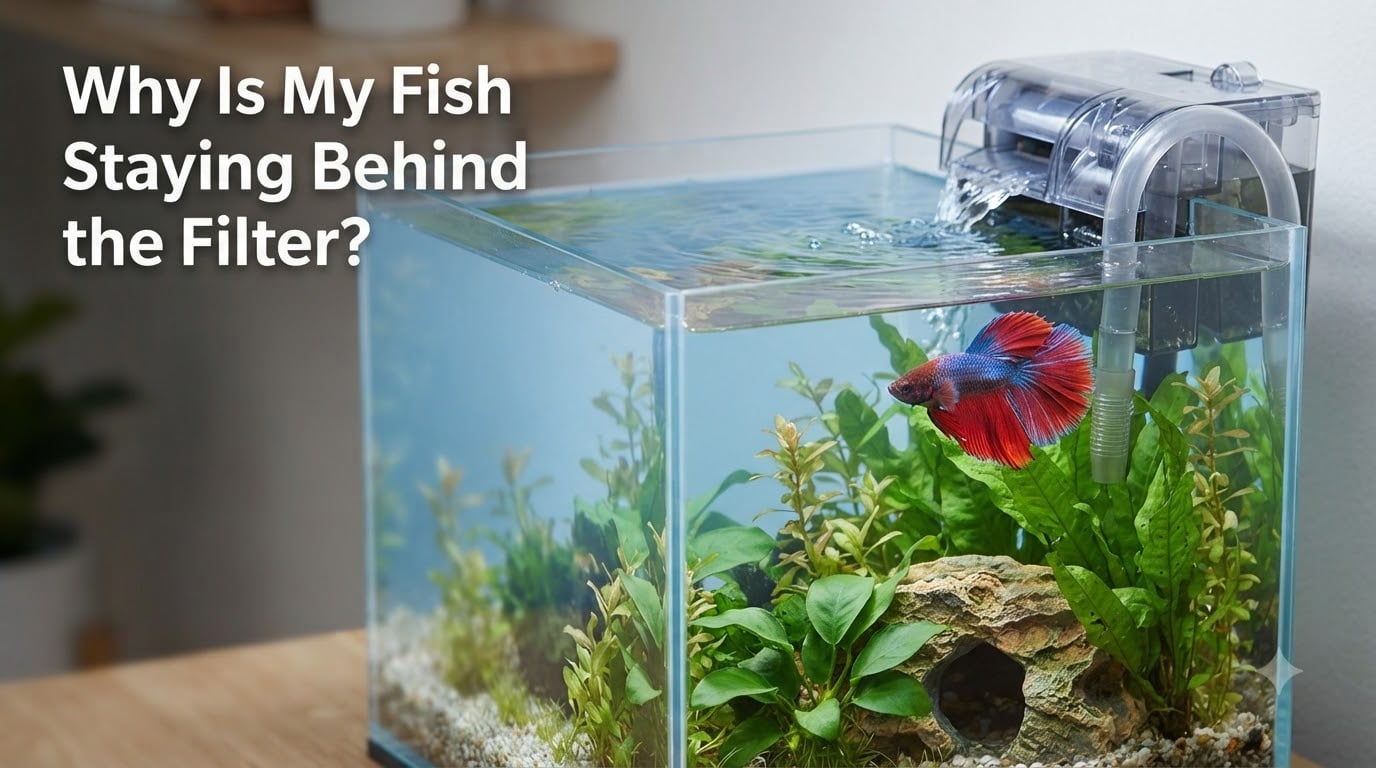
Seeing your fish camped out behind the filter day after day can be unsettling. I remember checking my tank one morning and watching my betta wedge himself between the filter and the glass, refusing to come out for hours. If you are asking yourself “why is my fish staying behind the filter,” the short answer is that the space behind the filter feels dark, safe, and oxygen-rich, which fish seek out when they are stressed, sick, or simply tired of a strong current.
This behavior is common, but it is not always harmless. Sometimes it points to ammonia building up, an uncycled tank, or even a dangerous filter intake. In this guide, I will walk through the six most common reasons your fish is hiding behind the filter, a quick diagnostic checklist to figure out which one applies to your tank, and the exact steps to fix each one. By the end, you will know whether your fish is just resting or whether something needs to change today.
Contents Table of Contents →
- 1Quick Answer: Why Is My Fish Staying Behind the Filter?
- 2Reason 1: The Filter Current Is Too Strong
- 3Reason 2: Poor Water Quality and Ammonia Stress
- 4Reason 3: Your Tank Is Not Fully Cycled Yet
- 5Reason 4: Not Enough Hiding Spots in the Tank
- 6Reason 5: Bullying or Territorial Tank Mates
- 7Reason 6: New Fish Acclimation Stress
- 8How to Diagnose Which Cause Applies to Your Fish
- 9Safety Warning: Filter Intake Can Trap or Kill Fish
- 10Quick Fixes for Each Cause
- 11Is It Ever Normal for a Fish to Stay Behind the Filter?
- 12FAQs
- 13Why is my fish staying behind the filter?
- 14How do I stop my fish from going behind the filter?
- 15Why is my betta fish always hiding behind the filter?
- 16How long does it take for new fish to stop hiding?
- 17How long can fish survive with the filter off?
- 18Can a filter hurt my fish?
- 19Conclusion
Quick Answer: Why Is My Fish Staying Behind the Filter?
Your fish is most likely staying behind the filter for one of six reasons: the current is too strong, ammonia or nitrite is stressing them, the tank is not fully cycled, there are not enough hiding spots, a tank mate is bullying them, or they are a new fish still adjusting. The area behind the filter offers low-flow shelter and steady oxygen, which makes it the go-to spot when a fish feels unsafe.
Here is the quick breakdown:
Strong current – The filter pushes your fish around, so they hide where the flow is calmer.
Poor water quality – Elevated ammonia or nitrite burns gills and makes fish seek the most oxygenated spot.
Uncycled tank – A tank still going through the nitrogen cycle has ammonia spikes that stress fish.
Few hiding spots – With no plants or caves, the filter gap becomes the only safe place.
Bullying – Aggressive tank mates chase the weaker fish into the corner near the filter.
New fish stress – Recently added fish hide for days or weeks while they adjust to unfamiliar surroundings.
If you want the fastest path to an answer, test your water first. I recommend an API Freshwater Master Test Kit because it covers ammonia, nitrite, nitrate, and pH in one box. Bad water parameters are the most common root cause, and the test takes about five minutes.
Reason 1: The Filter Current Is Too Strong
This is the cause I see most often, especially with bettas, guppies, and other slow-swimming species. A filter rated for a 30-gallon tank on a 10-gallon setup creates a current that pushes fish around like a treadmill they cannot step off. After fighting the flow all day, your fish retreats behind the filter where the water is calmer.
Bettas are the classic example. Their long fins act like sails, and a strong hang-on-back filter can exhaust them within hours. Forum members on r/bettafish consistently report that bettas hide behind filters until the flow is reduced. I had this exact issue with my own betta, who refused to leave the corner until I baffleled the output.
Signs the current is the problem:
Your fish gets swept sideways when it swims into open water.
Only the weakest swimmers hide while stronger fish seem fine.
The water surface has a visible push or ripple across the entire tank.
Your fish looks physically tired, with clamped fins and sluggish movement.
How to fix it: Reduce the flow using the filter’s built-in valve if it has one. If not, attach a sponge pre-filter to the intake or baffle the output with a plastic bottle, filter sponge, or commercially made baffle. Many betta owners switch to a sponge filter entirely, which provides gentle filtration without any current to fight. I made this switch and my betta started exploring the whole tank within a day.
Reason 2: Poor Water Quality and Ammonia Stress
When ammonia or nitrite levels climb, the water literally burns your fish’s gills. Fish respond by seeking the area with the highest oxygen and cleanest flow, which is right next to the filter output or intake. This is not a preference. It is survival behavior.
Ammonia stress shows up fast. Your fish may gasp at the surface, clamp its fins, refuse food, or list to one side. The AquariaCentral forum community has explained this clearly for years: both ammonia and nitrite inhibit a fish’s ability to breathe during the cycling process, which drives them toward the filter where oxygen exchange is strongest.
Test immediately if you notice any of these:
Fish hovering near the filter and breathing rapidly.
Red or inflamed gills.
Cloudy or milky water.
A smell of ammonia when you lift the lid.
Multiple fish hiding at once when they did not before.
How to fix it: Do a 28-percent water change with dechlorinated water right away. I use Seachem Prime because it also temporarily binds ammonia, buying you time. Then test daily and keep doing partial water changes until ammonia and nitrite read zero. Do not tear down the tank or replace the filter media, since that destroys the beneficial bacteria you need.
Reason 3: Your Tank Is Not Fully Cycled Yet
If your tank is new, this is probably the culprit. A tank that has not completed the nitrogen cycle cannot convert toxic ammonia into safer compounds. During a fish-in cycle, ammonia spikes happen quickly, and the fish pays the price.
The cycle takes anywhere from four to eight weeks. During that window, ammonia rises first, then nitrite (which is also toxic), and finally nitrate builds up as the cycle completes. Your fish hiding behind the filter during this period is a direct response to invisible water chemistry problems.
Signs your tank is still cycling:
The tank has been running for less than six weeks.
Ammonia or nitrite reads above zero on your test kit.
The water turned cloudy white around week two (a bacterial bloom).
Fish were added before the tank finished cycling.
How to fix it: Test every day and do water changes whenever ammonia or nitrite hits 0.25 ppm or higher. Dose with Prime daily to bind toxins, and add bottled bacteria like Tetra SafeStart or Seachem Stability to speed up the cycle. I cycled my first tank fish-in and tested twice a day for a month. It is tedious, but it works, and it keeps your fish alive while the bacteria colony establishes.
Reason 4: Not Enough Hiding Spots in the Tank
Sometimes the answer is simple. Fish are prey animals. In the wild, they have plants, roots, rocks, and caves to duck into when they feel exposed. In a bare or sparsely decorated tank, the gap behind the filter is the only dark, enclosed space available.
This is the fix that takes the least guesswork. If your tank has a single plastic plant and a flat decoration, your fish has nowhere else to feel safe. Adding cover often resolves the hiding behavior within hours.
Quick checklist for adding cover:
Add live or silk plants, especially tall ones that reach the surface.
Include at least one cave or cavern where the fish can disappear completely.
Break up sight lines with driftwood or rock structures.
Aim for roughly 50 to 70 percent of the tank having some form of cover.
I turned a bare 20-gallon into a planted tank over a weekend, and the difference was immediate. My danios, which had been glued to the filter corner, started schooling across the entire tank within a day. Give your fish options and they will use them.
Reason 5: Bullying or Territorial Tank Mates
If one fish is always behind the filter and the others swim freely, bullying is a likely cause. Aggressive tank mates chase submissive fish into the only corner where they cannot be followed. Over time, the bullied fish stops coming out at all because every attempt to feed or swim results in being harassed.
This happens most often when mixing species with mismatched temperaments. A common scenario is a peaceful community fish sharing a tank with a territorial species that claimed the open water as its own.
Signs of bullying:
One fish has torn fins or missing scales.
You see chasing or nipping when food is added.
The hiding fish waits until lights-out to come out.
One species constantly patrols while others stay pressed to the glass.
How to fix it: Rearrange the decorations to break up established territories. Add more hiding spots and visual barriers. If the aggression continues, you will likely need to rehome the bully or move the victim to a separate tank. I had to separate a territorial dwarf gourami from my harlequin rasboras after weeks of the rasboras hiding behind the filter. The moment the gourami left, they resumed normal schooling.
Reason 6: New Fish Acclimation Stress
If you added a fish within the last two weeks, hiding is often completely normal. A new fish does not know the tank, the other inhabitants, or the feeding routine. Their instinct is to find a sheltered spot and observe until they feel safe enough to explore.
This behavior usually resolves on its own, but you can speed it up. Keep the lights low for the first few days, avoid sudden movements near the tank, and let the fish settle at its own pace.
Timeline for new fish hiding:
Days 1 to 3: Hiding almost constantly is normal.
Days 4 to 7: Short exploratory trips should begin.
Week 2: The fish should be eating and moving around more confidently.
Week 3 and beyond: If the fish is still hiding, something else is wrong.
If hiding persists past two weeks, run through the other five causes. A fish that never settles in is telling you the environment has a problem.
How to Diagnose Which Cause Applies to Your Fish
Work through this checklist in order. Each step narrows down the cause and most take only a few minutes.
Step 1: Test the water. Check ammonia, nitrite, nitrate, and pH. If ammonia or nitrite is above zero, you have your answer. Fix the water first.
Step 2: Watch the current. Drop a small piece of flake food at the surface. If it shoots across the tank in seconds, the flow is too strong for your fish.
Step 3: Count hiding spots. Stand back and look at the tank. If you can see the entire back wall with no breaks, your fish has nowhere else to hide.
Step 4: Observe interactions. Watch at feeding time for 10 minutes. Note any chasing, nipping, or one fish blocking another from food.
Step 5: Check how long the fish has been in the tank. If less than two weeks, acclimation stress may be the whole story.
Most cases resolve at step 1 or step 2. Bad water and strong currents account for the majority of filter-hiding behavior I have seen across my own tanks and the forums I follow.
Safety Warning: Filter Intake Can Trap or Kill Fish
This deserves its own section because it is the one cause that can turn fatal fast. Small fish, bettas with long fins, shrimp, and fry can get pinned against the filter intake by suction. I have read too many forum posts from owners who found their fish stuck behind or against the intake, sometimes too late.
If your fish is behind the filter and not moving much, check that it has not been pulled against the intake slot. A sponge pre-filter over the intake costs a few dollars and prevents this entirely. This is the single cheapest safety upgrade you can make, and I recommend it for every tank with small fish or bettas.
Quick Fixes for Each Cause
Here is a summary of the solutions mapped to each cause so you can act fast.
Strong current: Baffle the output, reduce flow, or switch to a sponge filter.
Ammonia or nitrite: 28-percent water change with dechlorinated water, dose Prime, test daily.
Uncycled tank: Daily testing, water changes as needed, add bottled bacteria, wait it out.
Few hiding spots: Add plants, caves, and driftwood to cover 50 to 70 percent of the tank.
Bullying: Rearrange decor, add barriers, rehome aggressive fish if needed.
New fish stress: Dim lights, give it two weeks, do not chase the fish out.
Is It Ever Normal for a Fish to Stay Behind the Filter?
Sometimes, yes. Certain species naturally prefer low-flow areas and will rest near the filter as part of their normal routine. Plecos, Corydoras catfish, and other bottom-dwellers often park themselves near filter returns because the water movement brings them food particles.
The difference between normal and concerning comes down to behavior. A healthy fish that rests near the filter but also swims, eats, and interacts with the tank is fine. A fish that never leaves, refuses food, shows clamped fins, or gasps is in trouble.
FAQs
Why is my fish staying behind the filter?
Fish hide behind filters because the area offers calm water, shelter, and high oxygen. The six most common reasons are strong filter current, ammonia or nitrite stress, an uncycled tank, too few hiding spots, bullying from tank mates, and new fish acclimation stress. Test your water first to rule out the most dangerous causes.
How do I stop my fish from going behind the filter?
Fix the root cause. Reduce the filter flow with a baffle or sponge pre-filter, test and correct water parameters, add plants and caves for cover, and separate aggressive tank mates. A sponge pre-filter over the intake also prevents small fish from getting trapped.
Why is my betta fish always hiding behind the filter?
Bettas are weak swimmers with heavy fins, so a strong filter current exhausts them and drives them behind the filter where flow is calmer. Reduce or baffle the flow, add tall plants and a cave, and consider switching to a sponge filter. If the betta also refuses food or clamps its fins, test for ammonia immediately.
How long does it take for new fish to stop hiding?
Most new fish hide for the first one to three days and start exploring within a week. By week two they should be eating confidently. If a fish is still hiding behind the filter after two to three weeks, something else is wrong and you should test water quality and check for bullying.
How long can fish survive with the filter off?
Fish can survive without a filter for several hours to a couple of days depending on tank size and bioload, but beneficial bacteria start dying within a few hours without oxygenated flow. Never turn the filter off to solve hiding behavior. Instead, reduce the flow rate or add a baffle.
Can a filter hurt my fish?
Yes. A strong intake can trap small fish, bettas, shrimp, and fry against the filter, sometimes fatally. Long-finned fish can also have fins damaged by the intake. Adding a sponge pre-filter over the intake prevents injury and is recommended for any tank with small or delicate fish.
Conclusion
Figuring out why your fish is staying behind the filter comes down to a simple process: test the water, check the current, evaluate the layout, and watch the tank dynamics. In most cases, the fix is straightforward. A water change, a baffled filter, or a few new plants can turn things around in a single afternoon.
The behavior is your fish telling you something. Listen to it, run through the diagnostic steps, and act on what you find. Fish that feel safe swim, eat, and show their colors. Once you solve the underlying issue, your fish will leave the filter corner behind for good.