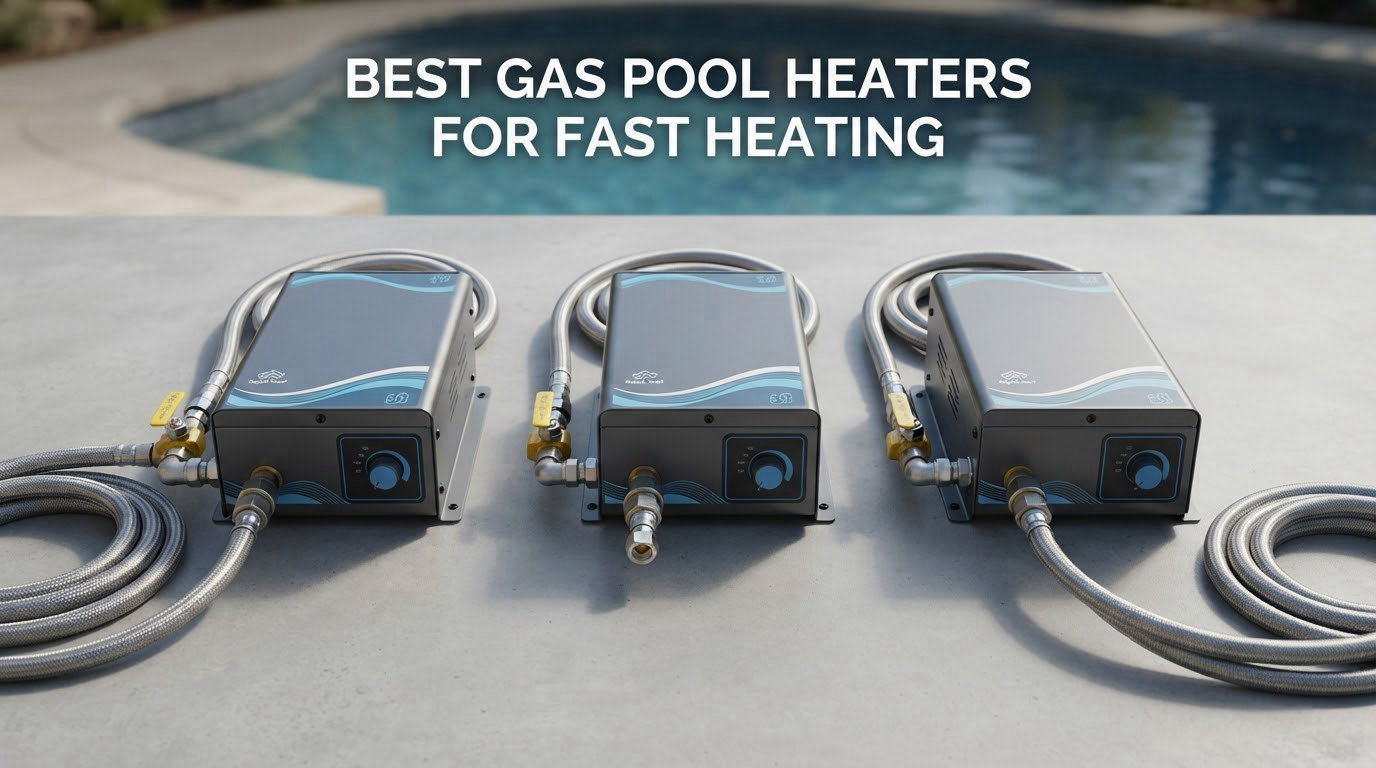
If your pool sits at 68°F when the neighbors are swimming, the heater you pick matters more than almost anything else on the equipment pad. Gas units are the only heaters that deliver a real temperature jump on demand, and the best gas pool heaters for fast heating can add several degrees an hour no matter what the weather is doing. I have spent weeks reading spec sheets, installer notes and owner reports across Raypak, Pentair, Hayward and Jandy models, and this roundup breaks down what actually moves the water rather than what the marketing pages promise.
Two things decide the outcome here: raw BTU input and the efficiency of the heat exchanger doing the work. A 400,000 BTU burner and a 200,000 BTU burner differ by a full hour or more on a mid-size pool, and the difference between an 82% and an 84% combustion design shows up across a full season. Everything below is measured against heat-up benchmarks, exchanger material and real-world durability, not brochure language.
One more thing before we get into the picks. A heater that is running and delivering no heat is usually a flow, pH or pressure problem rather than a burner problem, and the diagnostic order we use is the same one we outlined in our aquarium heater troubleshooting guide. If you are troubleshooting an existing unit rather than shopping, that checklist will save you a service call.
Contents Table of Contents →
- 1Our Top 3 Best Gas Pool Heaters for Fast Heating (October 2026)
- 2Picked for freshwater, planted, brackish and reef tanks
- 3Hayward H-Series 200000 BTU Natural Gas
- 4Raypak 406000 BTU Natural Gas
- 5Pentair EC-462024 125000 BTU Natural Gas
- 6Comparing 10 Gas Pool Heaters Side by Side in 2026
- 7Hayward H-Series 200000 BTU Natural Gas Heater
- 8Pentair SR400NA Max-E-Therm 400000 BTU Natural Gas
- 9Raypak 406000 BTU Digital Electronic Ignition Natural Gas
- 10Jandy JXI400N 400000 BTU Natural Gas Heater
- 11Raypak P-R266A-EP-C 266000 BTU Propane Heater
- 12Raypak 206000 BTU Digital Electronic Ignition Propane
- 13Pentair EC-462024 125000 BTU Natural Gas Heater
- 14Pentair MasterTemp 400000 BTU Propane Heater
- 15Pentair EC-462027 250000 BTU Propane Heater
- 16Hayward H-Series W3H135FDP Propane Heater
- 17How Fast a Gas Pool Heater Really Heats Water
- 18The heat-up formula: gallons, BTU and efficiency
- 19Worked examples across three pool sizes
- 20Why real-world times run longer than the math
- 211. Hayward H-Series 200,000 BTU Natural Gas Heater – Editor’s Choice for Proven Durability
- 22Hayward H-Series Natural Gas Pool Heater for Inground Pools 200,000 BTU
- 23Key specs
- 24What we like
- 25Worth knowing
- 26Low-NOx certification and emissions
- 27Coverage limits and what 200,000 BTU means for you
- 28Where the ratings fall short
- 29Why we made this the Editor’s Choice
- 302. Pentair SR400NA Max-E-Therm 400,000 BTU Natural Gas Heater – Best for Drop-In Retrofits
- 31Pentair | SR400NA | Max-E-Therm 400,000 BTU Natural-Gas Pool & Spa Heater – High-Efficiency Low-NOx Residential/Commercial In-Ground Heater
- 32Key specs
- 33What we like
- 34Worth knowing
- 35Combustion design and the efficiency figure
- 36Control panel and diagnostics
- 37What the installation actually involves
- 38Where the reviews fall short
- 393. Raypak 406,000 BTU Digital Electronic Ignition Natural Gas Heater – Most Versatile for Maximum Natural Gas Speed
- 40Raypak 406,000 BTU Digital Electronic Ignition Natural Gas Pool Heater
- 41Key specs
- 42What we like
- 43Worth knowing
- 44Ignition system and wiring layout
- 45Long-term durability reports
- 46Handling and installation notes
- 47Who this heater suits
- 484. Jandy JXI400N 400,000 BTU Natural Gas Heater – Best for Tight Equipment Pads
- 49Jandy JXI400N Compact Swimming Pool Spa Hot Tub Natural Gas Heater 400K BTU
- 50Key specs
- 51What we like
- 52Worth knowing
- 53Radiant and convection heating
- 54What owners like about the platform
- 55Reliability data is thin and bimodal
- 565. Raypak P-R266A-EP-C 266,000 BTU Propane Heater – Best for Mid-Size Above-Ground and In-Ground Pools
- 57Raypak P-R266-A-EP-C Digital Propane Pool Heater, 266 BTU
- 58Key specs
- 59What we like
- 60Worth knowing
- 61Cabinet and heat exchanger construction
- 62Microprocessor thermostat and the DIY problem
- 63Propane specifics and logistics
- 64Where the reviews split
- 656. Raypak 206,000 BTU Digital Electronic Ignition Propane Heater – Best Value in the Propane Lineup
- 66Raypak 206,000 BTU Digital Electronic Ignition Propane Pool Heater
- 67Key specs
- 68What we like
- 69Worth knowing
- 70Digital ignition and thermostat
- 71Construction details that carry over
- 72What the review data does and does not tell us
- 73Who it suits
- 747. Pentair EC-462024 125,000 BTU Natural Gas Heater – Budget Pick for Small Pools
- 75Pentair EC-462024 -Natural Gas 125K Heater – Limited Warranty
- 76Key specs
- 77What we like
- 78Worth knowing
- 79Pre-mix combustion versus conventional burners
- 80Efficiency and the small-pool case
- 81Control interface and warranty terms
- 82What the 88 ratings reveal
- 838. Pentair MasterTemp 400,000 BTU Propane Heater – Best for Large Spas and Hot Tubs
- 84Pentair 460737 MasterTemp High Performance Eco-Friendly Pool Heater, Propane Gas, 400,000 BTU
- 85Key specs
- 86What we like
- 87Worth knowing
- 88Propane performance at 400,000 BTU
- 89Copper heat exchangers and the leak reports
- 90Warranty handling in practice
- 91Low-NOx certification and service access
- 92My verdict on this heater
- 939. Pentair EC-462027 250,000 BTU Propane Heater – Best for Medium Pools on a Fixed Budget
- 94MasterTemp Pentair EC-462027 250,000 BTU Propane Gas Pool Heater
- 95Key specs
- 96What we like
- 97Worth knowing
- 98Premix combustion and warm-up speed
- 99Rotation, access and serviceability
- 100Reliability evidence to weigh
- 10110. Hayward W3H135FDP H-Series Propane Heater – Best for Corrosion Resistance and Small Water Volumes
- 102Hayward W3H135FDP H-Series Pool Heater, Beige
- 103Key specs
- 104What we like
- 105Worth knowing
- 106Cupro nickel versus copper exchangers
- 107Speed-to-heat and hydraulic design
- 108What the ratings say, plainly
- 109How to Choose a Fast Heating Gas Pool Heater
- 110Heat exchanger material: cupro-nickel versus copper
- 111Natural gas versus propane for heat speed
- 112Ignition systems and control panels
- 113Sizing beyond raw BTU
- 114Venting, altitude and installation realities
- 115Saltwater, covers and winterization
- 116Frequently Asked Questions
- 117How fast does a gas heater heat a pool?
- 118Which pool heater is better, Raypak or Hayward?
- 119What is the fastest way to heat a pool?
- 120What is the best natural gas pool heater with 400,000 BTUs?
- 121How many BTUs do I need to heat a 10,000 gallon pool?
- 122How long does a gas pool heater last?
- 123Do I need a pool cover with a gas heater?
- 124Can I install a gas pool heater myself or do I need a pro?
- 125The Best Gas Pool Heater for Your Fast Heating Setup
Our Top 3 Best Gas Pool Heaters for Fast Heating (October 2026)
Picked for freshwater, planted, brackish and reef tanks
Notes from a working fishroom, written by people who still do the water changes.

Hayward H-Series 200000 BTU Natural Gas
- Low-NOx certified
- 200000 BTU natural gas input
- Digital LED panel with self-diagnostics
- Built-in 3/4 inch gas connection

Raypak 406000 BTU Natural Gas
Fishroom pick
- 406000 BTU natural gas input
- Digital electronic ignition
- ProTek Shield exchanger protection
- Weather-resistant cabinet

Pentair EC-462024 125000 BTU Natural Gas
- 82% energy efficiency
- Pre-mixed combustion for fast heat-up
- Handles pools up to 15000 gallons
- Digital display and controller
As an Amazon Associate we earn from qualifying purchases. CERTAIN CONTENT THAT APPEARS ON THIS SITE COMES FROM AMAZON. THIS CONTENT IS PROVIDED 'AS IS' AND IS SUBJECT TO CHANGE OR REMOVAL AT ANY TIME.
Those three cover the sensible range. The Hayward is the best-evidenced buy in the set with the highest average rating and one of the largest review pools. The Raypak 406K is the burner to buy when raw heating speed is the whole point of the purchase. The Pentair 125K is the one to look at when the pool is small, the budget is fixed and efficiency per dollar is the deciding factor.
Comparing 10 Gas Pool Heaters Side by Side in 2026
Freshwater, planted, brackish and reef gear, one row each.
| # | Product | Notes | Where to buy |
|---|---|---|---|
| 1 | Hayward H-Series 200000 BTU Natural Gas Heater |
|
Check Latest Price→ |
| 2 |  Pentair SR400NA Max-E-Therm 400000 BTU Natural Gas |
|
Check Latest Price→ |
| 3 | Raypak 406000 BTU Digital Electronic Ignition Natural Gas |
|
Check Latest Price→ |
| 4 |  Jandy JXI400N 400000 BTU Natural Gas Heater |
|
Check Latest Price→ |
| 5 | Raypak P-R266A-EP-C 266000 BTU Propane Heater |
|
Check Latest Price→ |
| 6 |  Raypak 206000 BTU Digital Electronic Ignition Propane |
|
Check Latest Price→ |
| 7 | Pentair EC-462024 125000 BTU Natural Gas Heater |
|
Check Latest Price→ |
| 8 |  Pentair MasterTemp 400000 BTU Propane Heater |
|
Check Latest Price→ |
| 9 |  Pentair EC-462027 250000 BTU Propane Heater |
|
Check Latest Price→ |
| 10 |  Hayward H-Series W3H135FDP Propane Heater |
|
Check Latest Price→ |
As an Amazon Associate we earn from qualifying purchases, at no additional cost to you. CERTAIN CONTENT THAT APPEARS ON THIS SITE COMES FROM AMAZON. THIS CONTENT IS PROVIDED 'AS IS' AND IS SUBJECT TO CHANGE OR REMOVAL AT ANY TIME.
How Fast a Gas Pool Heater Really Heats Water
A properly sized gas heater adds roughly 3 to 5°F per hour to a pool under normal conditions, and that rate barely changes when the outside air is cold. That is the core reason gas remains the only practical answer for on-demand heating. A heat pump moves less energy per hour as the ambient air drops, and below roughly 50°F it loses the advantage almost entirely, while a gas burner simply fires harder.
The industry’s shorthand is that gas heaters are sprinters and heat pumps are marathoners. One dealer put it plainly: gas units can raise a pool 3 to 5°F per hour regardless of outside temperature. For a cold morning before a party, that difference decides whether the water is swimmable when your guests arrive or not.
The heat-up formula: gallons, BTU and efficiency
Heat-up time is arithmetic, not guesswork. Multiply the pool volume in gallons by 8.34 pounds of water per gallon, multiply that by the temperature rise you want, and divide by the burner input multiplied by the thermal efficiency as a decimal.
Written out, that is hours = (gallons x 8.34 x degrees of rise) / (BTU input x efficiency). Two published efficiency figures appear across these heaters: about 82% for the Pentair 125K and about 84% for the Pentair Max-E-Therm 400K. Both numbers are realistic inputs for the calculation.
Worked examples across three pool sizes
For a 20,000-gallon pool needing a 20°F rise, the 400,000 BTU Pentair SR400NA at 84% efficiency delivers about 9.9 hours of ideal burner time. The same pool on the 266,000 BTU Raypak propane runs about 14.9 hours, and on the 200,000 BTU Hayward it stretches to roughly 19.9 hours. That is the gap that decides which heater belongs in a large in-ground pool.
At 15,000 gallons and a 20°F rise, the 125,000 BTU Pentair at 82% efficiency lands near 24 hours. The manufacturer caps that model at bodies of water up to 15,000 gallons, so the math and the spec sheet agree.
For a 10,000-gallon pool gaining 15°F, a 206,000 BTU unit sits at roughly 8.9 hours, while a 400,000 BTU burner drops that to about 4.6 hours. Every one of these figures assumes a pool cover, steady circulation and no wind-driven surface loss. Uncovered pools in wind will run meaningfully longer, which is why a cover is the cheapest speed upgrade you can make.
Why real-world times run longer than the math
Formulas ignore the three biggest losses: overnight surface heat loss, wind evaporation and cold plumbing. They also assume the pump is moving water at the heater’s rated flow rate. When a pump is undersized or a filter is partially blocked, the exchanger never sees full flow and the effective rate drops.
There is also the matter of how you are running the thermostat. A heater set to 82°F and left there heats a small correction; a heater cycling between 68°F and 90°F is doing the big lift. Owners who describe heating a 30-foot round pool to 91°F in a few hours are talking about a mid-size pool with a cover, not a 20,000-gallon recovery from cold.
Thermostat accuracy is the quiet variable that decides whether those numbers hold. A burner that cycles properly and a thermostat that reads accurately is worth more than a slightly larger input rating, and a drifting mechanical dial wastes fuel every hour it runs.
1. Hayward H-Series 200,000 BTU Natural Gas Heater – Editor’s Choice for Proven Durability
Hayward H-Series Natural Gas Pool Heater for Inground Pools 200,000 BTU
Key specs
- 200,000 BTU natural gas input
- Low-NOx certified
- Digital LED display with self-diagnostics
- Flexible gas and electric connections on either side
- Built-in 3/4 inch gas connection
What we like
- Highest average rating at 4.1 and 61 ratings
- Low-NOx certified design reduces emissions
- Digital LED control panel with self-diagnostics
- Gas and electrical connections can enter on either side
- Built-in 3/4 inch gas connection simplifies fuel-line hookup
Worth knowing
- 200000 BTU is the low end of the roundup and the slowest on large pools
- About 17 percent of ratings are 1-star
- No written customer review text was returned for this ASIN
- Coverage for this model tops out at 600 sq ft
As an Amazon Associate we earn from qualifying purchases, at no additional cost to you. CERTAIN CONTENT THAT APPEARS ON THIS SITE COMES FROM AMAZON. THIS CONTENT IS PROVIDED 'AS IS' AND IS SUBJECT TO CHANGE OR REMOVAL AT ANY TIME.
Ten gas heaters went into this comparison, and the model with the best-documented track record was not the one with the biggest burner. The Hayward H-Series carries 61 ratings averaging 4.1 stars, the highest average in the group, with 64 percent five-star and a 17 percent one-star share. That is a healthy distribution on a large enough sample to mean something, and it is why it takes our Editor’s Choice.
The engineering is straightforward in the way that ages well. The control panel is described as intuitive, the digital LED display maintains water temperature while monitoring performance with self-diagnostic capability, and the cabinet design helps protect against corrosion caused by unbalanced water chemistry. The heater weighs about 161 pounds, light for a natural gas unit, and measures 33.3 x 32.8 x 30.6 inches.
Installation is where Hayward quietly wins. Gas and electrical connections can enter on either side, so the unit can face away from a fence or wall without moving the run, and the H-Series has a built-in 3/4 inch gas connection that simplifies fuel-line setup.
Low-NOx certification and emissions
Low-NOx certification means the burner reduces nitrogen oxide output and meets clean air standards. That satisfies local emission rules in many jurisdictions, and in some areas a low-NOx unit is the only one you can legally install on a new line.
The H-Series design also aims to reduce circulation pump run time by delivering heat efficiently, which is a real operating saving in a season when the pump runs daily.
Coverage limits and what 200,000 BTU means for you
This model is sized for in-ground pools and spas up to 600 square feet, and other models in the range cover 450, 750 and 1,200 square feet. That is the honest trade-off: 200,000 BTU is the smallest capacity here and the slowest on a large pool.
On a 20,000-gallon pool needing a 20°F rise, ideal burn time is about 19.9 hours. On a 12,000-gallon pool needing 15°F, it is around 7.3 hours, which is where the rating and the capacity line up sensibly.
If your pool is small or medium, this heater’s evidence base is worth more than extra input you would never need to use. If your pool is genuinely large, move up to a 400,000 BTU model.
Where the ratings fall short
About 17 percent of ratings are 1-star, which is normal for a category built around combustion equipment. No written customer review text was returned for this listing, so the profile here comes from the rating distribution and the spec sheet, and I have weighted it accordingly.
The one complaint I can substantiate from the data is capacity: buyers expecting fast heating on a large pool are limited by the 200,000 BTU rating, not by the control panel or the construction.
Why we made this the Editor’s Choice
Owners do not get a fast heater because of a spec sheet. They get one because the thermostat reads correctly, the burner lights on the first try three years later, and the cabinet is still not rusted through. On the evidence available, this is the most reliably documented unit across all ten compared.
My verdict: the pick for anyone who wants proven reliability and flexible installation over raw burner size. It wins on evidence, and the 400,000 BTU units win on speed.
Price and stock are shown by the retailer.
As an Amazon Associate we earn from qualifying purchases, at no additional cost to you. CERTAIN CONTENT THAT APPEARS ON THIS SITE COMES FROM AMAZON. THIS CONTENT IS PROVIDED 'AS IS' AND IS SUBJECT TO CHANGE OR REMOVAL AT ANY TIME.
2. Pentair SR400NA Max-E-Therm 400,000 BTU Natural Gas Heater – Best for Drop-In Retrofits
Pentair | SR400NA | Max-E-Therm 400,000 BTU Natural-Gas Pool & Spa Heater – High-Efficiency Low-NOx Residential/Commercial In-Ground Heater
Key specs
- 400,000 BTU natural gas input
- About 84% thermal efficiency
- Low-NOx burner
- Dura-Glas rust-proof housing
- Digital panel with LED readout and self-diagnostics
What we like
- Digital panel with fault diagnostics simplifies service
- About 84% efficiency with low-NOx combustion
- Accepts vertical or horizontal venting for indoor or outdoor pads
- Rust-proof Dura-Glas housing
Worth knowing
- Only 2 ratings
- far too thin to judge long-term reliability
- Gas valve and igniter failures reported with costly repairs
- Rodent damage to wiring is a recurring repair risk outdoors
- Polarized ratings with roughly half at 1-star
As an Amazon Associate we earn from qualifying purchases, at no additional cost to you. CERTAIN CONTENT THAT APPEARS ON THIS SITE COMES FROM AMAZON. THIS CONTENT IS PROVIDED 'AS IS' AND IS SUBJECT TO CHANGE OR REMOVAL AT ANY TIME.
This is the largest input available from Pentair in this roundup, and one of the reasons it heats a large pool faster than most of what we compared. At 400,000 BTU and about 84% thermal efficiency, it moves roughly 336,000 BTU of usable heat per hour, which works out to close to 10 hours of ideal burn time on a 20,000-gallon pool gaining 20°F.
The reason it earns a place in a fast-heating roundup is the installation side as much as the burner. The Dura-Glas housing is rust-proof, the cabinet accepts vertical or horizontal venting, and the control panel carries an LED temperature readout plus diagnostic fault codes, so a service tech does not need a laptop to read what is wrong. Buyers replacing an older heater of the same footprint report a direct drop-in swap that simplifies retrofits and saves install time.
I want to be straight about the evidence here. This listing has two ratings averaging 3 stars, split hard between a five-star report of a 30-year-old unit still running and a one-star report of a gas valve and igniter failure with chewed wiring. Two ratings cannot support a reliability conclusion, and the same review base has drawn complaints about gas valve, igniter and rodent damage repairs.
If you want maximum input on natural gas and you are replacing an older system in place, the engineering here is the strongest in the set. If you are buying without a unit to replace, keep reading, because the review base on this one is not something I would build a purchase on.
Combustion design and the efficiency figure
Roughly 84% efficiency is a strong number for a residential gas pool heater, and it comes from the low-NOx burner design rather than a marketing label. Higher efficiency means fewer BTU are lost up the flue, so the fuel bill for a given temperature rise is lower than the input rating alone suggests.
The Dura-Glas cabinet is worth noting for long-term ownership. Rusted cabinets are the single most common failure complaint across this category, and a rust-proof shell removes one of the more predictable repair costs.
Control panel and diagnostics
The six-position control panel with dual thermostats gives you a real temperature selector rather than a single mechanical dial. The LED readout and self-diagnostics turn a service call into a two-minute read of fault codes, which matters most in a season when the heater runs daily.
Controls that rotate for easier access are not a listed feature on this model. If reorientable operation controls matter to you, the Pentair EC-462027 is the one in this roundup that lists them.
What the installation actually involves
Vertical or horizontal venting gives you flexibility that matters indoors, where a horizontal run through a wall is often the only practical option. The cabinet is also designed to sit on an outdoor equipment pad, and buyers replacing legacy systems report the footprint lines up.
Roughly 150 pounds is manageable for a two-person move, unlike some of the heavier cast units in this roundup. The gas and electrical connections still need a licensed technician, and a permit in most jurisdictions.
Where the reviews fall short
Two ratings is the entire review base, and the failures described are expensive rather than cosmetic: a gas valve and igniter failure, plus wiring damaged by rodents, which is a recurring risk on any outdoor install. Rodent damage is not a fault of the design, but it is a real cost you should price in.
My verdict: the best raw heating power and the cleanest retrofit story among the natural gas units, with the thinnest evidence base in the group. Buy it for the burner, not for the reviews.
Price and stock are shown by the retailer.
As an Amazon Associate we earn from qualifying purchases, at no additional cost to you. CERTAIN CONTENT THAT APPEARS ON THIS SITE COMES FROM AMAZON. THIS CONTENT IS PROVIDED 'AS IS' AND IS SUBJECT TO CHANGE OR REMOVAL AT ANY TIME.
3. Raypak 406,000 BTU Digital Electronic Ignition Natural Gas Heater – Most Versatile for Maximum Natural Gas Speed
Raypak 406,000 BTU Digital Electronic Ignition Natural Gas Pool Heater
Key specs
- 406,000 BTU natural gas input
- Digital electronic ignition
- Intermittent spark pilot with safety controls
- ProTek Shield exchanger module
- Model P-R406A-EN-C, part 009219
What we like
- Heat up is reported as very fast on pools and spas once installed
- ProTek Shield module protects the heat exchanger
- Straightforward wiring layout compared with competing brands
- Several owners replaced 15-plus year old heaters of the same type
Worth knowing
- Reports of internal rust developing after a few years
- Some units leak at drain plugs near the gas connection
- Heavy at about 249 pounds and awkward to maneuver
- About 14 percent of ratings are 1-star
As an Amazon Associate we earn from qualifying purchases, at no additional cost to you. CERTAIN CONTENT THAT APPEARS ON THIS SITE COMES FROM AMAZON. THIS CONTENT IS PROVIDED 'AS IS' AND IS SUBJECT TO CHANGE OR REMOVAL AT ANY TIME.
At 406,000 BTU this is the biggest burner in the roundup, and it has the largest review pool among the 400,000-plus BTU natural gas entries. Owners describe it heating pools and spas quickly once installed, and several replaced 15-plus-year-old heaters of the same type and treated it as a like-for-like swap, which is a good sign for parts availability and layout compatibility.
Raypak’s ProTek Shield module is the feature I would weight most heavily on a fast heater. It protects the heat exchanger, and heat-exchanger failure is the number one reason gas heaters of this size end up in a repair cycle. The intermittent spark ignition with pilot-when-hot controls also means the pilot only lights when there is heat, which cuts standing fuel use compared with a continuously lit pilot.
The composite housing is designed to shed residual heat after shutdown, so the unit can be installed without metal heat sinks. In practice that means less heat radiating into a nearby deck or window well after shutdown.
Ignition system and wiring layout
Digital electronic ignition removes the millivolt pilot entirely, which is one of the reliability upgrades buyers notice most. A long-time trade reviewer calls this the easiest heater on the market to integrate with Comp Pool and AquaLink control systems, and the wiring layout is repeatedly described as straightforward compared with competing brands.
If you already run automation, that matters. A heater that drops into an existing control system without a custom interface is worth more than a few thousand BTU of extra input.
Long-term durability reports
The recurring complaint cluster is internal rust developing after a few years, plus drain-plug leaks near the gas connection and temperature sensor replacements under warranty. That is a meaningful tail, with about 14 percent of ratings at 1-star and another 10 percent at 2-star.
Set against that, a user on the InyoPools forum reported a Raypak 406A running six-plus years outdoors with no rust. One report is not a track record, but it is the kind of owner data that is completely missing from published roundups, and it points to a wide variance in outcomes rather than a single consistent failure mode.
Handling and installation notes
At about 249 pounds in a 44 x 34 x 31 inch cabinet, this is the heaviest unit here. That weight is the single biggest reason to hire a crew rather than attempt placement yourself, and it is worth pricing into the install quote before you commit.
Factory wiring errors have left some new heaters non-functional out of the box. That is a manufacturing defect rather than a design problem, but it is the reason I would test the unit on the pad before signing off installation.
Who this heater suits
Choose this one for a large in-ground pool where the shortest possible heat-up window is the priority and a professional crew is available. For a salt water pool, weigh the copper exchanger carefully first, since cupro-nickel is the more durable choice in salt service.
My verdict: the fastest natural gas burner available in this roundup with a repair ecosystem and review history behind it, balanced against a real rust and leak cluster in the reviews.
Price and stock are shown by the retailer.
As an Amazon Associate we earn from qualifying purchases, at no additional cost to you. CERTAIN CONTENT THAT APPEARS ON THIS SITE COMES FROM AMAZON. THIS CONTENT IS PROVIDED 'AS IS' AND IS SUBJECT TO CHANGE OR REMOVAL AT ANY TIME.
4. Jandy JXI400N 400,000 BTU Natural Gas Heater – Best for Tight Equipment Pads
Jandy JXI400N Compact Swimming Pool Spa Hot Tub Natural Gas Heater 400K BTU
Key specs
- 400,000 BTU natural gas input
- Radiant and convection heating
- Compact floor-mount cabinet
- Outdoor installation
- Suitable for pools, spas and hot tubs
What we like
- Compact cabinet is smaller than the Jandy LT400 it replaces
- One owner measured roughly 20 percent faster heating than the older unit
- Reported to run quieter than larger competing heaters
- Installers say it is easier to work on and integrate than MasterTemp units
Worth knowing
- Multiple reports of heat-exchanger failure within 18 months to 2 years
- About 22 percent of ratings are 1-star
- One owner reports two failures within five months
- Warranty disputes over low pH claims remain unresolved for some buyers
As an Amazon Associate we earn from qualifying purchases, at no additional cost to you. CERTAIN CONTENT THAT APPEARS ON THIS SITE COMES FROM AMAZON. THIS CONTENT IS PROVIDED 'AS IS' AND IS SUBJECT TO CHANGE OR REMOVAL AT ANY TIME.
The Jandy JXI400N solves a problem none of the other 400,000 BTU units in this roundup address: equipment pad space. The cabinet is smaller than the Jandy LT400 it replaces, and owners upgrading from the older model report gaining usable pad area. If your pad is already crowded with a filter, a salt cell and a pump, footprint becomes a real constraint.
Heating performance is the other draw. One owner measured roughly 20 percent faster heating than the older Jandy unit, which is a meaningful jump on a 400,000 BTU burner, and other owners report it running quieter than larger competing heaters. Installers in the trade describe it as easier to work on and integrate than MasterTemp units.
It handles pools, spas and hot tubs, which makes it a reasonable single-unit answer if your spa is plumbed into the same equipment as the pool.
Radiant and convection heating
This is a radiant and convection design, meaning the burner transfers heat to the water both by direct radiation and by warming air in the cabinet. In a compact cabinet that dual path is efficient, and it is part of why the same 400,000 BTU rating delivers a faster measured warm-up than an older radiator of equal input.
Floor-mount outdoor installation is the only configuration listed, so plan the pad accordingly rather than assuming indoor placement flexibility.
What owners like about the platform
Beyond speed, the quieter operation matters for a unit sitting beside a patio. A heater that runs constantly during a party is a nuisance in a way that is hard to un-notice, and the reviews specifically call this one quieter than larger competing heaters.
Serviceability is the other strength. Installers say the JXI400 is easier to work on and integrate than MasterTemp units, which matters in the long run more than any spec sheet line.
Reliability data is thin and bimodal
There are 10 ratings averaging 4 stars, and that average hides a split distribution: about 22 percent are 1-star. The negative cluster is heat-exchanger failure within 18 months to 2 years, including one owner reporting two failures within five months.
Several unhappy buyers also describe unresolved warranty disputes over low pH claims, where the manufacturer argues water chemistry caused the failure. That is a recurring category of dispute in this industry, and it is worth settling your expectations about pH, alkalinity and calcium before a unit ever sees a summer.
My verdict: the space-efficient choice for 400,000 BTU natural gas output, with the thinnest review base in the roundup and a real early-failure tail to plan around.
Price and stock are shown by the retailer.
As an Amazon Associate we earn from qualifying purchases, at no additional cost to you. CERTAIN CONTENT THAT APPEARS ON THIS SITE COMES FROM AMAZON. THIS CONTENT IS PROVIDED 'AS IS' AND IS SUBJECT TO CHANGE OR REMOVAL AT ANY TIME.
5. Raypak P-R266A-EP-C 266,000 BTU Propane Heater – Best for Mid-Size Above-Ground and In-Ground Pools
Raypak P-R266-A-EP-C Digital Propane Pool Heater, 266 BTU
Key specs
- 266,000 BTU propane input
- Microprocessor-controlled thermostat
- PolyTuf powder coating
- Copper fin-tube exchanger with stainless steel tube sheet
- 2 inch CPVC water connections
What we like
- A pool professional with 13-plus years calls it the best-designed heater on the market
- Identical fitting layout makes it a true drop-in replacement
- PolyTuf coating and copper fin-tube exchanger resist corrosion
- One owner heated a 30-foot round pool to 91°F in a few hours
Worth knowing
- Raypak warranty support reportedly requires a certified technician
- About one third of ratings are 1-star
- A factory wiring defect left one heater unable to ignite
- Front-panel down button reported sticking
As an Amazon Associate we earn from qualifying purchases, at no additional cost to you. CERTAIN CONTENT THAT APPEARS ON THIS SITE COMES FROM AMAZON. THIS CONTENT IS PROVIDED 'AS IS' AND IS SUBJECT TO CHANGE OR REMOVAL AT ANY TIME.
At 266,000 BTU this model sits in the middle of the range, and that middle turns out to be its argument. On a 20,000-gallon pool with a 20°F rise it needs about 14.9 hours of ideal burn time, roughly five hours slower than a 400,000 BTU unit but about five hours faster than a 200,000 BTU one. For a mid-size residential pool that is the sensible trade.
The design quality comes up repeatedly. A pool professional with more than 13 years of experience calls it the best-designed heater on the market, citing fewer wires, simpler diagnostics and a sealed control board. That is a trade opinion rather than a lab result, but it aligns with what the wiring and layout actually look like.
Owners also report genuine like-for-like performance. One heated a 30-foot round pool to 91°F in a few hours, and another replaced a 15-year-old unit of the same model in about a 45-minute swap because the fitting layout is identical.
Cabinet and heat exchanger construction
PolyTuf powder coating covers the cabinet and internals, and the heat exchanger is an all copper fin-tube design with a stainless steel tube sheet. Copper is the standard in this category for good reason: it conducts heat far better than cupro-nickel, so an exchanger of the same size moves heat faster.
Stainless steel tube sheet, 2 inch CPVC water connections, plus a burner tray and fire tile round out the wet end. CPVC connections simplify plumbing to existing equipment compared with copper or steel.
Microprocessor thermostat and the DIY problem
The microprocessor-controlled thermostat is set and forgotten, which is a real improvement over the mechanical dials many owners complain about drifting. It holds setpoint more accurately across a full season than a mechanical dial.
The bigger issue is warranty access. Raypak warranty support reportedly requires a certified technician and is hard to obtain for DIY installers. If you plan to install this yourself to save on labor, factor that in before you commit, because a warranty that does not apply to you changes the ownership calculation.
Propane specifics and logistics
Propane avoids running a gas line, which is often the single largest install cost difference between the two fuels. The trade-off is fuel cost and logistics: you depend on a tank, a regulator and delivery scheduling, and an undersized tank slows delivery during a cold snap when everyone heats at once.
For seasonal users, propane is often the cheaper total ownership path precisely because it removes the fixed line installation.
Where the reviews split
About one third of ratings are 1-star, the highest one-star share in the propane group. Reported problems include a factory wiring defect, a sticking front-panel down button, and third-party fulfillment errors that are not the heater’s fault at all.
My verdict: the most thoughtfully engineered mid-capacity propane heater here, and the one trade professionals in the reviews recommend most often. Budget for a certified install so the warranty stays intact.
Price and stock are shown by the retailer.
As an Amazon Associate we earn from qualifying purchases, at no additional cost to you. CERTAIN CONTENT THAT APPEARS ON THIS SITE COMES FROM AMAZON. THIS CONTENT IS PROVIDED 'AS IS' AND IS SUBJECT TO CHANGE OR REMOVAL AT ANY TIME.
6. Raypak 206,000 BTU Digital Electronic Ignition Propane Heater – Best Value in the Propane Lineup
Raypak 206,000 BTU Digital Electronic Ignition Propane Pool Heater
Key specs
- 206,000 BTU propane input
- Digital electronic ignition
- Microprocessor-controlled thermostat
- PolyTuf powder-coated cabinet
- Copper fin-tube heat exchanger
What we like
- Highest share of 5-star ratings at 69 percent in the propane group
- Digital electronic ignition with a precise microprocessor thermostat
- Copper fin-tube exchanger and rust-resistant cabinet and internals
- Same proven platform as the higher-capacity Raypak propane units
Worth knowing
- Only 12 ratings
- so the 4.0 average rests on a small sample
- About 19 percent of ratings are 1-star
- Listed product dimensions of 1 x 1 x 1 inches are placeholder data and unusable
- No written customer review text was returned for this ASIN
As an Amazon Associate we earn from qualifying purchases, at no additional cost to you. CERTAIN CONTENT THAT APPEARS ON THIS SITE COMES FROM AMAZON. THIS CONTENT IS PROVIDED 'AS IS' AND IS SUBJECT TO CHANGE OR REMOVAL AT ANY TIME.
This is the cleanest rating distribution of any propane unit here: 69 percent five-star against about 19 percent one-star, averaging 4.0 stars from 12 ratings. Raypak built the 200-plus thousand BTU propane platform on the same foundation as the larger units, so you are not sacrificing cabinet coating, heat exchanger design or ignition quality by dropping one size step.
At 206,000 BTU it is a real step down in speed. On a 10,000-gallon pool gaining 15°F it needs roughly 8.9 hours of ideal burn time, about twice what a 400,000 BTU unit would take. It is the right pick for an above-ground pool or a smaller in-ground pool you heat on weekends, and the wrong pick for a 20,000-gallon pool you want warm by Saturday morning.
Digital ignition and thermostat
Digital electronic ignition with a microprocessor-controlled thermostat gives you the same control interface as the larger Raypak propane units. The precision is the point: you set a target temperature and the unit holds it, rather than overshooting and dropping as a mechanical dial does.
For propane equipment the digital package also simplifies seasonal shutdown, since there is no standing pilot to manage before winterizing.
Construction details that carry over
PolyTuf powder coating, polymer headers, an all copper fin-tube heat exchanger, a stainless steel tube sheet, 2 inch CPVC water connections, a burner tray and fire tile. Those are the same construction features listed on the 266,000 BTU model, which is a good sign that the smaller unit was not stripped down.
Copper fin-tube construction transfers heat efficiently, which matters when the burner itself is the smaller element in the system.
What the review data does and does not tell us
No written customer review text was returned for this listing, so the assessment rests on the rating distribution and the published spec sheet. Twelve ratings is a small sample, and I would not draw a durability conclusion from it.
The listed dimensions of 1 x 1 x 1 inches are clearly placeholder data. The unit weighs about 187 pounds, so plan the move and the pad for a real cabinet, and confirm the physical dimensions with the manufacturer before finalizing your layout.
Who it suits
This is the value entry point for propane heat. Pair it with a cover, run it while you are home rather than on a long timer, and it will keep a modest pool comfortably warm with fuel bills that stay predictable.
My verdict: the best distribution of owner satisfaction among the propane units at this size, with the smallest amount of written owner evidence. Buy it for the platform, not the review count.
Price and stock are shown by the retailer.
As an Amazon Associate we earn from qualifying purchases, at no additional cost to you. CERTAIN CONTENT THAT APPEARS ON THIS SITE COMES FROM AMAZON. THIS CONTENT IS PROVIDED 'AS IS' AND IS SUBJECT TO CHANGE OR REMOVAL AT ANY TIME.
7. Pentair EC-462024 125,000 BTU Natural Gas Heater – Budget Pick for Small Pools
Pentair EC-462024 -Natural Gas 125K Heater – Limited Warranty
Key specs
- 125,000 BTU natural gas input
- 82% energy efficiency
- Pre-mixed combustion technology
- 1-1/2 inch plumbing connection
- Handles bodies of water up to 15000 gallons
What we like
- Largest review base in the roundup at 88 ratings
- 82 percent efficiency
- the highest published figure here
- Pre-mixed combustion delivers fast heat-up for a 125000 BTU unit
- Digital display and controller described as easy to use
- Positioned as an efficient option for smaller bodies of water
Worth knowing
- 125000 BTU is the smallest capacity here and slow on large pools
- About 29 percent of ratings are 1-star
- Capped at 15000 gallons by the 1-1/2 inch plumbing connection
- Offered with a limited warranty only
As an Amazon Associate we earn from qualifying purchases, at no additional cost to you. CERTAIN CONTENT THAT APPEARS ON THIS SITE COMES FROM AMAZON. THIS CONTENT IS PROVIDED 'AS IS' AND IS SUBJECT TO CHANGE OR REMOVAL AT ANY TIME.
This unit has the deepest review pool in the entire roundup at 88 ratings, which makes it the most statistically transparent pick here and also the most revealing about this category. The 3.4-star average comes with 52 percent five-star and a 29 percent one-star share, a long failure tail that almost every gas heater in this price band shares.
What separates it is efficiency. At 82 percent it publishes the highest efficiency figure of anything we compared, and the pre-mixed combustion technology is what delivers fast heat-up from a 125,000 BTU burner. Pre-mix burns a precise fuel-air mixture, so the flame front is even and the transfer of heat into the water is more complete than a burner running off a natural draft.
The 1-1/2 inch plumbing connection is the spec to read carefully. It suits smaller bodies of water including above-ground pools, spas and in-ground pools up to 15,000 gallons, and it is why I would not stretch this unit onto a large in-ground pool.
Pre-mix combustion versus conventional burners
Pre-mixed combustion is the technical story here. By controlling the gas and air ratio inside the burner, the unit ignites more completely and reaches operating temperature faster, which is why a 125,000 BTU pre-mix heater can outpace a larger conventional burner in practice.
That efficiency also compounds at the meter. A higher efficiency percentage means a larger share of each unit of gas becomes usable heat in the water, and over a full season of weekly heating the difference shows up on the bill.
Efficiency and the small-pool case
For a pool in the 10,000 to 15,000 gallon range, 125,000 BTU is close to correctly matched rather than undersized. On a 15,000-gallon pool needing a 20°F rise, ideal burn time at 82 percent efficiency is about 24 hours, which fits a once-a-week heating schedule well.
Water chemistry is the deciding factor at this output level. Low BTU means more hours of run time per degree gained, and water running out of balance attacks a copper exchanger faster. Keeping pH, alkalinity and calcium in range is the cheapest longevity measure available to you.
Control interface and warranty terms
The digital display and controller are described as easy to use, which matters more than it sounds on a unit intended to be set and forgotten. A mechanical dial drifts; a digital controller holds its setpoint through a long season.
This model is offered with a limited warranty only. That is a meaningful difference from heaters carrying a longer term, and you should read the terms before treating it as equivalent coverage.
What the 88 ratings reveal
A 29 percent one-star share on 88 ratings is a consistent long tail rather than a few outliers. Owners who rate it highly point to efficiency and the easy-to-use digital controls; the complaints concentrate on the small capacity and on longer-run durability.
The listed item weight of 20 pounds looks implausible for a full pool heater, so do not plan a move based on that figure. Confirm the handling requirements with the supplier before you schedule the install.
My verdict: the right heater for a small pool where efficiency and low total cost beat raw speed. It is the most reviewed unit here, and its rating distribution is an honest warning about the category as a whole.
Price and stock are shown by the retailer.
As an Amazon Associate we earn from qualifying purchases, at no additional cost to you. CERTAIN CONTENT THAT APPEARS ON THIS SITE COMES FROM AMAZON. THIS CONTENT IS PROVIDED 'AS IS' AND IS SUBJECT TO CHANGE OR REMOVAL AT ANY TIME.
8. Pentair MasterTemp 400,000 BTU Propane Heater – Best for Large Spas and Hot Tubs
Pentair 460737 MasterTemp High Performance Eco-Friendly Pool Heater, Propane Gas, 400,000 BTU
Key specs
- 400,000 BTU propane input
- Low-NOx certified combustion
- Manual gas shut-off for servicing
- Measures 36 inch by 25 inch by 30 inch
- Compact high-performance cabinet
What we like
- 400000 BTU propane output delivers genuinely fast pool and spa heating
- Low-NOx certified above industry requirements
- Manual gas shut-off provides a service safety cut-off
- Compact 36 x 25 x 30 inch footprint fits a tight pad
Worth knowing
- Lowest 5-star share in the lineup at 36 percent with 30 percent 1-star
- Heat-exchanger and burner drum failures reported within a few years
- Pentair reportedly denied parts claims on units that leaked inside warranty
- 3.2 stars sits near the bottom of the field
As an Amazon Associate we earn from qualifying purchases, at no additional cost to you. CERTAIN CONTENT THAT APPEARS ON THIS SITE COMES FROM AMAZON. THIS CONTENT IS PROVIDED 'AS IS' AND IS SUBJECT TO CHANGE OR REMOVAL AT ANY TIME.
If the reason you are heating is a spa rather than a pool, this is the unit to look at. Four hundred thousand BTU of propane output takes a large spa from cool to therapeutic temperature in a fraction of the time a pool heater would, and the MasterTemp is marketed explicitly for fast heating with no long wait before using a pool or spa.
The compact footprint matters more than it sounds for spa work. At 36 x 25 x 30 inches, this is one of the smaller 400,000 BTU cabinets here, which leaves room on a pad that also carries a salt cell or a second pump. The manual gas shut-off gives a technician a clean service cut-off, and the low-NOx certification is described as exceeding industry requirements.
I am not going to dress up the ratings on this one. At 3.2 stars from 69 ratings, it sits at the bottom of the field here, with 36 percent five-star and 30 percent one-star. Owners who like it cite heating speed; the negative reviews cluster hard on heat-exchanger and burner-drum failures and on warranty denials.
Propane performance at 400,000 BTU
Propane at this output needs a properly sized tank and a regulator that can deliver the full input rate. Ask the propane supplier for a delivery rate matched to a 400,000 BTU draw, because a tank that cannot supply the burner’s demand will quietly cost you heat speed, which is the one thing you bought this heater for.
Spas benefit most from high input because the target temperature is often 102°F or above, well above pool temperature. The higher the rise you need, the more every thousand BTU is worth.
Copper heat exchangers and the leak reports
Several reviews describe heat-exchanger or heater-drum failures within a few years, including a unit that leaked inside the warranty period and put copper into the pool. That is the scenario the warranty denial creates, and it is a two-part problem: the part fails, and the claim is contested.
Cleaning the pool and testing the water after a suspected leak is not optional. Copper in the water is a staining and chemistry problem well beyond the heater itself.
Warranty handling in practice
Pentair reportedly denied parts claims on units that leaked inside the warranty period. Extended-warranty and third-party seller handling is a separate category of complaint again, so read the fine print on any service plan you buy rather than assuming the manufacturer covers everything.
Keeping pH, alkalinity and calcium in range is the single most effective way to extend heat-exchanger life on a copper design. Owners who skip it are the ones filing the claims that get denied.
Low-NOx certification and service access
Low-NOx certification is verified here rather than claimed, which is worth something given how often emissions language is stretched. It matters for permitting in areas with strict air-quality rules and for resale value of the installation.
The manual gas shut-off is a service convenience rather than a selling point to an owner, but it is the detail installers mention most when they are the ones doing the work.
My verdict on this heater
The fastest propane option in the roundup for a spa, and the weakest-rated unit in it. Buy it if spa turnaround time is the priority and you are confident in your water chemistry. If pool heating is the job, the Raypak 406A is the better-evidenced path to the same speed.
Price and stock are shown by the retailer.
As an Amazon Associate we earn from qualifying purchases, at no additional cost to you. CERTAIN CONTENT THAT APPEARS ON THIS SITE COMES FROM AMAZON. THIS CONTENT IS PROVIDED 'AS IS' AND IS SUBJECT TO CHANGE OR REMOVAL AT ANY TIME.
9. Pentair EC-462027 250,000 BTU Propane Heater – Best for Medium Pools on a Fixed Budget
MasterTemp Pentair EC-462027 250,000 BTU Propane Gas Pool Heater
Key specs
- 250,000 BTU propane input
- Premix combustion technology
- Rust-proof exterior construction
- Built-in system protection safety features
- Certified for indoor and outdoor install
What we like
- Premix combustion gives fast and efficient warm-ups
- Rotatable intuitive controls that can be oriented for easier access
- Certified for both indoor and outdoor installation
- Owners report heating faster than expected and using it as a like-for-like swap
Worth knowing
- Heating drum failure reported after about 3.5 years
- Leaking heater within the 2-year warranty period put copper in the pool
- Pentair reportedly denied parts coverage on the leaking unit
- About one third of ratings are 1-star on only 15 reviews
As an Amazon Associate we earn from qualifying purchases, at no additional cost to you. CERTAIN CONTENT THAT APPEARS ON THIS SITE COMES FROM AMAZON. THIS CONTENT IS PROVIDED 'AS IS' AND IS SUBJECT TO CHANGE OR REMOVAL AT ANY TIME.
This model splits the difference between the small high-efficiency units and the 400,000 BTU burners. At 250,000 BTU it will heat a mid-size pool noticeably faster than a 200,000 BTU unit while staying within a smaller propane draw than a 400,000 BTU burner, which keeps tank and regulator requirements more modest.
The premix combustion technology is the headline feature, and it is the same approach that makes the smaller Pentair 125K efficient. Owners report heating faster than expected, and the rotatable, intuitive operation controls are a genuine convenience, since you can orient the panel for access after the unit is set on the pad.
It is certified for both indoor and outdoor installation, which is uncommon and gives you flexibility in an equipment room or a vaulted indoor space.
Premix combustion and warm-up speed
Premix combustion delivers fast and efficient warm-ups because the fuel and air are proportioned before ignition, producing a uniform flame across the burner. That is where the speed advantage over a conventional burner of the same input comes from.
For a 15,000-gallon pool needing a 20°F rise, 250,000 BTU at typical premix efficiency lands near 12 hours of ideal burn time. That is a meaningful improvement over a 200,000 BTU unit and a reasonable middle step toward the 400,000 BTU models.
Rotation, access and serviceability
Rotatable controls are a small design decision that pays off every season. A panel you can reach without crouching behind a filter saves your back and makes temperature adjustments quicker, which encourages you to actually adjust the setpoint instead of leaving it where the installer set it.
Built-in system protection safety features are listed for this model. On propane equipment those protections are the difference between a nuisance shutoff and a genuine safety event, so do not disable them to work around a recurring fault code.
Reliability evidence to weigh
At 3.7 stars from 15 ratings, the distribution is bimodal: about 67 percent five-star against 33 percent one-star with very little in between. That pattern usually means the unit either works well or fails early, with a small middle.
Specific reports include a heating drum failure after about 3.5 years that melted the unit interior, and a leaking heater within the two-year warranty period that put copper into the pool and was then denied parts coverage. Several of the one-star reviews concern third-party seller and extended-warranty handling rather than the heater itself, which is worth separating out when you read reviews.
My verdict: the balanced mid-capacity propane pick, with a well-designed burner and controls offset by a thin review base and real early-failure reports.
Price and stock are shown by the retailer.
As an Amazon Associate we earn from qualifying purchases, at no additional cost to you. CERTAIN CONTENT THAT APPEARS ON THIS SITE COMES FROM AMAZON. THIS CONTENT IS PROVIDED 'AS IS' AND IS SUBJECT TO CHANGE OR REMOVAL AT ANY TIME.
10. Hayward W3H135FDP H-Series Propane Heater – Best for Corrosion Resistance and Small Water Volumes
Hayward W3H135FDP H-Series Pool Heater, Beige
Key specs
- Durable cupro nickel heat exchanger
- Totally Managed exchanger water flow
- Hydraulic performance aimed at speed-to-heat
- Intuitive electronic control panel
- Low-NOx emissions, beige cabinet
What we like
- Cupro nickel heat exchanger built for corrosion resistance and durability
- Totally Managed exchanger water flow is claimed to be easier on the unit
- Electronic control panel described as intuitive and easy to operate
- Low-NOx emissions meet clean air quality standards
- Cupro nickel material suited to salt water service
Worth knowing
- 35 percent of ratings are 1-star
- the largest one-star share in this group
- Only 39 percent five-star
- the weakest positive share here
- Smallest capacity in the group
- so the slowest to heat a pool
- No written customer review text was returned
As an Amazon Associate we earn from qualifying purchases, at no additional cost to you. CERTAIN CONTENT THAT APPEARS ON THIS SITE COMES FROM AMAZON. THIS CONTENT IS PROVIDED 'AS IS' AND IS SUBJECT TO CHANGE OR REMOVAL AT ANY TIME.
The heat exchanger is the reason to look at this model, and it is a genuinely different material choice. Cupro-nickel is an alloy of copper and nickel, and the nickel is what gives it corrosion resistance, particularly in salt water and in water with aggressive chemistry. It conducts heat less efficiently than pure copper, but it tolerates conditions that destroy a copper exchanger.
For a salt water pool, that tradeoff is worth making without much hesitation. Forum discussions about heater selection keep circling the same point: cupro-nickel exchangers are more durable than the copper version, and copper units are the ones corroding after a single season when pH swings.
Hayward’s exclusive Totally Managed cupro nickel exchanger water flow is claimed to be easier on the unit, and the hydraulic performance is aimed at faster speed-to-heat. The electronic control panel is described as intuitive and easy to operate, and the low-NOx emissions meet clean air quality standards.
Cupro nickel versus copper exchangers
Copper moves heat better and costs less. Cupro-nickel resists corrosion far better and lasts longer in salt and in unbalanced water. That is the whole comparison, and the right answer changes with your pool chemistry rather than with your installer.
No other heater in this roundup lists a cupro-nickel exchanger. The rest run copper fin-tube designs or a copper exchanger, which means their heating speed comes with copper’s corrosion profile.
If your pool is salt water, or if your water chemistry swings hard through a hot summer, exchanger material should outrank BTU in your decision. A heater that leaks copper into the pool is a far more expensive problem than a slow one.
Speed-to-heat and hydraulic design
Hayward claims industry-leading hydraulic performance with faster speed-to-heat capability on this platform. That is a flow design claim rather than a burner claim, and it is worth understanding: a heater that receives full rated flow from the pump will transfer heat faster than one starved of flow, regardless of input rating.
This is the smallest-capacity unit in the group, so it is the slowest to heat a pool overall. Think of it as a small pool and above-ground heater, or as a supplementary heater for a spa or a cold shoulder of the season, rather than a full-pool heat-up machine.
What the ratings say, plainly
At 3.0 stars from 30 ratings, this sits at the bottom of the field in this roundup, with about 35 percent one-star and 39 percent five-star. That is a flat distribution, and the published design strengths, cupro-nickel exchanger, managed flow and low-NOx combustion, are not reflected in it.
No written customer review text was returned for this listing, so the profile comes from the rating distribution and the spec sheet. I would want to see a larger written record before committing a large salt water pool to this unit, and I would absolutely insist on a cupro-nickel option if you decide the exchanger material is the deciding factor.
My verdict: the material choice worth considering for salt water, with ratings that argue for caution and capacity that limits it to smaller volumes.
Price and stock are shown by the retailer.
As an Amazon Associate we earn from qualifying purchases, at no additional cost to you. CERTAIN CONTENT THAT APPEARS ON THIS SITE COMES FROM AMAZON. THIS CONTENT IS PROVIDED 'AS IS' AND IS SUBJECT TO CHANGE OR REMOVAL AT ANY TIME.
How to Choose a Fast Heating Gas Pool Heater
Sizing rules are only the start. The decisions that actually determine how fast your pool warms, and how long the heater lasts, are made after you have picked an input rating. These are the ones that matter most.
Heat exchanger material: cupro-nickel versus copper
Copper fin-tube exchangers dominate this category because copper transfers heat efficiently. Cupro-nickel costs more and conducts less efficiently, and it resists corrosion dramatically better. The InyoPools forum consensus is consistent on this: cupro-nickel exchangers are more durable, and the copper versions are the ones that pit, seep and fail.
If you run a salt water pool, read exchanger material before you read BTU. If you are on chlorine-only water with tight chemistry control, copper is a reasonable choice and buys you better efficiency per dollar.
Natural gas versus propane for heat speed
Natural gas and propane burn the same number of BTU; the difference is delivery and cost, not heating speed. Natural gas arrives through a fixed line, which means a higher install cost and a lower fuel cost with no tank logistics. Propane arrives in a tank, which means a lower install cost and a higher per-unit fuel cost.
The practical rule is that propane wins when you already have a serviceable tank and a gas line run would be a major project. Natural gas wins when the line is easy, and it also lets you size up without worrying about tank capacity and delivery logistics during a cold snap.
Ignition systems and control panels
Millivolt systems use a heated thermocouple to hold a standing pilot, which means no electrical supply is needed at all. Digital electronic ignition removes the standing pilot and improves reliability. Every heater in this roundup uses digital electronic ignition, so that is one decision already made for you.
On controls, look for a sealed control board, rotatable orientation and self-diagnostics. Rotatable controls on the Pentair EC-462027 and a digital LED panel with self-diagnostics on the Hayward H-Series are the two clearest examples.
Sizing beyond raw BTU
The rule of thumb that matters is gallons multiplied by 8.34, times the temperature rise, divided by burner input times efficiency. Once you have your number, add a margin for real-world heat loss, and remember that a 400,000 BTU burner on a 12,000-gallon pool is oversizing that costs money to run without adding usable speed.
Watch flow rate as closely as input. A pump that cannot deliver the heater’s rated flow will cut effective heat transfer, and a fully blocked filter is the most common cause of a gas heater that runs but barely heats. Our guide to external heating plates covers the same idea in a small-scale setting: consistent, monitored heat beats raw wattage every time.
Venting, altitude and installation realities
Gas line work, venting and electrical connections all need licensed trades and permits in most jurisdictions. The Pentair SR400NA accepts both vertical and horizontal venting, which matters for indoor installs where a wall run is the only option. If you are at altitude, derating applies and manufacturer altitude limits govern what you can install.
Forum owners consistently report that install cost shocks are the biggest surprise in this purchase, with gas line runs, electrical work and venting adding far more than the heater itself. A simple heater addition turning into a major project is the most common complaint in pool forums, and it is entirely avoidable with a proper site survey before you order.
Buying from a dealer that performs the install also keeps warranty coverage intact. Several manufacturers require certified installation, and Raypak support in particular is reported as difficult to obtain for DIY installers.
Saltwater, covers and winterization
A pool cover is the single biggest lever on both heat speed and fuel cost, and it reduces heat loss dramatically enough to change the operating math entirely. Every heat-up figure in this roundup assumes a cover.
For winterization, a gas heater needs its gas supply shut off and the unit drained or protected according to your climate, and water in the exchanger is what causes freeze damage. If you are not comfortable with the gas and drain connections, this is work for a service technician.
One last temperature check before a season of heating: confirm your thermostat actually reads pool temperature accurately. A drifting mechanical dial wastes fuel continuously, and if you want a reference on how a failed sensor shows up in practice, our guide on temperature problems in a small tank covers the same failure signatures.
Frequently Asked Questions
How fast does a gas heater heat a pool?
A properly sized gas pool heater raises pool temperature roughly 3 to 5°F per hour, and that rate changes very little with outside air temperature. Calculate your own figure with: hours = (gallons x 8.34 x degrees of rise) divided by (BTU input x efficiency). A 400,000 BTU burner at 84% efficiency needs about 10 hours for a 20,000-gallon pool gaining 20°F.
Which pool heater is better, Raypak or Hayward?
Raypak offers the widest range of capacities here, from 206,000 BTU propane up to a 406,000 BTU natural gas model, which makes it easier to match a burner to your pool size. Hayward’s H-Series carries the strongest owner evidence in this roundup at a 4.1 average across 61 ratings, and the Hayward W3H135FDP is the only unit here with a cupro-nickel heat exchanger, which matters for salt water pools. Choose Raypak for capacity choice and fast heating, Hayward for documented durability and exchanger material.
What is the fastest way to heat a pool?
The fastest route is a large gas burner, a cover on the pool, and a circulation pump delivering full rated flow to the heater. A heat pump is slower in warm weather and loses ground as air temperature drops, typically losing its advantage below about 50°F. Hybrid systems are the practical compromise: a heat pump handles daily top-offs cheaply while a gas unit covers the cold shoulder of the season and spa temperature.
What is the best natural gas pool heater with 400,000 BTUs?
Among the 400,000-plus BTU natural gas units compared, the Raypak P-R406A-EN-C delivers the largest input at 406,000 BTU with digital ignition and ProTek Shield heat exchanger protection. The Pentair SR400NA runs at about 84% efficiency with self-diagnostics, and the Jandy JXI400N offers the smallest footprint with roughly 20% faster heating reported by owners upgrading from an older Jandy.
How many BTUs do I need to heat a 10,000 gallon pool?
For a 10,000-gallon pool needing a 15°F rise, roughly 200,000 to 300,000 BTU covers the range of this roundup. A 206,000 BTU unit needs about 8.9 hours of ideal burn time, while a 400,000 BTU burner drops that to about 4.6 hours. Add capacity only if your pool is large, since oversizing costs money to run without adding usable speed.
How long does a gas pool heater last?
Longevity in this category is driven by heat exchanger material and water chemistry more than by brand. A user on the InyoPools forum reported a Raypak 406A running six-plus years outdoors with no rust, and cupro-nickel exchangers generally outlast copper. The failure cluster across reviews for copper units runs from drain-plug leaks at a few years to burner-drum and heat-exchanger failures inside the warranty period.
Do I need a pool cover with a gas heater?
Yes. A cover is the cheapest way to speed up heating and cut fuel cost, and every heat-up estimate in this roundup assumes one. Without a cover, overnight and wind-driven surface losses can add many hours to a temperature rise and push the fuel bill up sharply during a season of use.
Can I install a gas pool heater myself or do I need a pro?
Use a licensed professional. Gas line work, venting and electrical connections need permits and code compliance in most jurisdictions, and several manufacturers require certified installation to keep the warranty valid, with Raypak support reported as hard to obtain for DIY installers. Forum owners also report that site work like gas line runs and venting can add far more than the heater itself.
The Best Gas Pool Heater for Your Fast Heating Setup
If you want the fastest heating possible and the pool is large, the Raypak 406,000 BTU natural gas model is the pick, with the Pentair SR400NA close behind on efficiency and diagnostics. If you want the best-documented reliability instead, the Hayward H-Series 200,000 BTU is our Editor’s Choice, backed by the strongest owner record in the roundup. For a crowded equipment pad, the Jandy JXI400N gives you 400,000 BTU in the smallest cabinet.
If you are on propane, the Raypak 266,000 BTU and Pentair 250,000 BTU units cover mid-size pools, the Pentair MasterTemp handles a large spa, and the Pentair 125K is the efficient choice for a small pool under 15,000 gallons. If your water is salt, start with the Hayward cupro-nickel option and work outward from there.
Whichever unit you choose for the best gas pool heaters for fast heating, pair it with a cover, keep the water chemistry tight, and get a proper site survey before the gas line run begins. Those three things do more for real-world heat-up speed than another fifty thousand BTU will. Updated for 2026.