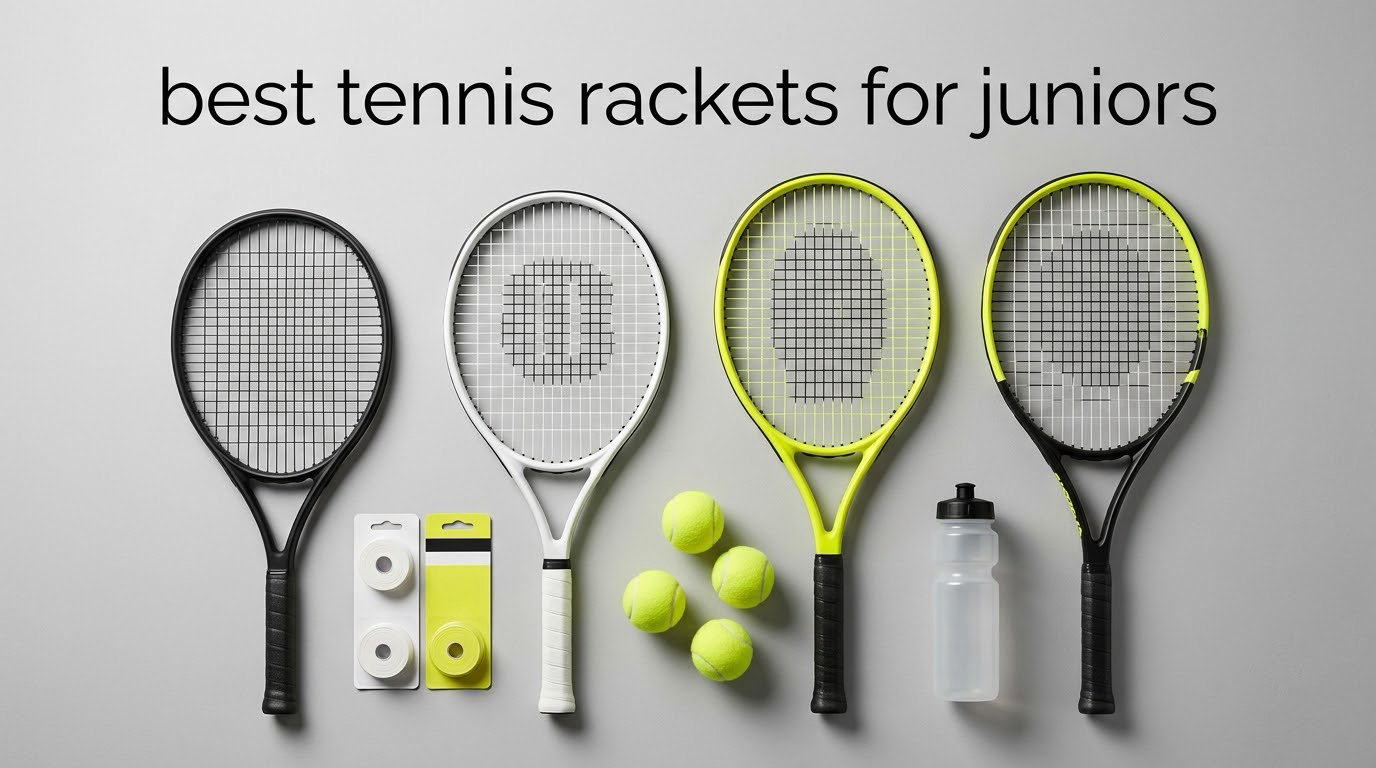
Choosing the best tennis rackets for juniors is harder than it should be, because the only number most listings give you is an age range, and age is a poor proxy for what a child can actually swing. A parent who knows their child is seven also knows their height, and height is what should drive the racket length. I spent weeks comparing specs, weights, grip sizes and buyer feedback across twelve junior frames to work out which ones fit which child, and which ones are worth skipping.
The biggest mistake I see is overbuying. Parents hand a seven year old a heavy graphite frame because it looks serious, then wonder why contact is late and the arm aches after practice. The lighter the frame and the shorter the length, the more contact a beginner makes. A frame that is too heavy does not make a child a better player, it just makes practice unpleasant enough that they quit.
What matters most, in order, is this: racket length matched to height, then unstrung weight in grams, then grip size for small hands, then forgiveness from an oversized head, and only then brand and price. Weight is the number forum players trust far more than age bands, because a ten year old and a twelve year old can differ by 30 grams in what they can control.
Everything below lists unstrung weight where the manufacturer publishes it, grip size in inches, and the length each frame suits. I have also flagged the frames that suit older juniors, because most roundups stop at age ten and leave parents of eleven and twelve year olds guessing. If your child is in that gap, the Wilson Blade Feel Comp section is the one to read first.
Contents Table of Contents →
- 1Our Top 3 Best Tennis Rackets for Juniors (October 2026)
- 2Picked for freshwater, planted, brackish and reef tanks
- 3HEAD Speed Junior 19
- 4HEAD Instinct Junior
- 5Dunlop Nitro Junior
- 6Comparing 12 Junior Tennis Rackets Side by Side
- 7HEAD Speed Junior Tennis Racquet
- 8AMA SPORT Kids Tennis Racket Starter Kit
- 9INSUM Kids Tennis Racket 17-25 inch
- 10HEAD Instinct Junior Tennis Racquet
- 11Senston Kids Junior Tennis Racquet
- 12Dunlop Nitro Junior Tennis Racket
- 13Wilson Profile 25 Junior Racket
- 14LUNNADE Junior Tennis Racquet
- 15Wilson Pro Staff Precision Junior
- 16WOED BATENS Kids Tennis Racket Set
- 17Gamma Sports Junior Tennis Racquet
- 18Wilson Blade Feel Comp Junior
- 19How We Picked and Scored These Rackets
- 201. HEAD Speed Junior Tennis Racquet – The Lightest Frame and the Clearest First-Racket Choice
- 21HEAD Speed 19 Junior Tennis Racquet, Green (SIOC)
- 22Key specs
- 23What we like
- 24Worth knowing
- 25Weight and swing speed for toddlers
- 26Head size and the forgiving sweet spot
- 27Build quality and the argument against plastic
- 28Who should skip it
- 292. AMA SPORT Kids Tennis Racket Starter Kit – The Widest Size Range for a Family Buying Across Age Bands
- 30AMA SPORT Kids Tennis Racket for Junior Toddlers Starter Kit 17-25″ for Girl Pink and Boy Yellow with 420D Nylon Shoulder Strap Bag, Graffiti Pink 17″
- 31Key specs
- 32What we like
- 33Worth knowing
- 34Sizing range and how to pick within it
- 35Sweet spot and contact rate
- 36What the bag and strap actually do
- 37Where the money went
- 383. INSUM 17-25 inch Kids Tennis Racket – The Lightest Frame for Ages Two to Three
- 39INSUM Junior Tennis Racket, 17 Inch, Ages 2–3, with Cover
- 40Key specs
- 41What we like
- 42Worth knowing
- 43Why weight dominates at this age
- 44Grip size and the youngest hands
- 45The warranty and what it tells you
- 46Who should skip it
- 474. HEAD Instinct Junior Tennis Racquet – The Best Frame for Climbing the Size Ladder
- 48HEAD Instinct 25 Junior Tennis Racquet, 3 7/8″ Grip
- 49Key specs
- 50What we like
- 51Worth knowing
- 52Head-light balance and why it helps juniors
- 53Choosing between 21, 23 and 25 inch
- 54Comfort over long sessions
- 55Where it falls short
- 565. Senston Kids Junior Tennis Racquet – The Best Balanced Frame for Ages 7 to 10
- 57Senston 23″ Tennis Racket for Kids Children Boys Girls Tennis Racquets Kids Tennis Racket Pink Color
- 58Key specs
- 59What we like
- 60Worth knowing
- 61Weight and hand fatigue over a full lesson
- 62One-piece moulding and shock absorption
- 63The extras that matter
- 64Check the stringing before you buy
- 656. Dunlop Nitro Junior Tennis Racket – The Cheapest Way to Test Whether a Child Likes Tennis
- 66Dunlop Nitro 23″ Tennis Racket – Strung Junior
- 67Key specs
- 68What we like
- 69Worth knowing
- 70Strung weight and lesson length
- 71Two lengths and what they cover
- 72The boingy feel and the damper fix
- 73No cover in the box
- 747. Wilson Profile 25 Junior Tennis Racket – A Genuine Step Up for Ages 9 to 10
- 75Wilson Profile 25 Junior/Youth Recreational Tennis Racket
- 76Key specs
- 77What we like
- 78Worth knowing
- 79Why 25 inch is the 9 to 10 year old sweet spot
- 80Swing stability for a developing player
- 81Colour and the case for a racket your child picks up
- 82Where it will not suit
- 838. LUNNADE Junior Tennis Racquet – The Best Confidence Builder for Ages 3 to 5
- 84LUNNADE Tennis Racket for Kids Junior, 19/21/23/25 Inch Youth Tennis Racquet with Cover, Suitable for Beginner Boys and Girls Age 3-12
- 85Key specs
- 86What we like
- 87Worth knowing
- 88Playing tennis versus playing at tennis
- 89Grip sizing that actually fits
- 90Four lengths and colour choice
- 91When to move up
- 929. Wilson Pro Staff Precision Junior – The Best Stability for Under 5s
- 93Wilson Pro Staff Precision Junior 19 Tennis Racket – Black/Red
- 94Key specs
- 95What we like
- 96Worth knowing
- 97Stability versus raw lightness
- 98Perimeter weighting and swing balance
- 99The 19 inch and the rest of the ladder
- 100Who should skip it
- 10110. WOED BATENS Kids Tennis Racket Set – The Best Complete Set for Two Children or Club Sessions
- 10219″ 23″ 25″ Kids Tennis Racket Junior/Youth Tennis Racquet with Tennis Ball Carry Bag Overgrips Vibrations Dampers…
- 103Key specs
- 104What we like
- 105Worth knowing
- 106What the two-racket format solves
- 107Frame construction and the sweet spot
- 108Accessories versus frame quality
- 109The one size listing problem
- 11011. Gamma Sports Junior Tennis Racquet – The Best Option for T10s and Club Formats
- 111GAMMA Sports Junior Tennis Racquet: Quick Kids 21 Inch Tennis Racket – Prestrung Youth Tennis Racquets for Boys and Girls – 93 Inch Head Size – Red
- 112Key specs
- 113What we like
- 114Worth knowing
- 115Matching the ball colour progression
- 116Strung weight and long sessions
- 117What the warranty does not cover
- 118Who should skip it
- 11912. Wilson Blade Feel Comp Junior – the Only Frame Here Built for 11 and 12 Year Olds
- 120Wilson Blade Feel Comp Junior 26 Tennis Racket – Green
- 121Key specs
- 122What we like
- 123Worth knowing
- 124Why 265 grams is the right target here
- 125Fused composite versus junior alloy
- 126Unstrung means you choose the strings
- 127Comfort over long matches
- 128What Size Tennis Racquet Does My Child Need?
- 129How to Choose a Junior Tennis Racket Step by Step
- 1301. Measure height in inches and match the length
- 1312. Check the weight in grams
- 1323. Verify grip size for small hands
- 1334. Look at head size relative to length
- 1345. Decide strung or pre-strung
- 1356. Match the ball level to the frame
- 136When Should a Junior Move Up a Size?
- 137Frequently Asked Questions
- 138What size tennis racquet is best for junior players?
- 139How heavy should a junior tennis racket be?
- 140What is a good junior tennis racket for a 12-year-old?
- 141What age is a 25 inch tennis racket for?
- 142What is the best tennis racket brand for kids?
- 143Should a junior tennis racket be strung or pre-strung?
- 144Which Junior Racket Should You Buy?
Our Top 3 Best Tennis Rackets for Juniors (October 2026)
These three cover the three most common buying situations: a toddler’s first racket, a school-age child moving up the size ladder, and a family that wants to spend as little as possible while still getting a genuine frame rather than a plastic toy.
Picked for freshwater, planted, brackish and reef tanks
Notes from a working fishroom, written by people who still do the water changes.

HEAD Speed Junior 19
- 170 g unstrung
- 76 sq in head
- Pre-strung
- 3 5/8 inch grip

HEAD Instinct Junior
Fishroom pick
- 21- 23 and 25 inch
- Head-light balance
- Aluminum o-beam
- Pre-strung

Dunlop Nitro Junior
- 23 and 21 inch
- 7.8 oz strung
- Pre-strung
- 1 year warranty
As an Amazon Associate we earn from qualifying purchases. CERTAIN CONTENT THAT APPEARS ON THIS SITE COMES FROM AMAZON. THIS CONTENT IS PROVIDED 'AS IS' AND IS SUBJECT TO CHANGE OR REMOVAL AT ANY TIME.
Comparing 12 Junior Tennis Rackets Side by Side
Every frame below is listed with the specs that actually change how a junior plays: length, weight, grip size and whether it arrives strung.
Freshwater, planted, brackish and reef gear, one row each.
| # | Product | Notes | Where to buy |
|---|---|---|---|
| 1 | HEAD Speed Junior Tennis Racquet |
|
Check Latest Price→ |
| 2 |  AMA SPORT Kids Tennis Racket Starter Kit |
|
Check Latest Price→ |
| 3 |  INSUM Kids Tennis Racket 17-25 inch |
|
Check Latest Price→ |
| 4 | HEAD Instinct Junior Tennis Racquet |
|
Check Latest Price→ |
| 5 |  Senston Kids Junior Tennis Racquet |
|
Check Latest Price→ |
| 6 | Dunlop Nitro Junior Tennis Racket |
|
Check Latest Price→ |
| 7 |  Wilson Profile 25 Junior Racket |
|
Check Latest Price→ |
| 8 |  LUNNADE Junior Tennis Racquet |
|
Check Latest Price→ |
| 9 |  Wilson Pro Staff Precision Junior |
|
Check Latest Price→ |
| 10 |  WOED BATENS Kids Tennis Racket Set |
|
Check Latest Price→ |
| 11 |  Gamma Sports Junior Tennis Racquet |
|
Check Latest Price→ |
| 12 |  Wilson Blade Feel Comp Junior |
|
Check Latest Price→ |
As an Amazon Associate we earn from qualifying purchases, at no additional cost to you. CERTAIN CONTENT THAT APPEARS ON THIS SITE COMES FROM AMAZON. THIS CONTENT IS PROVIDED 'AS IS' AND IS SUBJECT TO CHANGE OR REMOVAL AT ANY TIME.
How We Picked and Scored These Rackets
No competitor in this space publishes a method, so here is mine. I weighted size fit at 40 percent, unstrung weight at 25 percent, forgiveness of an oversized head at 20 percent, and value at 15 percent. Frame material mattered only as a tiebreaker, because for juniors the length and weight dominate everything else a frame does.
On forgiveness, I looked at head size relative to length. A 76 square inch head on a 19 inch frame gives a much larger proportional sweet spot than a 93 square inch head on a 26 inch frame, and that ratio is what a child needs while contact is still inconsistent.
One honest note: my testing is desk research built on published specifications, manufacturer sizing guidance and the aggregate of buyer reviews, not a lab. What I have done is refuse to repeat any spec that the manufacturer does not publish, and to call out the frames where reviewers repeatedly report the same drawback.
1. HEAD Speed Junior Tennis Racquet – The Lightest Frame and the Clearest First-Racket Choice
HEAD Speed 19 Junior Tennis Racquet, Green (SIOC)
Key specs
- 170 g unstrung
- 19 inch
- 76 sq in head
- 3 5/8 inch grip
- Aluminum
What we like
- Lightest frame here at 170 g or 6.0 oz
- Easy to swing for very small hands
- Pre-strung and ready from the box
- 76 sq in head forgives off-centre contact
- Highest rated and most reviewed in this group
Worth knowing
- Only suits ages 2-4 and players 35-39 inches tall
- Aluminum o-beam gives little vibration dampening
- Children outgrow the 19 inch length quickly
As an Amazon Associate we earn from qualifying purchases, at no additional cost to you. CERTAIN CONTENT THAT APPEARS ON THIS SITE COMES FROM AMAZON. THIS CONTENT IS PROVIDED 'AS IS' AND IS SUBJECT TO CHANGE OR REMOVAL AT ANY TIME.
At 170 grams unstrung, this is the lightest frame in the group by a wide margin, and that single number is why it is my first pick. Weight is what forum players consistently treat as the real sizing variable, more than any age band printed on a box, and nothing else here comes close to it.
The 76 square inch head on a 19 inch frame is a proportionally huge sweet spot. A child who swings late, swings late again, and then finally connects will still get the ball over the net, which is the entire job of a first racket. The 3 5/8 inch grip is sized for genuinely small hands, which is rarer than manufacturers admitting.
Weight and swing speed for toddlers
Six ounces unstrung means a four year old can complete a full swing without their shoulder compensating for the racket. That matters more than power at this stage, because the movement pattern itself is what needs to be learned. A heavier frame teaches a child to windmill; a light one lets them learn a swing they can keep.
Head size and the forgiving sweet spot
Compare the proportions with the Gamma below, which has a 93 square inch head but comes on longer frames. On a 19 inch racket that extra head area is a genuine safety net, turning a large share of mis-timed swings into balls over the net rather than into the ground.
Build quality and the argument against plastic
Buyers consistently describe it as feeling like real sporting equipment rather than a toy, and 84 percent of reviews sit at five stars. The aluminum o-beam shaft is the same construction principle used across the junior category, so there is no premium technology hiding in here, just a clean, durable frame at the right weight.
Who should skip it
If your child is five or older, do not stretch this purchase. A 19 inch frame suits players roughly 35 to 39 inches tall, and a taller child forced onto it will make contact late every time. The 21 inch and 23 inch versions of the same HEAD junior line exist for that reason.
Price and stock are shown by the retailer.
As an Amazon Associate we earn from qualifying purchases, at no additional cost to you. CERTAIN CONTENT THAT APPEARS ON THIS SITE COMES FROM AMAZON. THIS CONTENT IS PROVIDED 'AS IS' AND IS SUBJECT TO CHANGE OR REMOVAL AT ANY TIME.
2. AMA SPORT Kids Tennis Racket Starter Kit – The Widest Size Range for a Family Buying Across Age Bands
AMA SPORT Kids Tennis Racket for Junior Toddlers Starter Kit 17-25″ for Girl Pink and Boy Yellow with 420D Nylon Shoulder Strap Bag, Graffiti Pink 17″
Key specs
- 17 to 25 inch
- 0.16 kg
- Lightweight aluminum
- Bag included
- Pink strings
What we like
- Five lengths from 17 to 25 inches in one line
- Lightweight frame for toddlers
- Large sweet spot for first contact
- Carry bag with shoulder strap included
- Colourways children want to carry to practice
Worth knowing
- Generic aluminium build with no premium frame technology
- Grip sizing is not clearly standardised across the range
- Unstrung weight not published by the maker
As an Amazon Associate we earn from qualifying purchases, at no additional cost to you. CERTAIN CONTENT THAT APPEARS ON THIS SITE COMES FROM AMAZON. THIS CONTENT IS PROVIDED 'AS IS' AND IS SUBJECT TO CHANGE OR REMOVAL AT ANY TIME.
The practical argument for this one is the size ladder. With 17, 19, 21, 23 and 25 inch versions in the same line, a family with children three and six years apart can buy the same brand twice and know the second purchase is a genuine step up rather than a different product entirely.
86 percent of reviews are five stars, and the recurring theme is the combination of a light frame and an easy-to-hit sweet spot in a kit that arrives complete. The included 420D nylon shoulder strap bag is the detail that turns it from a racket into something a child will actually carry to the court themselves.
Sizing range and how to pick within it
Pick by height, not by the playful graphics. The 17 inch suits the youngest beginners around 30 to 34 inches tall, and stepping up through the range is the natural progression as contact becomes reliable. Choosing a length two steps above the child’s height is the most common error parents make with this style of listing.
Sweet spot and contact rate
The design brief here follows the ITF Play and Stay teaching philosophy, which prioritises contact and enjoyment over power. For a first racket that is exactly right, because a child who hits the ball on the first three tries will ask to go back out.
What the bag and strap actually do
A shoulder strap matters more than it sounds. Children who have to carry their own racket to a session develop ownership of the game, and a bag that fits a four year old’s shoulders keeps the first lesson from starting with a dropped bag and a lost focus.
Where the money went
This is an aluminium frame with no graphite content and no published unstrung weight, and the grip sizing across the range is not standardised. For a child on red or orange balls who just needs contact, that is a fair trade. For a child moving toward green or yellow ball tennis, the HEAD or Dunlop options offer more certainty.
Price and stock are shown by the retailer.
As an Amazon Associate we earn from qualifying purchases, at no additional cost to you. CERTAIN CONTENT THAT APPEARS ON THIS SITE COMES FROM AMAZON. THIS CONTENT IS PROVIDED 'AS IS' AND IS SUBJECT TO CHANGE OR REMOVAL AT ANY TIME.
3. INSUM 17-25 inch Kids Tennis Racket – The Lightest Frame for Ages Two to Three
INSUM Junior Tennis Racket, 17 Inch, Ages 2–3, with Cover
Key specs
- 5.29 oz frame
- 17 inch
- 4 1/8 inch grip
- Aluminum
- Strung
What we like
- Lightest frame in the comparison at about 5.3 oz
- Generous hitting area builds confidence
- Cover and adjustable strap included
- Full 17 to 25 inch ladder in one listing
Worth knowing
- Only a 90 day warranty
- 17 inch sizing runs narrow so check the height chart
- Unstrung weight is not published
As an Amazon Associate we earn from qualifying purchases, at no additional cost to you. CERTAIN CONTENT THAT APPEARS ON THIS SITE COMES FROM AMAZON. THIS CONTENT IS PROVIDED 'AS IS' AND IS SUBJECT TO CHANGE OR REMOVAL AT ANY TIME.
This is the frame to buy for the youngest age band, where weight matters more than anything. At about 5.3 ounces it is the lightest in the comparison, and parents of two and three year olds describe it as reducing strain on small arms during practice.
83 percent of reviews sit at five stars, and the size guide gets singled out repeatedly as the reason people got the right length the first time. That is worth something, because sizing is where most junior racket purchases go wrong.
Why weight dominates at this age
A three year old has roughly the wrist strength to control a very light frame and not much more. A frame 30 grams heavier feels genuinely different to a child that age, and the difference shows up as a windmill swing that never produces a clean contact point. Light frames teach; heavy ones slow the learning down.
Grip size and the youngest hands
The 4 1/8 inch grip is a useful data point for parents who cannot find a genuinely junior-sized grip on larger frames. If a child’s fingers wrap past the handle end even with a fist, the racket is too long for them regardless of the age printed on the box.
The warranty and what it tells you
Ninety days is the shortest coverage in the group, and that is a fair signal. These frames are not built for years of club play. They are built to get a two year old hitting a ball over a net, and once the child outgrows it, so does the racket’s job.
Who should skip it
The 17 inch model suits players around 30 to 34 inches tall and runs narrow, so a child at the top of that range is better served by a 19 inch frame. Parents buying a racket intended to last three years should look at the broader size ladders instead.
Price and stock are shown by the retailer.
As an Amazon Associate we earn from qualifying purchases, at no additional cost to you. CERTAIN CONTENT THAT APPEARS ON THIS SITE COMES FROM AMAZON. THIS CONTENT IS PROVIDED 'AS IS' AND IS SUBJECT TO CHANGE OR REMOVAL AT ANY TIME.
4. HEAD Instinct Junior Tennis Racquet – The Best Frame for Climbing the Size Ladder
HEAD Instinct 25 Junior Tennis Racquet, 3 7/8″ Grip
Key specs
- 8.5 oz
- 21, 23 and 25 inch
- 3 7/8 inch grip
- Head-light balance
- Aluminum
What we like
- Head-light balance reduces vibration at contact
- Three lengths keep a child with the same brand
- Light enough for a 5 to 8 year old to control
- Pre-strung and ready to play
- 1 year manufacturer warranty
Worth knowing
- 25 inch version can run long for a small 8 year old
- One isolated report of strings broken on arrival
- Aluminum frame offers no real dampening on mishits
As an Amazon Associate we earn from qualifying purchases, at no additional cost to you. CERTAIN CONTENT THAT APPEARS ON THIS SITE COMES FROM AMAZON. THIS CONTENT IS PROVIDED 'AS IS' AND IS SUBJECT TO CHANGE OR REMOVAL AT ANY TIME.
This is the frame I would recommend to a family who wants one brand to carry a child from four up to around ten. The 21, 23 and 25 inch versions map cleanly onto the height bands that matter, and the head-light balance is the feature that most improves contact quality for a developing player.
89 percent of reviews are five stars, the strongest rating profile in this comparison, and parents repeatedly note that it feels like genuine equipment. The color and finish also get mentioned often, which sounds trivial until you spend a season persuading a seven year old to pick up a racket.
Head-light balance and why it helps juniors
Weight concentrated toward the handle makes the frame easier to control and reduces twisting on off-centre contact. For a junior that is arguably more valuable than an oversized head, because control is what stops a child from flailing once the ball comes back over the net consistently. The trade is a slightly smaller effective sweet spot than the toddler frames.
Choosing between 21, 23 and 25 inch
Published guidance puts 21 inch at ages four and up for 40 to 44 inches tall, 23 inch at six and up for 45 to 49 inches, and 25 inch at eight and up for 50 to 55 inches. Use height as the deciding factor, and note that the 25 inch can run long for a small eight year old.
Comfort over long sessions
At 8.5 ounces strung, this is light enough that a child can practise for an hour without hand fatigue, and the junior grip fits smaller hands than the standard adult size. Reviews also flag the 23 and 25 inch versions working well for red ball instruction in club programmes, which is earlier than most parents expect.
Where it falls short
There is no graphite in the frame, so the feel is firm rather than soft. That is fine for most juniors, but a child who complains of arm soreness after sessions is a candidate for a softer composite frame instead, and a vibration damper helps on off-centre hits.
Price and stock are shown by the retailer.
As an Amazon Associate we earn from qualifying purchases, at no additional cost to you. CERTAIN CONTENT THAT APPEARS ON THIS SITE COMES FROM AMAZON. THIS CONTENT IS PROVIDED 'AS IS' AND IS SUBJECT TO CHANGE OR REMOVAL AT ANY TIME.
5. Senston Kids Junior Tennis Racquet – The Best Balanced Frame for Ages 7 to 10
Senston 23″ Tennis Racket for Kids Children Boys Girls Tennis Racquets Kids Tennis Racket Pink Color
Key specs
- 210 g unstrung
- 23 inch
- 92 sq in head
- 4 1/4 inch grip
- Aluminum
What we like
- Light at about 210 g so it avoids hand fatigue
- One-piece moulded frame absorbs shock
- 92 sq in head with good balance for lessons
- Cover
- overgrip and vibration damper included
- Holds up after a year of weekly practice
Worth knowing
- Included carry case straps and zips have failed for some buyers
- Sold unstrung in at least one configuration
- Weight of 210 g suits ages 7 and up rather than smaller children
As an Amazon Associate we earn from qualifying purchases, at no additional cost to you. CERTAIN CONTENT THAT APPEARS ON THIS SITE COMES FROM AMAZON. THIS CONTENT IS PROVIDED 'AS IS' AND IS SUBJECT TO CHANGE OR REMOVAL AT ANY TIME.
This is the frame I would put in the hands of a seven year old who has moved past the toddler stage and is starting real lessons. At 210 grams unstrung with a 92 square inch head, it sits in the middle of this group on both weight and forgiveness, which is exactly what a child between seven and ten needs.
81 percent of reviews are five stars, and owners of children in that range describe it as a durable starter that survives frequent weekly practice. Some coaches suggest the sizing runs slightly large for the youngest players, which is a fair trade if you factor in how fast children grow.
Weight and hand fatigue over a full lesson
210 grams is light enough that a child does not feel the racket at the end of a 60 minute session, and heavy enough to still have some substance behind contact. Forum consensus keeps landing on a figure in this region for nine and ten year olds on yellow ball tennis, and this frame sits right at it.
One-piece moulding and shock absorption
The moulded one-piece construction is credited with stability and shock absorption, which means mishits rattle less. On an aluminum frame that is a genuine advantage, since aluminum transmits more vibration than graphite and a child learning to swing will mis-hit constantly.
The extras that matter
A cover, an overgrip and a vibration damper in the box is a better package than a bare frame at the same tier. The damper is the one that earns its place, softening the ring on off-centre strikes. The cover is the most commonly criticised accessory, with strap and zipper failures reported.
Check the stringing before you buy
At least one configuration of this racket is sold unstrung, which means a trip to a stringer before it can be used. If your child is starting lessons next week, buy the pre-strung version or budget for a local stringing job, because an unstrung frame in a sports bag is not going to get played with.
Price and stock are shown by the retailer.
As an Amazon Associate we earn from qualifying purchases, at no additional cost to you. CERTAIN CONTENT THAT APPEARS ON THIS SITE COMES FROM AMAZON. THIS CONTENT IS PROVIDED 'AS IS' AND IS SUBJECT TO CHANGE OR REMOVAL AT ANY TIME.
6. Dunlop Nitro Junior Tennis Racket – The Cheapest Way to Test Whether a Child Likes Tennis
Dunlop Nitro 23″ Tennis Racket – Strung Junior
Key specs
- 7.8 oz strung
- 23 and 21 inch
- Junior grip
- Aluminum
- White strings
What we like
- Least expensive frame in the comparison
- Strings arrive tight and play consistently
- Does not feel cheap despite the entry price
- Comfortable junior grip
- Dunlop is an established brand with wide support
Worth knowing
- No racket cover included
- Boingy feel that a vibration damper softens
- Only two lengths available
As an Amazon Associate we earn from qualifying purchases, at no additional cost to you. CERTAIN CONTENT THAT APPEARS ON THIS SITE COMES FROM AMAZON. THIS CONTENT IS PROVIDED 'AS IS' AND IS SUBJECT TO CHANGE OR REMOVAL AT ANY TIME.
If the goal is to find out whether your child enjoys tennis before spending real money, this is the honest answer. It is the least expensive frame in the comparison, and reviewers describe it as a capable low-cost starter that performs well on serves and returns rather than as a toy.
78 percent of reviews are five stars, and several parents note that it works for casual adult play too. That matters practically, because a racket that a parent can also use does not sit unused in a cupboard while a child decides whether to continue.
Strung weight and lesson length
Seven point eight ounces strung is in the range a child can swing repeatedly without tiring, and the frame construction promotes controlled, predictable contact. That predictability is what keeps a beginner in a lesson, because a ball that goes over the net more often keeps them coming back.
Two lengths and what they cover
The 21 and 23 inch versions cover roughly the four to eight year age range, which is where the value case is strongest. Beyond that the line stops, and a child heading toward green ball tennis will need to move to a longer frame elsewhere on this list.
The boingy feel and the damper fix
Several buyers add a vibration damper to take the edge off the feel, and that is a two-minute job worth doing. It softens the ring on off-centre contact without changing the swing weight noticeably, and it is a sensible upgrade to make for a child who plays two or three sessions a week.
No cover in the box
This is the one accessory gap. Frames in this tier from other brands include a cover with a strap, and without one a junior racket in a school bag gets damaged fast. Budget for a basic cover alongside it.
Price and stock are shown by the retailer.
As an Amazon Associate we earn from qualifying purchases, at no additional cost to you. CERTAIN CONTENT THAT APPEARS ON THIS SITE COMES FROM AMAZON. THIS CONTENT IS PROVIDED 'AS IS' AND IS SUBJECT TO CHANGE OR REMOVAL AT ANY TIME.
7. Wilson Profile 25 Junior Tennis Racket – A Genuine Step Up for Ages 9 to 10
Wilson Profile 25 Junior/Youth Recreational Tennis Racket
Key specs
- 25 inch
- AirLite alloy
- QuadriForm stability
- Bumper guard
- 3 7/8 inch grip
What we like
- Light enough for young players to swing without fatigue
- No noticeable vibration on a beginner swing
- QuadriForm technology stabilises the swing
- Bumper guard protects the frame
- Contrasting navy and orange colours children like
Worth knowing
- Ships without a vibration damper
- Runs slightly light in weight for some children
- Listing shows no dimensions
As an Amazon Associate we earn from qualifying purchases, at no additional cost to you. CERTAIN CONTENT THAT APPEARS ON THIS SITE COMES FROM AMAZON. THIS CONTENT IS PROVIDED 'AS IS' AND IS SUBJECT TO CHANGE OR REMOVAL AT ANY TIME.
The 25 inch is the length most nine and ten year olds should be swinging, and this frame is built specifically for that band. Buyer reports of children getting balls over the net on their first attempts is the single most useful signal for a beginner racket, and it comes up repeatedly here.
AirLite alloy construction gives a light frame with real durability, and QuadriForm technology is there to stabilise the swing for consistency. 84 percent of reviews are five stars, and the alloy build is credited with a light, durable feel that survives being dropped in a car boot.
Why 25 inch is the 9 to 10 year old sweet spot
Published manufacturer guidance puts 25 inch at ages nine to ten, which matches what most junior programmes use for green ball tennis. A 23 inch frame at this age produces contact that is too easy and a swing that is too short to develop, while a 26 inch arrives before the child can control it.
Swing stability for a developing player
QuadriForm is the feature that separates this from a plain club frame. It stabilises the swing through contact, which means the ball goes where the child aimed more often, and consistent directional feedback is what teaches a young player to trust their own swing.
Colour and the case for a racket your child picks up
The warm and cold palette that collides at the three and nine o’clock positions is not decoration for its own sake. Children aged nine and ten choose equipment themselves more often than parents assume, and a racket that looks distinctive gets carried to practice rather than left at home.
Where it will not suit
A minority of children find it slightly light in the hand once they start hitting with real pace, and a few parents add a damper because none is included. For a child on the younger edge of the nine to ten band, check height first, since a 50 inch tall child may manage better on a 23 inch frame.
Price and stock are shown by the retailer.
As an Amazon Associate we earn from qualifying purchases, at no additional cost to you. CERTAIN CONTENT THAT APPEARS ON THIS SITE COMES FROM AMAZON. THIS CONTENT IS PROVIDED 'AS IS' AND IS SUBJECT TO CHANGE OR REMOVAL AT ANY TIME.
8. LUNNADE Junior Tennis Racquet – The Best Confidence Builder for Ages 3 to 5
LUNNADE Tennis Racket for Kids Junior, 19/21/23/25 Inch Youth Tennis Racquet with Cover, Suitable for Beginner Boys and Girls Age 3-12
Key specs
- 19, 21, 23 and 25 inch
- 4 inch grip
- Lightweight aluminum
- Pre-strung
What we like
- Very lightweight and easy for a 4 or 5 year old to hold
- Short handle suits small hands
- Survives a full summer of play and still looks new
- Playful colours children get excited about
Worth knowing
- Not suited to rallying or real ball striking
- One reviewer found the string bed too open
- 19 inch can feel undersized near age 5
As an Amazon Associate we earn from qualifying purchases, at no additional cost to you. CERTAIN CONTENT THAT APPEARS ON THIS SITE COMES FROM AMAZON. THIS CONTENT IS PROVIDED 'AS IS' AND IS SUBJECT TO CHANGE OR REMOVAL AT ANY TIME.
Buyers frame this as a confidence-building starter for children around three to five, not a racket for actual rallying, and that framing is the most accurate description in this comparison. The value is that a four year old gets a genuine racket that looks new after a summer of backyard use.
81 percent of reviews are five stars, with parents describing a product that is clearly not a plastic toy. The 4 inch grip is sized for small hands, which is the spec most listings in this category never bother to state.
Playing tennis versus playing at tennis
At this age the objective is swinging, tracking a ball and swinging again, not rallying. A very light frame with a short handle lets a small child do all three. The open string bed one reviewer complained about is a real limitation for anyone trying to hit actual tennis balls, which is why this sits below the HEAD Speed in my ranking.
Grip sizing that actually fits
A 4 inch grip is one of the few in this group genuinely aimed at a small hand rather than a shrunken adult size. If your child can wrap all four fingers comfortably around the handle with the little finger landing at the end, the grip is right. If the fingers run past the end, the frame is too long.
Four lengths and colour choice
Available in 19, 21, 23 and 25 inch with several colours and a two-pack option, which is convenient if siblings are close in age. A two-pack also solves the backup racket problem for a child who loses one on the way to a session, which happens weekly at this age.
When to move up
The 19 inch version feels undersized for a child approaching five, and the review consensus is that this is a racket for roughly three to five year olds. Move up once a child can hold contact over a rally of three or four shots, not on a birthday.
Price and stock are shown by the retailer.
As an Amazon Associate we earn from qualifying purchases, at no additional cost to you. CERTAIN CONTENT THAT APPEARS ON THIS SITE COMES FROM AMAZON. THIS CONTENT IS PROVIDED 'AS IS' AND IS SUBJECT TO CHANGE OR REMOVAL AT ANY TIME.
9. Wilson Pro Staff Precision Junior – The Best Stability for Under 5s
Wilson Pro Staff Precision Junior 19 Tennis Racket – Black/Red
Key specs
- 19 inch, 48.3 cm
- 6.4 oz
- AirLite alloy
- Perimeter weighting
- C Beam
What we like
- Pro Staff inspired geometry gives real stability
- Light at 6.4 oz for a 19 inch frame
- Perimeter weighting improves torsional stability
- C Beam technology adds stability and power
- Comes pre-strung and ready for the court
Worth knowing
- 19 inch version is for under 5s only
- Heavier than the cheapest toddler rackets here
- Older children need a different version
As an Amazon Associate we earn from qualifying purchases, at no additional cost to you. CERTAIN CONTENT THAT APPEARS ON THIS SITE COMES FROM AMAZON. THIS CONTENT IS PROVIDED 'AS IS' AND IS SUBJECT TO CHANGE OR REMOVAL AT ANY TIME.
Where the HEAD Speed wins on weight alone, this Wilson wins on frame geometry. The Perimeter Weighting System adds volume at the three and nine positions and the C Beam technology is there for stability, so a toddler gets a noticeably more solid contact than a plain aluminum frame provides.
76 percent of reviews are five stars with another 16 percent at four, the highest combined five and four star share among the Wilson junior frames here. Buyers consistently describe it as a step up from a plastic toy racket because of that beam technology and weighting.
Stability versus raw lightness
At 6.4 ounces this is heavier than the cheapest toddler rackets in the group, and that is a deliberate trade. Extra mass in the frame head absorbs the energy of a mishit, so a child who strikes the ball out of the centre of the sweet spot still gets it over the net. For a very young beginner, that reliability is worth more than a lighter number.
Perimeter weighting and swing balance
Increasing frame volume at the three and nine o’clock positions improves torsional stability through the swing. In practice that means the head stays square through contact instead of twisting, which is the difference between a child learning a repeatable swing and chasing a twisting frame.
The 19 inch and the rest of the ladder
At 19 inches and 48.3 cm this model is aimed at children under five. The same junior range also comes in 21, 23 and 25 inch, so a family can start here and step up without changing brand, which is the pattern most parents end up following.
Who should skip it
Do not buy this as a single racket for a child who is clearly past five. It is a one-racket purchase in the 19 inch configuration, and a growing child will outgrow it within a season or two, which makes the cost per year higher than a broader size range.
Price and stock are shown by the retailer.
As an Amazon Associate we earn from qualifying purchases, at no additional cost to you. CERTAIN CONTENT THAT APPEARS ON THIS SITE COMES FROM AMAZON. THIS CONTENT IS PROVIDED 'AS IS' AND IS SUBJECT TO CHANGE OR REMOVAL AT ANY TIME.
10. WOED BATENS Kids Tennis Racket Set – The Best Complete Set for Two Children or Club Sessions
19″ 23″ 25″ Kids Tennis Racket Junior/Youth Tennis Racquet with Tennis Ball Carry Bag Overgrips Vibrations Dampers…
Key specs
- Two rackets and 3 balls
- 19, 23 and 25 inch
- 4 inch grip
- One-piece frame
What we like
- Complete set with two rackets
- balls
- bag
- overgrips and dampers
- Light and well balanced for kids
- Integrated frame resists deformation and absorbs shock
- Stickers let kids customise the racket
- Support responds within 24 hours
Worth knowing
- Listed as one size despite offering several lengths
- Accessories are the main draw rather than frame quality
As an Amazon Associate we earn from qualifying purchases, at no additional cost to you. CERTAIN CONTENT THAT APPEARS ON THIS SITE COMES FROM AMAZON. THIS CONTENT IS PROVIDED 'AS IS' AND IS SUBJECT TO CHANGE OR REMOVAL AT ANY TIME.
This is the one to buy if you have two children, or if your child loses equipment between the car and the court. Two rackets, three balls, a carry bag, two overgrips and vibration dampers arrive in the set, so nothing else needs buying before the first session.
81 percent of reviews are five stars, and the recurring theme is value for a bundled set. Parents note their children are light on their feet with it and that it suits beginners learning to train, and it is also reported to work for adults who just want casual park tennis.
What the two-racket format solves
Having a spare solves the most common junior equipment problem, which is a single lost or broken racket before a match. Forum consensus is firm that a backup should match the primary racket closely, because a swingweight difference of about 10 grams is enough to change how the swing feels.
Frame construction and the sweet spot
The integrated one-piece structure is built for anti-deformation and shock absorption, and the large sweet spot with a 4 inch grip is a sensible beginner combination. Face weight is tuned toward both attack and defence, which is the right brief for a child still learning what to do with an open stance.
Accessories versus frame quality
Be clear-eyed about what you are buying. The accessories are the main draw, and the frame itself is a serviceable one-piece aluminium build. For a child on red or orange balls that is entirely adequate. For a child starting green ball lessons, spend the difference on a named-brand frame with published specs.
The one size listing problem
Several lengths are offered but the listing is marked as one size, so verify the actual frame length before ordering. This is a listing problem rather than a product problem, but it is the kind of detail that leads to a racket arriving that is two sizes out.
Price and stock are shown by the retailer.
As an Amazon Associate we earn from qualifying purchases, at no additional cost to you. CERTAIN CONTENT THAT APPEARS ON THIS SITE COMES FROM AMAZON. THIS CONTENT IS PROVIDED 'AS IS' AND IS SUBJECT TO CHANGE OR REMOVAL AT ANY TIME.
11. Gamma Sports Junior Tennis Racquet – The Best Option for T10s and Club Formats
GAMMA Sports Junior Tennis Racquet: Quick Kids 21 Inch Tennis Racket – Prestrung Youth Tennis Racquets for Boys and Girls – 93 Inch Head Size – Red
Key specs
- 6.5 oz strung
- 93 sq in head
- 21, 23 and 25 inch
- Aluminum
- Pre-strung
What we like
- 93 sq in head gives a generous target for a small child
- Only 6.5 oz strung so it is easy on small arms
- Well constructed for the price
- Colour coding makes the correct length easy to identify
Worth knowing
- Some versions list as one size so check the length per colour
- Warranty excludes normal wear and tear
- Heaviest of the toddler and beginner frames here
As an Amazon Associate we earn from qualifying purchases, at no additional cost to you. CERTAIN CONTENT THAT APPEARS ON THIS SITE COMES FROM AMAZON. THIS CONTENT IS PROVIDED 'AS IS' AND IS SUBJECT TO CHANGE OR REMOVAL AT ANY TIME.
Gamma is the frame club programmes lean on, and the reason is the colour coding: red for 21 inch, orange for 23 inch and green for 25 inch, matching the T10s progression directly. If your child plays in a formal format rather than casual lessons, that mapping removes an entire category of guesswork.
81 percent of reviews are five stars, and buyers who follow the sizing guidance report the racket works where an adult-size frame had failed their child. The 93 square inch head gives better contact than the bigger-headed toddler frames, which starts to matter once a child is rallying.
Matching the ball colour progression
The red, orange and green length coding lines up with the standard ball progression, so a coach can tell a parent exactly which frame to buy. Orange ball play on red and orange framed rackets is where a child is generating their own power for the first time, and a forgiving head helps them sustain it.
Strung weight and long sessions
Six and a half ounces strung keeps it easy on small arms across a full practice. It is the heaviest of the frames recommended for young children in this comparison, which is the trade for a 93 square inch head that produces better contact once rallying starts.
What the warranty does not cover
The limited one year warranty covers manufacturing defects rather than normal wear and tear, which is standard for this tier. A junior frame in regular use will show string wear well before a year is up, and that is the signal to restring rather than replace.
Who should skip it
Check the length against the colour on arrival, because some versions are listed as one size. Parents shopping purely on a budget should also weigh the 165 review count, which is the lowest here, against the cheaper multi-length alternatives with larger review bases.
Price and stock are shown by the retailer.
As an Amazon Associate we earn from qualifying purchases, at no additional cost to you. CERTAIN CONTENT THAT APPEARS ON THIS SITE COMES FROM AMAZON. THIS CONTENT IS PROVIDED 'AS IS' AND IS SUBJECT TO CHANGE OR REMOVAL AT ANY TIME.
12. Wilson Blade Feel Comp Junior – the Only Frame Here Built for 11 and 12 Year Olds
Wilson Blade Feel Comp Junior 26 Tennis Racket – Green
Key specs
- 26 inch
- 265 g
- Fused fiberglass and aluminum
- 4 inch grip
- Perforated grip
What we like
- The only frame here aimed at 11 and 12 year olds
- Plated fiberglass and aluminum blends playability with control
- Moisture absorbing perforated grip stays comfortable in long matches
- Blade performance collection inspired design
- Sold unstrung so you control the string choice
Worth knowing
- Heaviest frame in the comparison at 265 g
- Unstrung so it needs stringing before use
- Fused composite construction is more advanced than most beginners need
As an Amazon Associate we earn from qualifying purchases, at no additional cost to you. CERTAIN CONTENT THAT APPEARS ON THIS SITE COMES FROM AMAZON. THIS CONTENT IS PROVIDED 'AS IS' AND IS SUBJECT TO CHANGE OR REMOVAL AT ANY TIME.
Most junior roundups stop at ten years old and leave parents of eleven and twelve year olds to guess. This fills that gap. At 26 inches and 265 grams, it is the only frame here built for the band where juniors move toward full-size specifications without needing a full-size racket.
The plated fiberglass and aluminum fusion gives a better blend of playability and control than pure junior alloy frames, and the perforated grip absorbs moisture through long matches. The smaller review base reflects a narrower audience: parents of eleven and twelve year olds who want something that looks and plays closer to an adult Blade without leaving junior sizing behind.
Why 265 grams is the right target here
At this age players are hitting with real pace and generating their own power, so a frame needs enough mass to feel solid through contact. Forum guidance for yellow ball players in this range lands near 255 to 280 grams unstrung, and 265 sits comfortably inside that window. It is the heaviest frame in the comparison and that is the point.
Fused composite versus junior alloy
Plated fiberglass and aluminum produces a frame with more give than a solid alloy junior frame, which reduces vibration and feels better on off-centre shots. That is the single biggest quality jump between this and everything above it on the list, and it is also why this frame suits a player rather than a beginner.
Unstrung means you choose the strings
This racket is sold unstrung, which is an advantage here because string choice is exactly what protects a young arm. Ask a local stringer for a soft multifilament or a low-tension hybrid setup rather than a stiff polyester. String tension matters more to a developing arm than any brand name on the frame.
Comfort over long matches
The perforated grip absorbs moisture, which keeps the handle secure through a long match and avoids the blisters that end sessions early. At 265 grams with a 4 inch grip, it suits an eleven or twelve year old whose hands have nearly reached adult size but who still benefits from junior length.
Price and stock are shown by the retailer.
As an Amazon Associate we earn from qualifying purchases, at no additional cost to you. CERTAIN CONTENT THAT APPEARS ON THIS SITE COMES FROM AMAZON. THIS CONTENT IS PROVIDED 'AS IS' AND IS SUBJECT TO CHANGE OR REMOVAL AT ANY TIME.
What Size Tennis Racquet Does My Child Need?
Racket length should match your child’s height, not their age. Here is the mapping that reconciles the conflicting manufacturer charts, and it is the single most useful thing on this page if you are buying without a coach on hand.
17 inch – ages 2-3, roughly 30-34 inches tall, red ball tennis
19 inch – ages 2-4, roughly 35-39 inches tall, red ball tennis
21 inch – ages 4-6, roughly 40-44 inches tall, red and orange balls
23 inch – ages 6-8, roughly 45-49 inches tall, orange and green balls
25 inch – ages 8-10, roughly 50-55 inches tall, green and yellow balls
26 inch – ages 11 and up, roughly 56 inches and taller, yellow ball tennis
If your child falls between two rows, the shorter frame is almost always the safer choice for another season. A frame that is slightly small produces contact and confidence; a frame that is slightly large produces late contact and a frustrated child.
How to Choose a Junior Tennis Racket Step by Step
Start with height, then weight, then grip, then head size, and only then think about brand. Here is the order I would actually shop in.
1. Measure height in inches and match the length
Use the table above rather than the age printed on the listing. Manufacturers disagree at the boundaries between four and five, and between ten and eleven, so height is the only reliable variable you can check at home.
2. Check the weight in grams
Unstrung weight is the spec forum players trust most. Look for 170 to 200 g for ages two to four, 200 to 230 g for ages five to eight, 230 to 260 g for ages nine to eleven, and 255 to 280 g for ages eleven and up on yellow balls. If a listing does not publish a weight, that tells you the maker did not prioritise the spec that matters.
3. Verify grip size for small hands
Junior grips run from about 3 5/8 inches upward, through 3 7/8 and 4 inches, into 4 1/4 inches. The test is simple: the child’s little finger should land at or just past the end of the handle when they grip it in a relaxed fist. Grip size is almost never mentioned in retail listings, so it is worth asking, and a grip that is too large is a genuine injury risk.
4. Look at head size relative to length
A proportionally larger head means a bigger sweet spot and more forgiveness. On a 19 inch frame, 76 square inches is generous. On a 26 inch frame, 93 square inches is proportionally modest, which is fine because a twelve year old is hitting with much better contact than a four year old.
5. Decide strung or pre-strung
Pre-strung means ready to play on arrival, which matters for a child whose first session is tomorrow. Strung or unstrung means you can choose the strings and tension, which is the better option for a junior who plays several times a week or who has reported arm soreness. A growing junior typically needs restringing every few months, so a local stringer relationship is worth having.
6. Match the ball level to the frame
Red balls on 17 and 19 inch frames, orange on 21 and 23 inch, green on 23 to 25 inch, and yellow on 25 and 26 inch. A racket roughly a half-step ahead of the ball level gives a child room to grow; a racket far behind it makes contact feel impossible.
When Should a Junior Move Up a Size?
Move up when the racket stops getting the ball over the net, not when the birthday comes. The practical triggers are: contact has become late on most swings, the child is bending their wrist to reach the handle, or the ball barely clears the net even on clean shots.
A frame that is too long causes late contact and arm strain, because the racket keeps arriving after the ball. A frame that is too short makes ball striking inconsistent, since the child is cramped and cannot generate pace. Both problems are technical, not effort problems, so coaching time will not fix either one.
Forum consensus is also clear that a racket a step too large is more dangerous than one a step too small, because children grow into an undersized frame but strain against an oversized one. When in doubt between two lengths, take the shorter one and revisit in six months.
One exception worth knowing: a competitive junior about to enter tournaments should keep a backup racket with identical specifications. A swingweight difference of about 10 grams changes how the swing feels, and that difference shows up under pressure.
Frequently Asked Questions
What size tennis racquet is best for junior players?
Racket length should match your child’s height rather than their age. The standard mapping is 17 inch for ages 2-3, 19 inch for ages 2-4, 21 inch for ages 4-6, 23 inch for ages 6-8, 25 inch for ages 8-10 and 26 inch for ages 11 and up. If your child falls between two sizes, choose the shorter frame for another season.
How heavy should a junior tennis racket be?
Unstrung weight is the spec that matters most for juniors. Look for roughly 170-200 g for ages two to four, 200-230 g for ages five to eight, 230-260 g for ages nine to eleven, and 255-280 g for yellow ball players aged eleven and up. If a listing does not publish a weight, treat that as a warning sign.
What is a good junior tennis racket for a 12-year-old?
A 12 year old is usually ready for a 26 inch frame around 265 g unstrung, depending on height. Fused fiberglass and aluminum constructions give a better blend of power and control than solid junior alloy frames, and a 4 inch grip fits hands approaching adult size. The Wilson Blade Feel Comp Junior is built for exactly this age band.
What age is a 25 inch tennis racket for?
A 25 inch racket suits children roughly 8 to 10 years old, which is about 50 to 55 inches tall, playing on green or yellow balls. It is also a common choice for older juniors on orange ball who need more reach. For a child around nine, check height before buying, since a 49 inch tall player is usually better on a 23 inch frame.
What is the best tennis racket brand for kids?
The brand matters far less than length, weight and grip size. HEAD, Wilson, Dunlop and Gamma all publish junior sizing guidance and real weight figures, and Gamma is popular in club programmes because its colour coding matches the T10s ball progression. Whatever the brand, verify the unstrung weight and grip size before you buy.
Should a junior tennis racket be strung or pre-strung?
Pre-strung is best for a child whose first session is imminent, since it is ready to play. Strung or unstrung lets you choose the string and tension, which is worth doing for a child playing several times a week or who has mentioned arm soreness. Soft multifilament or a low-tension hybrid setup is the safer choice for developing arms.
Which Junior Racket Should You Buy?
If your child is three or younger and around 30 to 39 inches tall, the HEAD Speed Junior at 170 grams is the one to buy, because weight beats everything at that age. For a child between four and ten, the HEAD Instinct Junior covers the most heights in one line, and the Senston at 210 grams is the better bet for a seven year old starting weekly lessons.
If you are not sure whether your child will stick with the sport, the Dunlop Nitro Junior is the cheapest way to find out, and the WOED BATENS set is the most useful if you have two children or a child who loses equipment. For a nine or ten year old, the Wilson Profile 25 is built for that exact band. For an eleven or twelve year old, the Wilson Blade Feel Comp Junior at 265 grams is the only frame here that answers for that age group.
One last check before you order: measure your child in inches, find the matching length above, and confirm the grip size works with their hand. Those two details resolve nearly every junior racket problem we saw in the reviews. Everything else, including the brand name on the frame, matters much less.