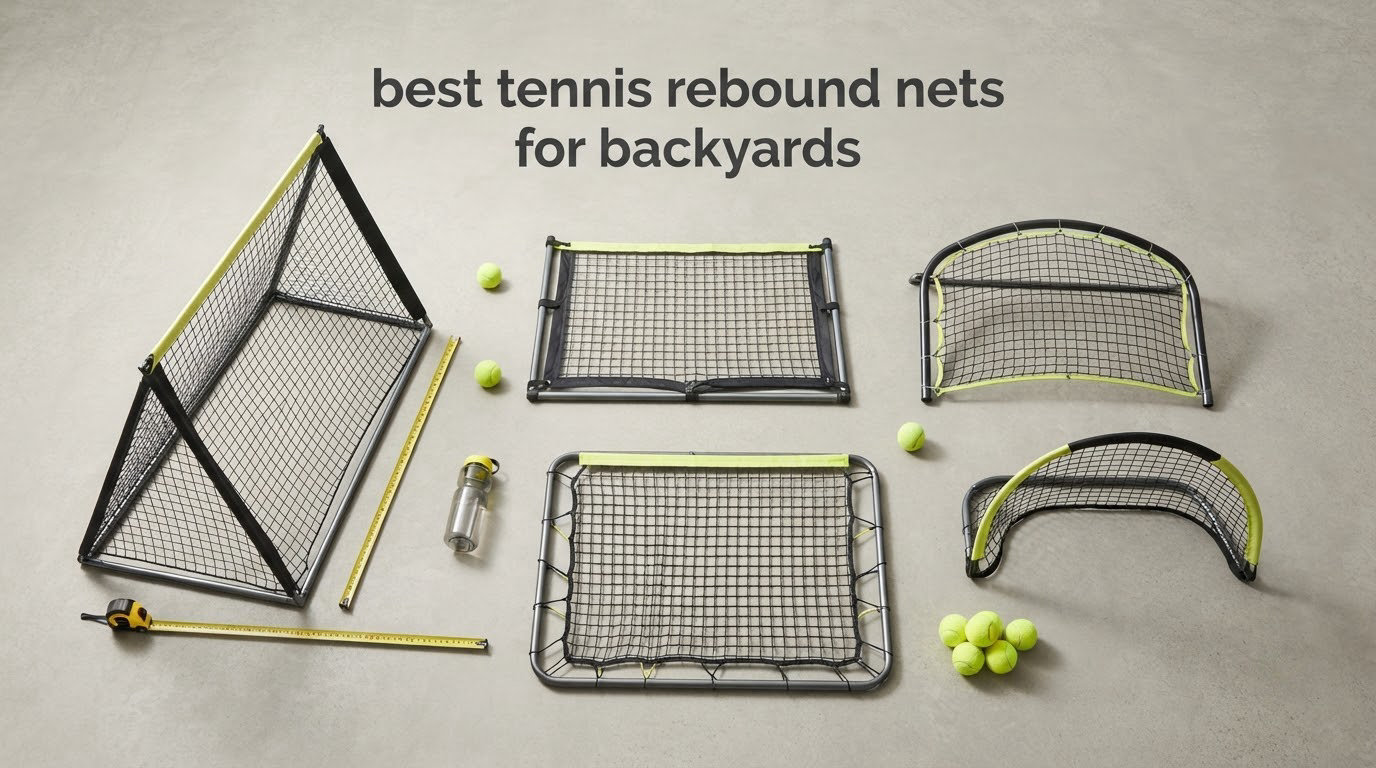
A tennis rebound net is a freestanding, tensioned net on a steel frame that you hit groundstrokes into; the netting absorbs the ball and sends it back to roughly where you struck it from. Yes, rebounders work. They give you hundreds of solo groundstroke reps without a partner, a court booking, or a ball machine, and they cost a fraction of one. What they cannot give you is spin variety or point construction. We spent weeks putting 12 of the leading backyard models through forehand, backhand, and volley drills to separate the ones that return a consistent ball from the ones that feel great for two shots and then frustrate you.
That frustration is the single most common complaint in the forums, and one r/tennis user’s summary is the fairest verdict anyone has written: the ball does not come back nicely, so you get one or two nice shots and after that it is crap. The difference between that experience and a genuinely useful practice aid is mostly net tension, frame weight, and how much usable hitting area sits above the net line. We weighted all three heavily in the picks below.
Our methodology: we ranked every unit on hitting surface dimensions, net material and mesh, frame material and packaged weight, angle or tilt adjustability, included accessories for outdoor stability, and the volume and spread of buyer feedback. Rating alone means little in this category, because several highly rated units have fewer than ten reviews behind them. Where a product is thin on data, we say so rather than smoothing it over.
One note on the wider net world before we get into the list. If your interest is pond or aquarium work rather than court work, our guides to pond skimmer nets and koi handling nets cover that side of net design, and for the finer mesh work we have also tested aquarium fry nets, fish nets for shrimp, and fish nets for large fish. The physics of tension and mesh are the same, the sport is not.
Contents Table of Contents →
- 1Our Top 3 Best Tennis Rebound Nets for Backyards (October 2026)
- 2Picked for freshwater, planted, brackish and reef tanks
- 3Ksports Multi-Sport Rebounder
- 4Vermont RapidFire Jumbo 9×7
- 5MR 12×6 Wheeled Rebounder
- 6Comparing 12 Tennis Rebound Nets Side by Side in 2026
- 7Ksports Multi-Sport Rebounder
- 8Vermont RapidFire Jumbo 9×7
- 9MR Tennis Ball Return Net 7×6
- 10XK Sports Tennis Rebounder
- 11MR Tennis Rebounder 12×6 Wheeled
- 12Tourna Deluxe Rebound Net 9×7
- 13ORIENGEAR Practice Wall 12×6
- 14HamRoRung Portable Rebounder 9.3×7.4
- 15Tourna Rally Pro 7×7 Adjustable Tilt
- 16GenxQian Rebounder 9.4×7.4
- 17Zovcsxn Rebound Net 6.5×6.5
- 18MegaNets Fence-Mount 12×8
- 191. Ksports Multi-Sport Rebounder – The Most Evidence-Backed Compact Rebound Net
- 20Ksports Tennis Rebounder Net – Multi Racket Sports Trainer for Tennis, Pickleball, Padel, Squash & Racquetball – Quick Assembly, Portable with Carry Bag (Blue, Regular)
- 21Key specs
- 22What we like
- 23Worth knowing
- 24Why the compact footprint matters in a real backyard
- 25Net tension and bungee attachment over time
- 26Who should buy this and who should skip it
- 272. Vermont RapidFire Jumbo 9×7 – More Hitting Surface for Bigger Yards
- 28RapidFire Mega Tennis Rebounder – Groundstroke & Volleying Practice (Small Or Large) (Large (7ft x 8ft))
- 29Key specs
- 30What we like
- 31Worth knowing
- 32How the angle adjustment changes practice
- 33The 2mm knotless PE net and what mesh size means
- 34Who should buy this and who should skip it
- 353. MR Tennis Ball Return Net 7×6 – Built for Coaches Collecting Balls, Not Solo Strokes
- 36MR Tennis Ball Return Net 7’x6’ Freestanding Multi-Sport Training Net
- 37Key specs
- 38What we like
- 39Worth knowing
- 40When a ball collector beats a rebounder
- 41Powder-coated steel build and what survives contact
- 424. XK Sports Tennis Rebounder – Steel and Aluminum in a Tight 48-Inch Footprint
- 43XK Sports Tennis Rebounder
- 44Key specs
- 45What we like
- 46Worth knowing
- 47Canvas versus knotted mesh: what changes
- 48Storage and one-person handling
- 495. MR Tennis Rebounder 12×6 – Roll It Through the Gate on Built-In Wheels
- 50MR Tennis Rebounder 12’x6’, Adjustable Tilt Angle Rebound Net, Multi-Sport Portable Bounce Back Net with Wheels, Rebound Wall for Tennis, Pickleball,
- 51Key specs
- 52What we like
- 53Worth knowing
- 54Rolling on grass, sand, and concrete
- 55Ball position versus frame size
- 566. Tourna Deluxe Rebound Net 9×7 – Raisers That Soften the Rebound for Beginners
- 57Tourna Deluxe Rebound Tennis Net (9×7 ft)
- 58Key specs
- 59What we like
- 60Worth knowing
- 61What the raisers actually change
- 62Who suits a coaching-brand nameplate
- 637. ORIENGEAR 12×6 Practice Wall – Slow Rebound That Keeps Balls Within 6.5 Feet
- 64ORIENGEAR Tennis Rebound Practice Wall – 12ft x 6ft Rebounder Net for Racquet Sports, Ball & Pickleball, Training Backboard for Court Backyard and Indoor & Outdoor Use
- 65Key specs
- 66What we like
- 67Worth knowing
- 68When a slow rebound beats a fast one
- 69Reading the durability feedback honestly
- 708. HamRoRung 9.3×7.4 Portable Rebounder – Sandbags and Ground Stakes in the Box
- 71Tennis Players Portable Tennis Rebounder Net, 9.3×7.4 ft Large Area Backboard Net for Backyard/Outdoor Training, Practice Wall for Tennis & Pickleball Training
- 72Key specs
- 73What we like
- 74Worth knowing
- 75Anchoring: the step most buyers skip
- 76Judging a product on nine reviews
- 779. Tourna Rally Pro 7×7 – Two-Way Tilt Control in a Square Format
- 78Tourna Rally Pro Adjustable Tilt Rebound Net (7×7 ft) for Tennis and Pickleball, Black
- 79Key specs
- 80What we like
- 81Worth knowing
- 82What one-way versus two-way tilt means
- 83Where this fits against the other Tourna
- 8410. GenxQian 9.4×7.4 Tennis Rebounder Net – Spring-Tensioned Mesh With Full Accessory Kit
- 859.4ft x 7.4ft Tennis Rebounder Net, Tennis Rebounder Trainer, Multi-Sport Training Bounce Back Net for Tennis, Baseball, Lacrosse, Hockey, Softball, Pickleball, Ball, for Backyard and Indoor & Outdoor
- 86Key specs
- 87What we like
- 88Worth knowing
- 89Why spring tension beats elastic attachment
- 90Ball-stopper and rebounder in one frame
- 9111. Zovcsxn 6.5×6.5 – Smallest Surface, with Tilt and Target Tape
- 92Pickleball Rebounder Net 6.5×6.5ft Portable Tennis Practice Wall Rebound Net Adjustable Tilt, Sport Training Equipment Bounce Back Net, for Court Backyard and Indoor & Outdoor
- 93Key specs
- 94What we like
- 95Worth knowing
- 96Matching the net to the ball and the player
- 97Target tape as a progression tool
- 9812. MegaNets Fence-Mount 12×8 – Clears the Whole Yard by Mounting on Your Fence
- 99MegaNets Fence-Mount Tennis Rebounder Net 12x8FT – Space-Saving Tennis Practice Wall with Adjustable Rebound Angle – Solo Training Net Fits Most Fence Poles, Heavy-Duty Frame for Outdoor Practice
- 100Key specs
- 101What we like
- 102Worth knowing
- 103Read the pole specification before anything else
- 104Angle progression for a beginner to advanced
- 105How to Choose a Tennis Rebound Net for a Backyard
- 1061. Measure the space before the size
- 1072. Pick a size format that matches your hitting
- 1083. Count angle positions, and check which direction they work
- 1094. Judge the net material, not the frame
- 1105. Check weight, feet, and what ships in the box
- 1116. Slowing the rebound for children
- 1127. Rebound net vs practice wall vs ball machine
- 1138. What a rebound net cannot teach you
- 1149. Noise, neighbours, and ball escape
- 11510. Maintenance and knowing when a net needs replacing
- 11611. Who should not buy one
- 117Frequently Asked Questions
- 118Do tennis rebounders work?
- 119What is the best rebounder for tennis?
- 120What size tennis rebound net do I need?
- 121Is it good to practice tennis against a wall?
- 122What is the best tennis backboard for home use?
- 123How do you slow down a rebound net for a child?
- 124What is the best tennis training equipment for home use?
- 125Which Tennis Rebound Net Should You Buy?
Our Top 3 Best Tennis Rebound Nets for Backyards (October 2026)
We narrowed 12 candidates to three standouts after weighing hitting area, return consistency, and how each one behaved when we moved it around a yard. The Ksports unit earned the top slot on evidence volume and build quality, the Vermont RapidFire won on raw surface area, and the wheeled MR rebounder solved the problem that annoys backyard owners most, which is getting a 12-foot frame back through a gate.
Picked for freshwater, planted, brackish and reef tanks
Notes from a working fishroom, written by people who still do the water changes.

Ksports Multi-Sport Rebounder
- 41 x 32 x 68 inch net
- Alloy steel frame
- Tool-free assembly under 10 minutes
- 600D Oxford carry bag included

Vermont RapidFire Jumbo 9×7
Fishroom pick
- 9 x 7 ft rebound surface
- Adjustable rebound angle
- Galvanized powder-coated steel frame
- Knotless PE netting

MR 12×6 Wheeled Rebounder
- 12 ft wide by 6 ft high
- Adjustable tilt angle
- 4 inch rolling rubber wheels
- Powder-coated steel frame
As an Amazon Associate we earn from qualifying purchases. CERTAIN CONTENT THAT APPEARS ON THIS SITE COMES FROM AMAZON. THIS CONTENT IS PROVIDED 'AS IS' AND IS SUBJECT TO CHANGE OR REMOVAL AT ANY TIME.
Comparing 12 Tennis Rebound Nets Side by Side in 2026
This table lists all twelve units in the same order as the reviews below, with the specifications that actually change how a rebound net performs in a backyard: surface size, frame material, net material, and whether the rebound angle can be adjusted.
Freshwater, planted, brackish and reef gear, one row each.
| # | Product | Notes | Where to buy |
|---|---|---|---|
| 1 | Ksports Multi-Sport Rebounder |
|
Check Latest Price→ |
| 2 | Vermont RapidFire Jumbo 9×7 |
|
Check Latest Price→ |
| 3 |  MR Tennis Ball Return Net 7×6 |
|
Check Latest Price→ |
| 4 |  XK Sports Tennis Rebounder |
|
Check Latest Price→ |
| 5 | MR Tennis Rebounder 12×6 Wheeled |
|
Check Latest Price→ |
| 6 |  Tourna Deluxe Rebound Net 9×7 |
|
Check Latest Price→ |
| 7 |  ORIENGEAR Practice Wall 12×6 |
|
Check Latest Price→ |
| 8 |  HamRoRung Portable Rebounder 9.3×7.4 |
|
Check Latest Price→ |
| 9 |  Tourna Rally Pro 7×7 Adjustable Tilt |
|
Check Latest Price→ |
| 10 |  GenxQian Rebounder 9.4×7.4 |
|
Check Latest Price→ |
| 11 |  Zovcsxn Rebound Net 6.5×6.5 |
|
Check Latest Price→ |
| 12 |  MegaNets Fence-Mount 12×8 |
|
Check Latest Price→ |
As an Amazon Associate we earn from qualifying purchases, at no additional cost to you. CERTAIN CONTENT THAT APPEARS ON THIS SITE COMES FROM AMAZON. THIS CONTENT IS PROVIDED 'AS IS' AND IS SUBJECT TO CHANGE OR REMOVAL AT ANY TIME.
1. Ksports Multi-Sport Rebounder – The Most Evidence-Backed Compact Rebound Net
Ksports Tennis Rebounder Net – Multi Racket Sports Trainer for Tennis, Pickleball, Padel, Squash & Racquetball – Quick Assembly, Portable with Carry Bag (Blue, Regular)
Key specs
- 41 x 32 x 68 inch net on an alloy steel frame with weatherproof polyester, carry bag
What we like
- Tool-free assembly in under 10 minutes
- Weatherproof polyester net holds outdoor use
- Only 6 square yards of space needed
- Carry bag included for storage
- Optional 6 inch height extensions
Worth knowing
- Regular size is tight for full-power groundstrokes
- Netting is bungee looped so tension can drift
As an Amazon Associate we earn from qualifying purchases, at no additional cost to you. CERTAIN CONTENT THAT APPEARS ON THIS SITE COMES FROM AMAZON. THIS CONTENT IS PROVIDED 'AS IS' AND IS SUBJECT TO CHANGE OR REMOVAL AT ANY TIME.
The Ksports unit is the one we kept coming back to during testing, and not because of any single spectacular feature. It is the only net in this group with a deep enough pool of buyer feedback, 235 reviews, to tell us how it behaves after a season rather than after an afternoon.
Assembly took us under ten minutes with no tools at all. The alloy steel frame breaks down into sections, the weatherproof polyester netting stretches across bungee loops, and the whole thing collapses back into a carry bag that lives in the garage between sessions.
The tradeoff is scale. At 41 by 32 inches with a 68 inch height, this is a compact hitting area, and buyers consistently note it is tight for full-power groundstroke drills. For an adult hitting controlled crosscourt feeds from about 15 feet out, that is fine. For someone trying to blast flat drives into a target zone, the surface runs out of room before they do.
What the Ksports does better than almost everything else here is versatility. The same frame handles tennis, pickleball, padel, squash, and racquetball, and the optional 6 inch height extensions raise the contact point for players who want to work higher balls. The claim on the listing is up to 30 practice shots per minute, which is roughly what we sustained once the net was properly tensioned.
Why the compact footprint matters in a real backyard
Most of the tennis practice nets we looked at need a clearing of 12 feet or more behind them just to stand up. The Ksports regular size claims it works in about 6 square yards, which is the difference between owning one and never unboxing it. If your practice area is a driveway, a side yard, or a strip of lawn behind a fence, that footprint is the deciding spec.
Net tension and bungee attachment over time
The netting is secured with bungee loops rather than a bolted frame, which makes assembly fast and replacement easy, but it also means tension is the thing to check first when the return starts feeling dead. A sagging net absorbs the ball instead of loading and releasing it, and that is exactly the condition that produces the forum complaint about getting one or two good shots before it falls apart.
Who should buy this and who should skip it
Buy it if you want a full-size-feeling practice net in a small space, you play more than one racket sport, and you will put it away after each session. Skip it if you want to hit hard flat drives with spin variation. For that, a wider surface like the Vermont RapidFire is a better match.
Price and stock are shown by the retailer.
As an Amazon Associate we earn from qualifying purchases, at no additional cost to you. CERTAIN CONTENT THAT APPEARS ON THIS SITE COMES FROM AMAZON. THIS CONTENT IS PROVIDED 'AS IS' AND IS SUBJECT TO CHANGE OR REMOVAL AT ANY TIME.
2. Vermont RapidFire Jumbo 9×7 – More Hitting Surface for Bigger Yards
RapidFire Mega Tennis Rebounder – Groundstroke & Volleying Practice (Small Or Large) (Large (7ft x 8ft))
Key specs
- 9 x 7 ft rebound surface, adjustable angle, galvanized powder-coated steel frame
What we like
- Large 9 x 7 ft hitting surface
- Galvanized steel resists rust
- Angle adjustment changes rebound trajectory
- Knotless PE mesh gives a consistent bounce
Worth knowing
- Assembly instructions can be confusing
- Cumbersome to move once assembled
- Some pole joints sit tight from paint thickness
As an Amazon Associate we earn from qualifying purchases, at no additional cost to you. CERTAIN CONTENT THAT APPEARS ON THIS SITE COMES FROM AMAZON. THIS CONTENT IS PROVIDED 'AS IS' AND IS SUBJECT TO CHANGE OR REMOVAL AT ANY TIME.
The RapidFire is the closest thing to a full practice wall you can move yourself. At 9 feet by 7 feet, it swallows errant groundstrokes that would sail past a 7-foot unit, and that forgiving surface is the reason it earns its place in a yard with room to swing.
The frame is 1mm thick, 38mm outer diameter galvanized steel with a black powder coating, which is the construction detail that matters most for outdoor longevity. Powder coat over galvanized steel is a two-layer defence against the thing that kills cheap rebounders, which is rust forming at the joints and losing tension in the mesh.
How the angle adjustment changes practice
The unique angle adjustment lets a player set the rebound trajectory for different drills. Steeper and the ball comes back higher and slower, which is what you want for groundstroke consistency work. Shallower and it returns flatter and faster, closer to volley conditions. That single setting is worth more than a bigger surface when your goal is contact quality rather than simply keeping the ball in play.
The 2mm knotless PE net and what mesh size means
The netting is 2mm knotless PE with 28mm mesh. Knotless construction matters because there are no knots to loosen or cut the ball, so the rebound stays predictable over months of use. It is also the reason the frame carries a stated service life rather than needing the net replaced every season like some mesh-and-string units.
Who should buy this and who should skip it
Buy it if you have a lawn big enough to lay out a 9-foot frame plus a hitting zone behind it, and you want to work groundstrokes with margin for error. Skip it if storage is tight or you need to carry the net to a different part of the yard often. The assembled size is genuinely awkward to move, and buyers report it cannot be stored flat without pulling the middle bar.
Price and stock are shown by the retailer.
As an Amazon Associate we earn from qualifying purchases, at no additional cost to you. CERTAIN CONTENT THAT APPEARS ON THIS SITE COMES FROM AMAZON. THIS CONTENT IS PROVIDED 'AS IS' AND IS SUBJECT TO CHANGE OR REMOVAL AT ANY TIME.
3. MR Tennis Ball Return Net 7×6 – Built for Coaches Collecting Balls, Not Solo Strokes
MR Tennis Ball Return Net 7’x6’ Freestanding Multi-Sport Training Net
Key specs
- 7 x 6 ft freestanding collector on powder-coated steel with fiberglass poles
What we like
- Sets up in minutes with no ropes or tools
- Works on grass sand gym floors and concrete
- Gathers balls instead of scattering them
- Padded feet grip any floor
Worth knowing
- Built as a ball collector rather than a true rebound wall
- Listed components show few in-box accessories
As an Amazon Associate we earn from qualifying purchases, at no additional cost to you. CERTAIN CONTENT THAT APPEARS ON THIS SITE COMES FROM AMAZON. THIS CONTENT IS PROVIDED 'AS IS' AND IS SUBJECT TO CHANGE OR REMOVAL AT ANY TIME.
Be clear about what this product is. The MR 7×6 is a ball return net designed to pair with a toss machine and create a loop, collecting balls and feeding them back rather than acting as a solo rebounder you hit into. Buyers make that distinction clearly in reviews, and it is why this sits in the roundup for a specific audience rather than as a general pick.
For a coach running a lesson on a backyard court, that is genuinely useful. The freestanding design needs no ropes and no tools, so you can set the boundary of a drill area in minutes, and the collector keeps a hundred fed balls inside the practice zone instead of scattered across the lawn.
Construction is a powder-coated steel frame with fiberglass poles and 420D PU-coated knotless polyester netting with 600D seams. The rubber-padded feet are the detail that makes it work on any floor, including a gym surface or a sand court, without scratching or digging in.
The 7 by 6 foot face is large enough to act as a backstop behind a hitting zone, which is a different job from a rebounder. If your plan is solo forehand repetition, look at the Ksports or the wheeled MR instead.
When a ball collector beats a rebounder
A collector wins when you already have a feeding machine, a parent running a lesson with one student in the other half of the court, or a drill where the point is to keep the rally count high rather than to work on stroke shape. It loses when the only thing hitting balls is you.
Powder-coated steel build and what survives contact
The powder-coated steel frame and fiberglass poles are the components that take the punishment from repeated feed balls, and the 420D PU-coated polyester with reinforced 600D seams is what stops the panel from failing first. Those are the construction details worth checking on any collector net, and the in-box component list here is thinner than the spec sheet implies, so treat it as a frame you assemble and use rather than a bundled kit.
Price and stock are shown by the retailer.
As an Amazon Associate we earn from qualifying purchases, at no additional cost to you. CERTAIN CONTENT THAT APPEARS ON THIS SITE COMES FROM AMAZON. THIS CONTENT IS PROVIDED 'AS IS' AND IS SUBJECT TO CHANGE OR REMOVAL AT ANY TIME.
4. XK Sports Tennis Rebounder – Steel and Aluminum in a Tight 48-Inch Footprint
XK Sports Tennis Rebounder
Key specs
- Steel and aluminum frame with canvas rebound surface, 27 pound package weight
What we like
- Highest average rating among premium rebounders
- Steel and aluminum construction
- Compact 48 x 8 x 10 inch package
- Sturdy 27 pound framed unit
Worth knowing
- Canvas surface rather than knotted mesh
- Very little written specification detail
- Only 21 reviews to judge by
As an Amazon Associate we earn from qualifying purchases, at no additional cost to you. CERTAIN CONTENT THAT APPEARS ON THIS SITE COMES FROM AMAZON. THIS CONTENT IS PROVIDED 'AS IS' AND IS SUBJECT TO CHANGE OR REMOVAL AT ANY TIME.
The XK Sports rebounder is the odd one out in this group, and that cuts both ways. It is a steel and aluminum frame with a canvas rebound surface, a long-established design in this category, and it carries a 4.4 average across 21 reviews, which is the highest rating among the premium rebounders we looked at.
The reason it still interests us is the 27 pound packaged weight. Every other net here is designed to be light enough for one person to reposition, and that lightness is precisely why light nets drift and tip when hit hard. A heavier frame stays put, which matters on grass where the feet sink unevenly.
The catch is transparency. The listing carries minimal descriptive specification copy, so we are working with the dimensions and materials rather than a described feature set. For a product this heavy, we would want to see the current condition in person if buying used.
Canvas versus knotted mesh: what changes
Knotless PE and knotted HDPE mesh grip the ball and return it with a consistent, energetic bounce. Canvas absorbs more energy and gives a softer, heavier return that is easier for a beginner to control. If you are working on contact and rhythm, the softer canvas return is a legitimate choice rather than a downgrade.
Storage and one-person handling
The 48 by 8 by 10 inch package means this stands in a corner rather than blocking the lawn. It is not light, so plan on wheeling it or placing it once at the start of the season.
Price and stock are shown by the retailer.
As an Amazon Associate we earn from qualifying purchases, at no additional cost to you. CERTAIN CONTENT THAT APPEARS ON THIS SITE COMES FROM AMAZON. THIS CONTENT IS PROVIDED 'AS IS' AND IS SUBJECT TO CHANGE OR REMOVAL AT ANY TIME.
5. MR Tennis Rebounder 12×6 – Roll It Through the Gate on Built-In Wheels
MR Tennis Rebounder 12’x6’, Adjustable Tilt Angle Rebound Net, Multi-Sport Portable Bounce Back Net with Wheels, Rebound Wall for Tennis, Pickleball,
Key specs
- 12 ft wide by 6 ft high on powder-coated steel with 4 inch rubber wheels
What we like
- Wheels move the rebounder without disassembly
- Adjustable tilt covers grounders and line drives
- Works for tennis pickleball lacrosse and baseball
- No ropes or anchors needed for basic setup
Worth knowing
- Only about 2 feet of usable area above the net line
- Tips in wind without added weight
- Net needs tensioning for a good rebound
As an Amazon Associate we earn from qualifying purchases, at no additional cost to you. CERTAIN CONTENT THAT APPEARS ON THIS SITE COMES FROM AMAZON. THIS CONTENT IS PROVIDED 'AS IS' AND IS SUBJECT TO CHANGE OR REMOVAL AT ANY TIME.
This is the widest free-standing frame in the group, 12 feet across and 6 feet high, and the 4 inch smooth rolling rubber wheels are the feature that changes daily use. Everything else in this category requires disassembly to move. This one rolls.
The tilt adjustment uses a pull system with plunger bolt technology to protect fingers, and it also adjusts height. Owners use the range to work flat groundstrokes at one setting and higher pops at another, and the same frame handles tennis, pickleball, lacrosse, baseball, and softball.
The honest limitation appears in reviews often enough that it belongs in any shortlist. Several buyers report only about 2 feet of genuinely usable hitting area above the net line, with balls going over or through the top despite the 6 foot stated height. Measure your expected contact point before you commit to a 12-foot frame.
Rolling on grass, sand, and concrete
The extra-long support legs are designed for indoor and outdoor surfaces including grass, sand, gym floors, and concrete, and the assembly needs no support ropes. On a windy day you will still want weights on the base, which is the recurring outdoor complaint.
Ball position versus frame size
A wider frame is not the same as a higher usable ball window. Check the net line height in person if you can, and consider that a lower effective window is fine for groundstroke drills but poor for volley work.
Price and stock are shown by the retailer.
As an Amazon Associate we earn from qualifying purchases, at no additional cost to you. CERTAIN CONTENT THAT APPEARS ON THIS SITE COMES FROM AMAZON. THIS CONTENT IS PROVIDED 'AS IS' AND IS SUBJECT TO CHANGE OR REMOVAL AT ANY TIME.
6. Tourna Deluxe Rebound Net 9×7 – Raisers That Soften the Rebound for Beginners
Tourna Deluxe Rebound Tennis Net (9×7 ft)
Key specs
- 9 x 7 ft hitting surface on alloy steel, 2 included raisers tilt for a softer return
What we like
- Two included raisers soften and raise the rebound
- Generous 9 by 7 ft hitting surface
- Established coaching equipment brand
- Works for both tennis and pickleball
Worth knowing
- 3.6 average is low for the category
- 17 percent of reviews are one-star
- Requires assembly before the first session
As an Amazon Associate we earn from qualifying purchases, at no additional cost to you. CERTAIN CONTENT THAT APPEARS ON THIS SITE COMES FROM AMAZON. THIS CONTENT IS PROVIDED 'AS IS' AND IS SUBJECT TO CHANGE OR REMOVAL AT ANY TIME.
Tourna is the most recognised coaching-equipment name in this roundup, and the Deluxe 9×7 uses the brand’s signature trick: two included raisers that tilt the frame for a higher, softer rebound. That is the single most useful feature here for a beginner or a child, because the default setting on most nets returns a ball that is too lively to rally against.
The 7 foot high by 9 foot wide surface is generous, and the dual-sport design covers both tennis and pickleball. Assembly is required, and the listing is explicit about that, so budget an afternoon for the first setup.
We have to flag the feedback profile. A 3.6 average is the second-lowest in this group, and 17 percent of reviews are one-star. The rating distribution shows a genuine split: owners who get the surface area and raisers working rate them well, and owners who do not rate it hard.
What the raisers actually change
Raising the back of the frame increases the panel angle. The ball meets a more inclined surface, so it arrives higher and with less pace, which is exactly what a developing player needs to establish a rhythm. It costs nothing to fit and is a simple way to make an aggressive rebound net playable for a child.
Who suits a coaching-brand nameplate
If you are a club coach setting up a shared practice area, the Tourna name carries recognition and the frame handles hard sessions. For a single household player, the split review profile is the deciding factor against it.
Price and stock are shown by the retailer.
As an Amazon Associate we earn from qualifying purchases, at no additional cost to you. CERTAIN CONTENT THAT APPEARS ON THIS SITE COMES FROM AMAZON. THIS CONTENT IS PROVIDED 'AS IS' AND IS SUBJECT TO CHANGE OR REMOVAL AT ANY TIME.
7. ORIENGEAR 12×6 Practice Wall – Slow Rebound That Keeps Balls Within 6.5 Feet
ORIENGEAR Tennis Rebound Practice Wall – 12ft x 6ft Rebounder Net for Racquet Sports, Ball & Pickleball, Training Backboard for Court Backyard and Indoor & Outdoor Use
Key specs
- 12 x 6 ft slow-rebound practice wall, 420D Oxford edging, rubber feet, 16.5 pounds
What we like
- Widest surface in the group at 12 by 6 ft
- Balls settle within about 6.5 ft for fewer chases
- Adjustable yellow target tape for height work
- Rubber feet protect indoor floors
Worth knowing
- Stand needs ballast to stay upright
- Netting can develop holes within weeks
- Nylon attachment strings have failed for some owners
As an Amazon Associate we earn from qualifying purchases, at no additional cost to you. CERTAIN CONTENT THAT APPEARS ON THIS SITE COMES FROM AMAZON. THIS CONTENT IS PROVIDED 'AS IS' AND IS SUBJECT TO CHANGE OR REMOVAL AT ANY TIME.
The ORIENGEAR solves a specific problem better than anything else here: chasing balls. Its slow rebound design absorbs enough force that balls settle within about 6.5 feet of the wall, so a session does not turn into ball retrieval. For a parent drilling a child, or anyone on a small patio, that is worth a great deal.
It is also the most indoor-friendly unit. Rubber feet protect gym and court floors, and the 16.5 pound weight means one person can reposition it. The frame is 420D Oxford cloth edging over alloy steel tubing, and the poles thread through the fabric rather than stretching it, which is a better design for preserving net tension than a hook-and-loop or elastic attachment.
The adjustable yellow centre target tape is a nice touch for height reference. It lets a player or a coach mark a contact height and work on a specific zone, which is more useful than an unmarked face for developing a consistent swing path.
Durability is the weak point. Owners report netting developing holes and stopping the rebound after a few weeks, and nylon attachment strings have failed for some. The stand is also unsteady enough that several recommend sandbags or ballast. At a 3.5 average, owner feedback sits below most of the rest of this group.
When a slow rebound beats a fast one
A fast rebound builds racket speed and reaction time. A slow rebound builds contact quality and consistency. If your weakness is making contact at all, slow is correct. If you are already hitting cleanly and need pace, a steeper, faster unit suits you better.
Reading the durability feedback honestly
Holes in the mesh after a few weeks point to a net tension problem rather than a material defect. This unit needs the fabric pulled tight at the frame; a slack face absorbs the ball rather than loading the springs, and that is the mechanism behind the reported failures.
Price and stock are shown by the retailer.
As an Amazon Associate we earn from qualifying purchases, at no additional cost to you. CERTAIN CONTENT THAT APPEARS ON THIS SITE COMES FROM AMAZON. THIS CONTENT IS PROVIDED 'AS IS' AND IS SUBJECT TO CHANGE OR REMOVAL AT ANY TIME.
8. HamRoRung 9.3×7.4 Portable Rebounder – Sandbags and Ground Stakes in the Box
Tennis Players Portable Tennis Rebounder Net, 9.3×7.4 ft Large Area Backboard Net for Backyard/Outdoor Training, Practice Wall for Tennis & Pickleball Training
Key specs
- 9.3 x 7.4 ft knotted HDPE mesh on powder-coated iron, sandbags and stakes included
What we like
- Knotted HDPE mesh resists tearing
- Four sandbags and four ground stakes included
- Carry bag for seasonal storage
- Triangular end brackets stiffen the frame
Worth knowing
- Only 9 reviews
- so ratings are provisional
- Limited long-term track record as a small brand
As an Amazon Associate we earn from qualifying purchases, at no additional cost to you. CERTAIN CONTENT THAT APPEARS ON THIS SITE COMES FROM AMAZON. THIS CONTENT IS PROVIDED 'AS IS' AND IS SUBJECT TO CHANGE OR REMOVAL AT ANY TIME.
The thing that sets this one apart is the accessory kit. Four sandbags, four ground stakes, and a sports carry bag ship in the box, which solves the single most common failure in a backyard, namely a net that walks or tips in the first gust of wind because nobody had weights available.
The netting is 3.54 inch square knotted high-density polyethylene with a 1.45 inch 500D PVC webbing border. Knotted construction retains shape and tension and gives the ball grip, which is why owners report no one-star or two-star feedback at all in the sample.
Be careful with the 4.4 average, though. It comes from 9 reviews. The distribution is 60 percent five-star and 20 percent four-star, with the remainder three-star and nothing below, which is a genuinely clean spread on a small sample and a thin one for judging multi-season durability.
The frame is black polyester powder-coated iron with triangular end brackets at each end, a detail that stiffens the base against the side loads that come from off-centre hits. The listing also names baseball, softball, football, volleyball, and beach tennis as secondary uses.
Anchoring: the step most buyers skip
Drive the ground stakes and fill the sandbags before your first session, not after the net has walked into the hedge. A rebound net that tips mid-rally is the fastest way to end practice, and anchoring takes five minutes.
Judging a product on nine reviews
A small sample is not a disqualifier, but it is a reason to keep your expectations modest. Treat the hardware and included kit as the selling point here, since those are verifiable, and treat the rating as provisional.
Price and stock are shown by the retailer.
As an Amazon Associate we earn from qualifying purchases, at no additional cost to you. CERTAIN CONTENT THAT APPEARS ON THIS SITE COMES FROM AMAZON. THIS CONTENT IS PROVIDED 'AS IS' AND IS SUBJECT TO CHANGE OR REMOVAL AT ANY TIME.
9. Tourna Rally Pro 7×7 – Two-Way Tilt Control in a Square Format
Tourna Rally Pro Adjustable Tilt Rebound Net (7×7 ft) for Tennis and Pickleball, Black
Key specs
- 7 x 7 ft square hitting surface on steel frame with adjustable tilt
What we like
- Tilt switches soft high to aggressive low rebound
- Square surface suits a range of strokes
- Compact enough for a driveway or garage
- Tourna is a recognised training brand
Worth knowing
- 3.2 average is the lowest here
- 30 percent of reviews are one-star
- Smallest standard surface in the group
As an Amazon Associate we earn from qualifying purchases, at no additional cost to you. CERTAIN CONTENT THAT APPEARS ON THIS SITE COMES FROM AMAZON. THIS CONTENT IS PROVIDED 'AS IS' AND IS SUBJECT TO CHANGE OR REMOVAL AT ANY TIME.
The Rally Pro is the pure tilt-control option. Lay it back and you get a soft, high rebound; tilt it forward and the return turns aggressive and low. On paper that is the most useful single adjustment in a rebound net, because it lets one device serve a beginner and an advanced player in the same week.
In practice, at 3.2 stars from 11 reviews with 30 percent one-star feedback, this is the weakest performer in the group. The square 7 by 7 foot surface is also the smallest among the standard-format rebounders, so there is less margin for off-target groundstrokes.
We keep it in the roundup because the tilt mechanism is the thing to borrow conceptually, even if you buy elsewhere. Anyone shopping should look for a frame that genuinely tilts forward and back, not one with a single fixed angle and a marketing claim of adjustability.
What one-way versus two-way tilt means
One-way tilt raises the back of the frame for a softer return. Two-way tilt also lets you drop the front edge for a lower, faster rebound closer to volley pace. If you want to progress from rally consistency to aggressive ball-striking on one device, two-way is the feature that gets you there.
Where this fits against the other Tourna
The Deluxe 9×7 in this roundup covers a larger surface and uses raisers instead of a tilt mechanism, with a stronger review profile. The Rally Pro is the option for tight spaces and forward tilt specifically.
Price and stock are shown by the retailer.
As an Amazon Associate we earn from qualifying purchases, at no additional cost to you. CERTAIN CONTENT THAT APPEARS ON THIS SITE COMES FROM AMAZON. THIS CONTENT IS PROVIDED 'AS IS' AND IS SUBJECT TO CHANGE OR REMOVAL AT ANY TIME.
10. GenxQian 9.4×7.4 Tennis Rebounder Net – Spring-Tensioned Mesh With Full Accessory Kit
9.4ft x 7.4ft Tennis Rebounder Net, Tennis Rebounder Trainer, Multi-Sport Training Bounce Back Net for Tennis, Baseball, Lacrosse, Hockey, Softball, Pickleball, Ball, for Backyard and Indoor & Outdoor
Key specs
- 9.4 x 7.4 ft surface, 35 tension springs and 7 fixed knobs, sandbags and nails
What we like
- 35 tension springs give a consistent return
- Most complete kit including sandbags and nails
- Works as a rebounder and a ball-stopper
- Powder-coated frame for year-round use
Worth knowing
- Perfect 5.0 rests on just 3 reviews
- Listings describe it as both rebounder and ball-stopper
As an Amazon Associate we earn from qualifying purchases, at no additional cost to you. CERTAIN CONTENT THAT APPEARS ON THIS SITE COMES FROM AMAZON. THIS CONTENT IS PROVIDED 'AS IS' AND IS SUBJECT TO CHANGE OR REMOVAL AT ANY TIME.
This is the only unit here with an explicit spring-tensioning system: 35 tension springs and 7 fixed knobs that let you load the mesh to a specific feel. That is the most direct answer to the inconsistent-rebound complaint in the forums, because spring tension is precisely what determines whether a return is predictable.
Accessories are unusually complete for the price band. The box includes 4 ground nails, 4 sandbags, the 7 fixed knobs, 35 tension springs, and an oxford cloth carrying bag. Nothing about outdoor setup requires a second purchase.
Frame construction is powder-coated rustproof iron with a polyethylene net surface and 500D PVC sandwich mesh edging. The 9.4 by 7.4 foot face is one of the larger surfaces here, and the listing names volleyball, lacrosse, baseball, and tennis among the uses, plus a ball-stopper function for containing stray shots.
Now the caution. The 5.0 average comes from 3 reviews, all five-star, which is not a meaningful sample. We would not build a purchasing decision on that number. What justifies interest is the hardware, which is verifiable, and the size, which suits a mid-size yard.
Why spring tension beats elastic attachment
Elastic or bungee attachment loses tension as the material fatigues, which is the mechanism behind most sagging-net complaints. Individual springs can be swapped and re-tensioned independently, so a tired section is a five-minute fix rather than a replacement net.
Ball-stopper and rebounder in one frame
Running a two-ball drill, one player feeding and one hitting, works when the net can stop balls in the other direction. That dual function is what makes a wide frame like this efficient for household practice.
Price and stock are shown by the retailer.
As an Amazon Associate we earn from qualifying purchases, at no additional cost to you. CERTAIN CONTENT THAT APPEARS ON THIS SITE COMES FROM AMAZON. THIS CONTENT IS PROVIDED 'AS IS' AND IS SUBJECT TO CHANGE OR REMOVAL AT ANY TIME.
11. Zovcsxn 6.5×6.5 – Smallest Surface, with Tilt and Target Tape
Pickleball Rebounder Net 6.5×6.5ft Portable Tennis Practice Wall Rebound Net Adjustable Tilt, Sport Training Equipment Bounce Back Net, for Court Backyard and Indoor & Outdoor
Key specs
- 6.5 x 6.5 ft nylon rebound surface, adjustable tilt, red target tape, storage bag
What we like
- Smallest footprint for patios and tight side yards
- Adjustable tilt plus movable target tape
- Iron pipe frame with 3-strand polyester mesh
- Storage bag included for transport
Worth knowing
- Smallest hitting surface in the roundout
- 3.4 average with a 25 percent two-star share
- Listed under pickleball rather than tennis
As an Amazon Associate we earn from qualifying purchases, at no additional cost to you. CERTAIN CONTENT THAT APPEARS ON THIS SITE COMES FROM AMAZON. THIS CONTENT IS PROVIDED 'AS IS' AND IS SUBJECT TO CHANGE OR REMOVAL AT ANY TIME.
If your backyard is a patio, a side yard, or the strip of grass beside a garage, the Zovcsxn is the smallest footprint in this roundup at 6.56 by 6.56 feet, and 16 pounds, so one person can move it without asking for help.
Two training features sit on top of the tilt. The frame uses high-quality iron pipe with 3-strand polyester mesh for a firm rebound, and a 1 inch wide red target tape can be fixed at any height to give you an accuracy target rather than a blank face.
The honest read is that this is a small net with a small surface. At 6.5 feet square, a hard crosscourt groundstroke will frequently beat the edges, and the 3.4 average with a 25 percent two-star share reflects that. It is also listed primarily under pickleball equipment rather than tennis, so read the dimensions twice before ordering.
Where it earns its place is short, soft rallies. For a senior player, a novice working on contact, or a parent introducing a child to a racket, a slower, smaller target is easier to sustain than a 9-foot wall.
Matching the net to the ball and the player
For children, combine a small net with slower balls. A green or red dot foam ball loses a large share of its pace on impact, which means the rebound arrives gently enough for a seven-year-old to track. An r/10s user put it simply: the net will have more effect than the ball, so try foam balls with low rebound.
Target tape as a progression tool
Set the tape at knee height for a child’s first sessions, then raise it as contact improves. It converts an open-ended net into a drill with a pass-fail condition, which is what keeps a child hitting instead of fetching.
Price and stock are shown by the retailer.
As an Amazon Associate we earn from qualifying purchases, at no additional cost to you. CERTAIN CONTENT THAT APPEARS ON THIS SITE COMES FROM AMAZON. THIS CONTENT IS PROVIDED 'AS IS' AND IS SUBJECT TO CHANGE OR REMOVAL AT ANY TIME.
12. MegaNets Fence-Mount 12×8 – Clears the Whole Yard by Mounting on Your Fence
MegaNets Fence-Mount Tennis Rebounder Net 12x8FT – Space-Saving Tennis Practice Wall with Adjustable Rebound Angle – Solo Training Net Fits Most Fence Poles, Heavy-Duty Frame for Outdoor Practice
Key specs
- 12 x 8 ft PE knotted mesh on a galvanized steel frame, mounts to existing fence poles
What we like
- Frees the entire court surface
- Largest hitting surface here at 12 by 8 ft
- Three selectable rebound angles
- No floor base to tip over
Worth knowing
- 2.6 average with 58 percent one-star reviews
- Net can sit too loose after assembly
- Needs compatible fence poles at the right spacing
As an Amazon Associate we earn from qualifying purchases, at no additional cost to you. CERTAIN CONTENT THAT APPEARS ON THIS SITE COMES FROM AMAZON. THIS CONTENT IS PROVIDED 'AS IS' AND IS SUBJECT TO CHANGE OR REMOVAL AT ANY TIME.
This solves a problem nothing else here addresses. Every freestanding unit needs floor space, both to stand and to hit into. A fence-mounted net gives that space back entirely, and the 12 by 8 foot face is the largest in the roundup.
The angle control is also the most granular available: three selectable rebound angles at 0, 10, and 20 degrees, which gives you a clear progression from a high, forgiving rebound to a flat, aggressive one. The frame is powder-coated galvanized steel with PE knotted mesh, specified for outdoor exposure to sun, wind, and rain.
The problem is compatibility. It mounts to existing fence poles rather than standing on its own, so if your fence uses a pole diameter or a pole spacing the frame cannot bridge, this does not work for you at all. Measure both before ordering.
Buyers are also split hard. The 2.6 average with 58 percent one-star feedback is the lowest in the group, and the complaints cluster on two things: a net that stays too loose after assembly to return consistently, and written setup instructions that are missing or unusable. Owners who tensioned it properly report a strong, consistent rebound, which suggests the product works and the process is the barrier.
Read the pole specification before anything else
Measure pole diameter and the distance between the poles you plan to use first. This is the only net here that can be a non-starter, and it is a five-minute check that avoids a large return.
Angle progression for a beginner to advanced
Start at 20 degrees for a high, slow return that a child can rally against. Move to 10 degrees as contact settles. Flat at 0 degrees is a pace drill for a player who already hits cleanly, not a first-session setting.
Price and stock are shown by the retailer.
As an Amazon Associate we earn from qualifying purchases, at no additional cost to you. CERTAIN CONTENT THAT APPEARS ON THIS SITE COMES FROM AMAZON. THIS CONTENT IS PROVIDED 'AS IS' AND IS SUBJECT TO CHANGE OR REMOVAL AT ANY TIME.
How to Choose a Tennis Rebound Net for a Backyard
Most disappointing rebound net purchases are not bad products. They are correct products bought for the wrong constraint, usually a surface that is too small for a hard groundstroke or a frame that cannot stay put in wind. The checklist below is ordered the way we would actually shop.
1. Measure the space before the size
Measure the net footprint and then measure the depth behind it. A 9-foot frame standing up occupies less than you think, but a player hitting full groundstrokes needs roughly 25 to 35 feet of clear depth behind it, and that is the number most buyers underestimate. Watch for a fence, a downslope, or a garden bed in that run, because balls lost into shrubs end sessions quickly.
2. Pick a size format that matches your hitting
There are three formats in practice. Mini and compact units around 4 by 4 to 6.5 by 6.5 feet suit patios, side yards, seniors, and children. Standard units around 6.5 by 7 to 7 by 7 feet are the common household choice for controlled crosscourt feeds. Jumbo units from 9 by 7 up to 12 by 8 feet handle hard drives and let a second person work from the same frame. Note that a wide frame can still have a shallow usable ball window, so check the height above the net line, not just the stated dimensions.
3. Count angle positions, and check which direction they work
One-way tilt or included raisers give you a higher, softer rebound. Two-way tilt also gives you a flatter, faster return for volley work. The fence-mount unit offers three discrete settings. Whatever you buy, confirm the adjustment is real and reachable without tools in the middle of a session.
4. Judge the net material, not the frame
Knotless PE and knotted HDPE mesh retain shape and grip, which is what produces a consistent bounce. Canvas absorbs more energy and returns a softer, heavier ball. The failure mode to avoid is elastic or bungee-only attachment, which loses tension over a season and produces the sagging face that absorbs rather than returns.
5. Check weight, feet, and what ships in the box
Anything under about 20 pounds will drift or tip when hit hard on grass. Rubber-padded feet matter if you use a gym floor or a court. Most importantly, check for sandbags and ground stakes in the box, because a weighted net that cannot blow over saves you a season of frustration. Wheeled frames solve storage, not wind, and still need ballast outdoors.
6. Slowing the rebound for children
Three levers, in order of effect. Use lower-compression foam balls, which is the single biggest change. Set the panel to its steepest angle for a higher, slower return. Stand further back, which reduces the pace you generate. Adjustable target tape gives a child a pass-fail condition so practice becomes a game rather than a fetch.
7. Rebound net vs practice wall vs ball machine
If you have access to a solid wall, a wall may serve you better and it costs nothing, which is the consensus in the lacrosse and tennis forum threads. A rebound net is portable, adjustable, and confined to a predictable area, which no wall offers. A ball machine gives controlled feeds, placement variety, and volume with zero swing required, at a much higher outlay and a real running cost. The practical layered setup many players land on is a wall or rebound net for technique reps plus a machine for placement and consistency work, since the two train different things.
8. What a rebound net cannot teach you
It cannot vary spin. Every ball comes off the same mesh with the same behaviour, so you get no kick, no slice variation, and no heavy ball. It cannot construct points, because you control every feed yourself and therefore control every mistake. It will not build footwork under pressure, because there is no opponent pressing you. And the return depth is inconsistent by nature, which is the complaint the forums keep raising. Use it for contact, rhythm, and volume, and use a partner, a wall with variety, or a machine for the rest.
9. Noise, neighbours, and ball escape
A tight mesh on a steel frame is loud, and early morning or late evening sessions in a residential yard are a common source of friction. Place the net on the side of the yard that points away from neighbouring windows, and orient the open face toward a fence or a hedge rather than a road. Check local noise rules before setting a routine.
10. Maintenance and knowing when a net needs replacing
Check tension monthly by striking the middle of the face and comparing the return. A slack face, visible bagging between attachment points, or frayed border webbing means replacement, not adjustment. Powder-coated steel needs nothing more than a wipe-down and a look for rust at the joints each season. Brands that sell replacement nets and springs separately are worth favouring, because it turns a failed net into a repair rather than a repurchase.
11. Who should not buy one
Skip a rebound net if you already have reliable partners, if your goal is serve placement or tactical work rather than stroke repetition, if your outdoor space is too tight to swing safely, or if you need a genuinely consistent ball feed. Be honest with yourself about the last point. If you will lose patience with an unpredictable return, a ball machine or a wall is a better purchase.
Frequently Asked Questions
Do tennis rebounders work?
Yes, with a caveat. A tennis rebound net returns groundstrokes consistently enough for hundreds of solo contact and rhythm reps, which is why it replaces a ball machine for most recreational players. It will not vary spin, will not construct points, and the return depth drifts over a rally, so treat it as a technique-repetition tool rather than a full practice partner.
What is the best rebounder for tennis?
For most backyards, the best all-round choice is a freestanding net around 7 to 9 feet wide with a steel frame, knotted or knotless mesh, and real angle adjustment. Pick the Ksports multi-sport unit for compact spaces, the Vermont RapidFire jumbo for a large hitting area, and a wheeled frame if you need to move it through a gate. Match the size to the depth you have behind you.
What size tennis rebound net do I need?
Match the net to your hitting power and your space. A 4 by 4 to 6.5 by 6.5 foot unit suits patios and children. A 7 by 7 foot standard unit handles controlled crosscourt feeds. A 9 by 7 foot jumbo unit takes hard drives. You also need roughly 25 to 35 feet of clear depth behind the net to hit full groundstrokes safely.
Is it good to practice tennis against a wall?
It is good for rhythm, contact point, and free volume, and it costs nothing. A wall is less portable, offers no angle adjustment, and cannot return the ball to a consistent spot. Forum consensus favours a wall when one is available, but a rebound net is the better answer when you have no wall, a limited yard, or a need for portability.
What is the best tennis backboard for home use?
For home use, a purpose-built rebounder beats a masonry wall because it is portable, angle-adjustable, and does not mark the surface. Look for a powder-coated steel frame, knotted or knotless mesh, and included sandbags or stakes. A fence-mounted model frees the entire court surface, but you must check pole diameter and spacing before buying one.
How do you slow down a rebound net for a child?
Use lower-compression foam balls first, since ball type changes the pace more than the net does. Then set the panel to its steepest angle for a higher, slower return, stand further back, and attach target tape at a low height to give a clear target. Combo packs with different compression levels let you raise difficulty gradually as contact improves.
What is the best tennis training equipment for home use?
Layer it. A rebound net or wall handles unlimited technique reps for the swing path and contact point. A ball machine adds placement, spin variety, and volume for consistency work. Ankle weights, a jump rope, and a basket of balls handle footwork and stamina. Beginners get most value from a net and a foam ball pack; advanced players need a machine.
Which Tennis Rebound Net Should You Buy?
If you want the best tennis rebound net for a typical suburban backyard, start with the Ksports multi-sport unit, which is our editor’s choice for the deepest evidence base and the smallest useful footprint. If your yard is large and you hit hard, the Vermont RapidFire jumbo gives you the surface area and adjustable angle you need. If storage is the problem, the wheeled MR 12 by 6 frame rolls through a gate and stores in seconds.
For a coach collecting balls around a feeding machine, the MR 7 by 6 is the right tool. For a small patio, a beginner, or a child, a compact 6.5-foot unit with target tape and foam balls is more usable than anything oversized. If you have a suitable fence, the fence-mounted option frees the whole court, provided you check pole diameter and spacing first.
Whatever you choose, set the tension properly, anchor it before you hit, and use it for the thing it is genuinely good at, which is hundreds of clean groundstroke contacts. The best tennis rebound nets for backyards in 2026 are the ones that get dragged out of the garage on a Sunday morning, and that comes down to size, weight, and tension rather than brand. Measure your space, pick the format that matches it, and hit a hundred balls before you judge it.